This copy is for your personal, non-commercial use only. Distribution and use of this material are governed by our Subscriber Agreement and by copyright law. For non-personal use or to order multiple copies, please contact The Epoch Times Reprints.
German Lawmakers Back Voluntary Military Service Law, Leave Open Possibility of Conscription
The minimum service period is six months, and those who commit to at least 12 months are granted a subsidy for getting a driver’s license for a car or truck.
New recruits of the German Army Bundeswehr attend a ceremony to take the oath in front of the North Rhine-Westphalia state parliament in Duesseldorf, Germany, on Sept. 4, 2025. Martin Meissner/AP Photo
German lawmakers on Dec. 5 backed the government’s plans to create a legal framework for a “new, attractive military service,” aimed at boosting the number of people in the Bundeswehr, the German armed forces.
The law was passed in Germany’s parliament, the Bundestag—323 in favor to 272 against, with one abstention. It stops short of conscription but leaves the option open in the event that a voluntary drive fails to produce the required numbers of military personnel.
According to a statement from the Bundestag outlining the details, from early 2026, all men and women aged 18 will receive a questionnaire asking them to declare whether they are interested in joining the military services. Completion of the form is optional for women, but mandatory for men, and will be followed by a medical examination.
The Bundestag described the new offer to young people to entice them to volunteer as “attractive,” with a monthly salary of 2,600 euros ($3,027) before tax.
The minimum service period is six months, and those who commit to at least 12 months are granted a subsidy for getting a driver’s license for a car or truck.
This military service plan was previously announced by the German government on Nov. 13. Germany hopes to boost the size of its armed forces to 270,000 men and women by 2035. Currently, there are about 184,000 uniformed personnel in the German military.
However, the German parliament said in its statement: “There is the possibility of mandatory conscription if the threat level worsens and not enough volunteers can be found. This would require a separate, new law passed by the Bundestag.”
France’s Youth Military Scheme
Other European countries, including France, have announced similar plans.
On Nov. 27, Paris launched a new voluntary youth military service scheme in response to “accelerating threats” around the world.
The program, which is slated to begin next year, will be open to 18- and 19-year-olds of both sexes. They will be paid for their service, which will last 10 months, during which time they will receive training in weapons handling, marching, and field drills.
Those who join will be in the military for 10 months and serve only on French soil.
Some 3,000 people are expected to sign up in 2026, rising to 10,000 by 2030.
Last month, Belgium’s defense minister sent letters to the nation’s 17-year-olds urging them to sign up for military service, with hopes of selecting 500 candidates between the ages of 18 and 25 to launch the program in September 2026.
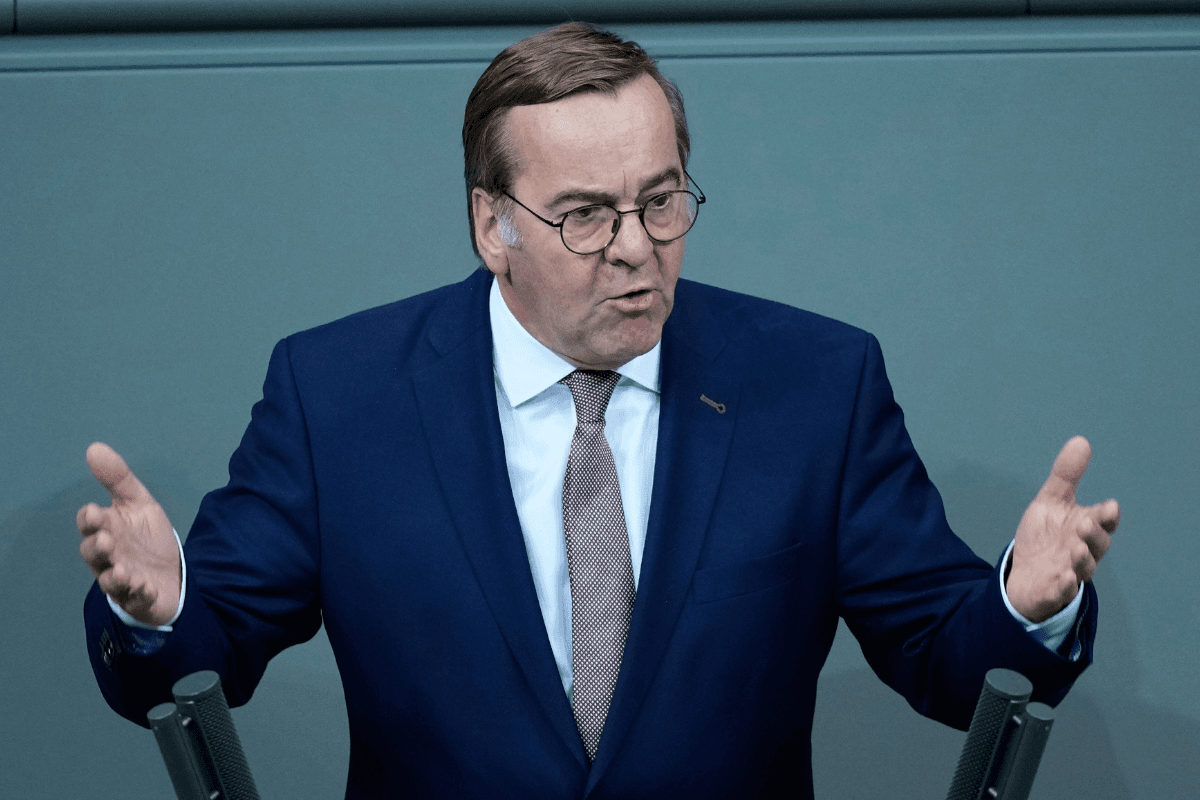
German Defense Minister Boris Pistorius speaks during a meeting about military recruitment in the German Parliament in Berlin on Dec. 5, 2025. Ebrahim Noroozi/AP Photo
Poland has also begun a new voluntary military training program, which aims to train 100,000 volunteers a year from 2027. The move is part of Warsaw’s plans to establish an army of reservists.
Of the European Union’s 27 member states, nine EU countries have compulsory military service: Austria, Cyprus, Denmark, Estonia, Finland, Greece, Latvia, Lithuania, and Sweden, while Croatia has announced its reintroduction for next year.
Current Threats to NATO
The push to grow Germany’s army comes in the context of conflict on Europe’s doorstep, with the Russia–Ukraine war approaching its fifth year.
Last month, NATO Secretary-General Mark Rutte said he was pleased that Germany’s coalition government had agreed on plans to grow its armed forces.
“Each country decides for themselves how to get enough men and women into the military, but I’m very happy to hear that the coalition in Germany has now agreed on a way forward, and that is very important,” Rutte told reporters during a visit to Allied Joint Force Command Brunssum in the Netherlands.
“It’s up to each nation how to deal with this, but obviously, as NATO secretary-general, I’m always happy when decisions are taken to get more people involved in our military.”
Victoria Friedman is a UK-based journalist covering a wide range of international stories, with a particular interest in technology, eastern Europe, and defense.