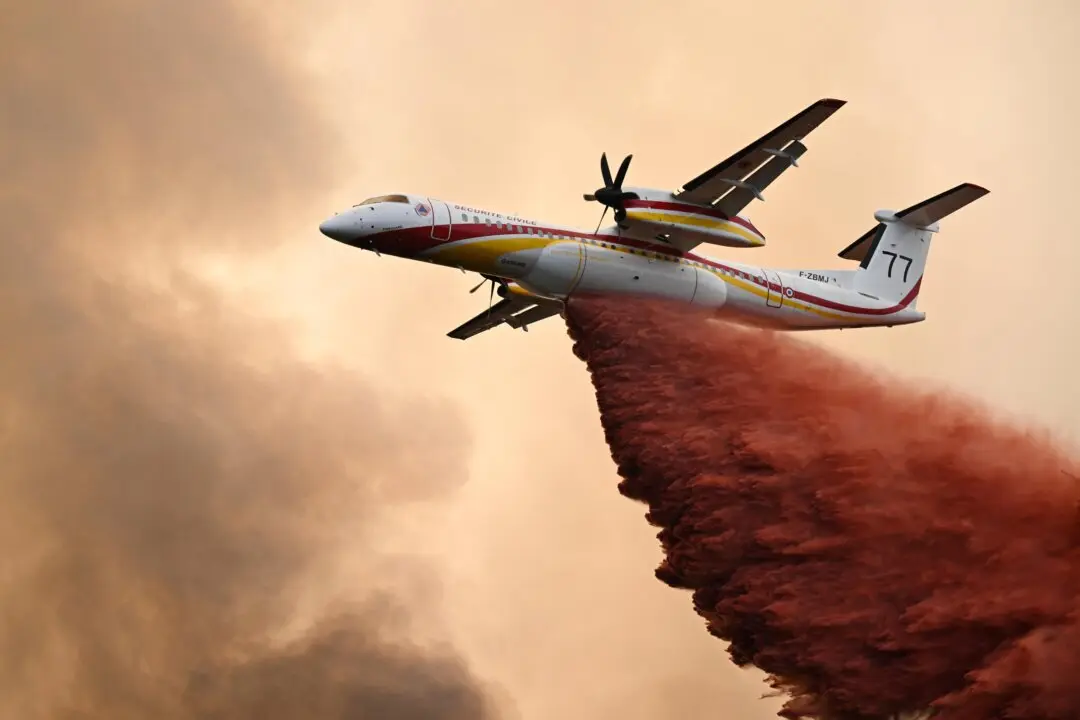
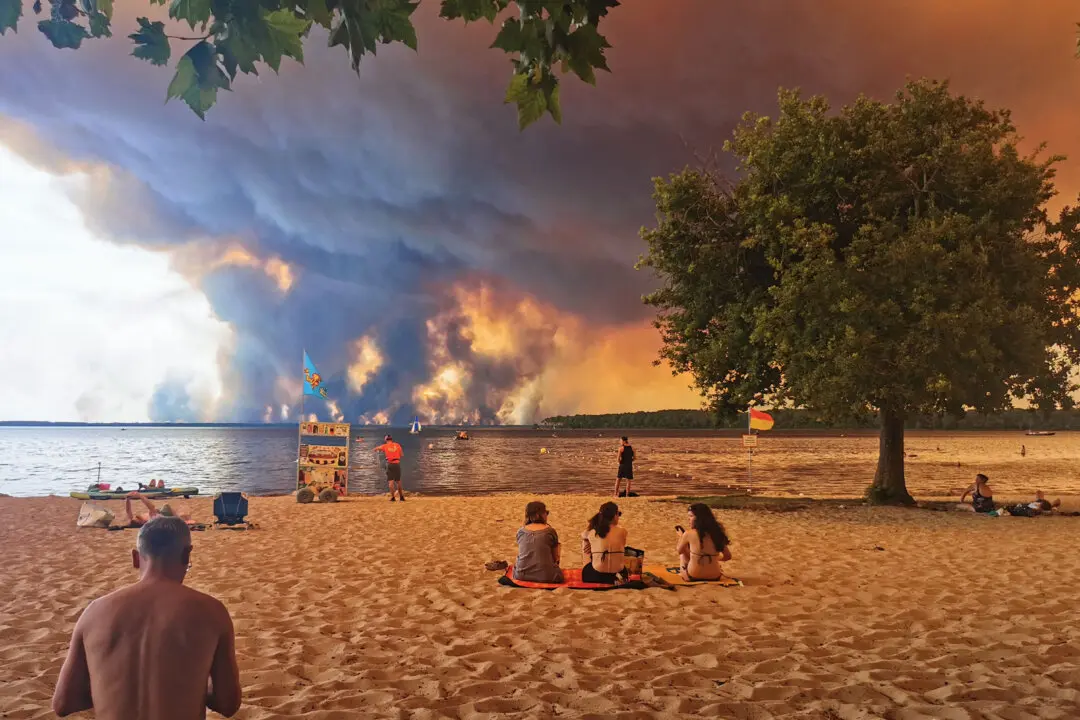
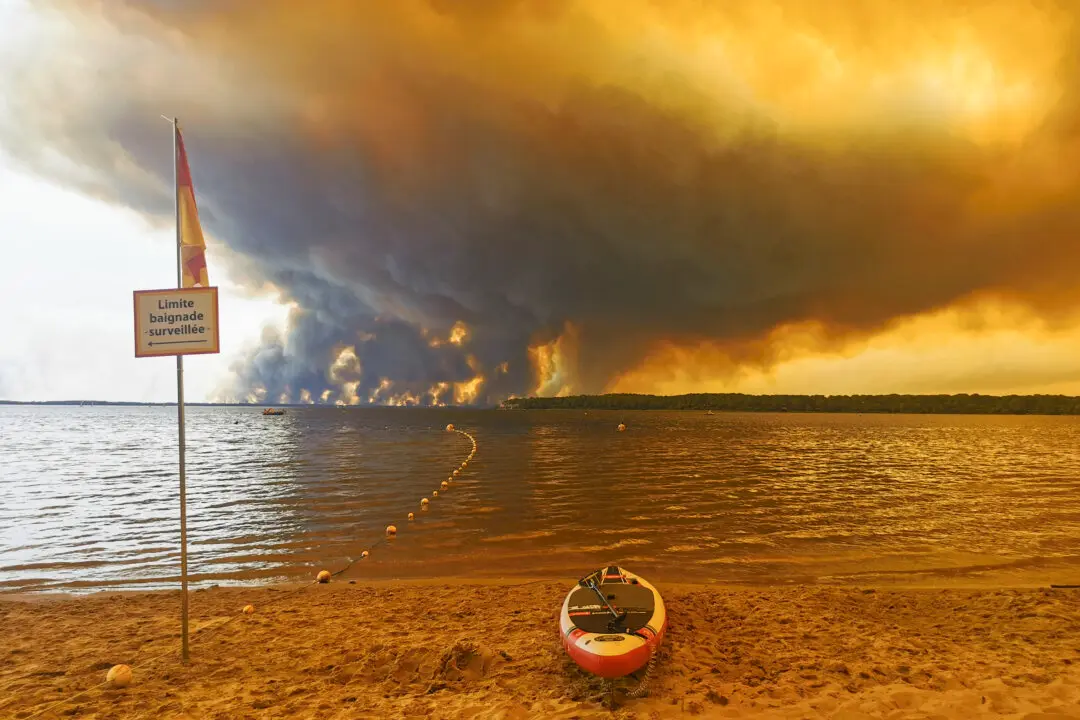
France gave tens of thousands more wildfire evacuees the green light to return home on July 30—the strongest signal yet that firefighters are gaining the upper hand over the biggest blaze in the country’s modern history. But officials cautioned that the respite rests on fragile weather, and fires continued to erupt elsewhere across a parched Southern Europe.
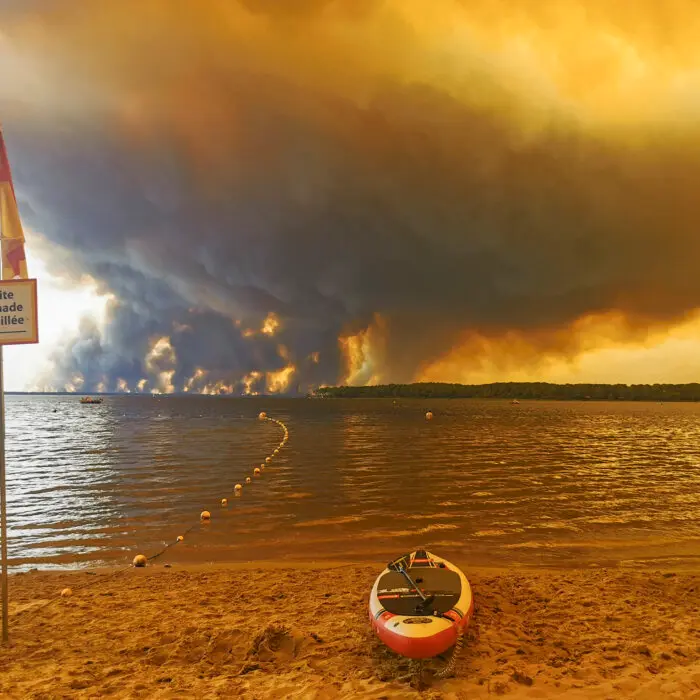
The blaze ignited on July 22 in the pine forests near Bordeaux and has charred some 42,000 hectares (about 104,000 acres)—an area four times the size of Paris. Sophie Brocas, the top government official for the surrounding Gironde region, called July 30 “the first somewhat optimistic day” since the fire began, saying only two active hot spots remained, near the resort town of Lacanau and on the Cap Ferret peninsula, which is still closed off.
Roughly 144,000 of the 224,000 residents and vacationers ordered out have now been cleared to return, including 84,000 on the morning of July 30 alone, and the A63 highway linking Bordeaux to Spain has reopened as France enters its peak August holiday season. Returnees were told to keep phones on and bags packed.
Evacuation orders were also lifted around Brignoles, in the southeastern Var region, where a separate fire had driven hundreds from their homes, among them Hollywood actor George Clooney and his family.
The battle near Bordeaux is only the sharpest front of a continental emergency. Successive heat waves have left vegetation tinder-dry from the Atlantic to the Aegean, and roughly 330,000 people were displaced from homes and vacation spots in southwestern Europe at the peak of the evacuations.
Data from the European Union’s Copernicus satellite program show the bloc’s burned area this year already exceeds the size of Luxembourg, putting 2026 on track to become the EU’s worst fire season on record.
A Pause, Not an End
Interior Minister Laurent Nuñez said on July 30 that the situation remains “still quite complicated,” counting 14,131 fires in France since the season began and some 117,000 hectares (289,000 acres) burned nationwide.
Seventy-two firefighter brigade units are deployed across the country, he said, reinforced under the EU’s civil protection mechanism by nine Air Tractor planes, a Canadair, and seven water-bombing helicopters from other European states.
Cooler air, higher humidity, and scattered showers finally gave crews a breather at the end of the week.
But Jean-Christophe Vincendon, national wildfire coordinator at the weather service Météo-France, told The Epoch Times that the improvement should not be mistaken for the end of the crisis.
“This is a pause,” he said. “In the days ahead, we will still have some very hot and dry days. The area will remain under close watch for several days, and I think for several weeks.”
The coming week will see France swing between spells of extreme heat and passing thunderstorms, Vincendon said, with no substantial drop in temperatures.
“The storms only pass through, and once everything has dried out, after two days, it is as if nothing had happened,” he said.
One favorable factor, he added, is that no strong winds are forecast, depriving the flames of a key driver of spread.
The deeper problem is the vegetation itself. Under normal conditions, Vincendon said, serious fire danger requires a combination of high temperatures, low humidity, and wind.
“Given the dryness of the vegetation, a single day of very intense heat is enough to restart quite a few fires,” he said.
Even where the flames have been beaten back, the danger has gone underground.
In the dry, peaty soils of the burn zone west of Bordeaux, embers can smolder beneath the surface for months and resurface far from where they vanished, a phenomenon firefighters call “zombie fires.”
Crews who fought the region’s massive 2022 Landiras fire, which stayed hot underground for two years, expect extinguishing work to last until the winter rains.
‘Bordeaux Would Be Burning’
The strain on France’s fire services has become a national issue.
Éric Brocardi, spokesman for the National Federation of French Firefighters, told The Epoch Times that the country is confronting “an event that touches the entire national territory,” with fires migrating from the south toward the north with what he called an intensity beyond all norms.
The question now, he said, is how France will fight fires burning simultaneously across the whole country.
Four firefighters have died since the fires began, a toll Nuñez acknowledged.
“Nobody on Earth is capable of standing up to natural forces the way firefighters do, at the sacrifice of their lives,” Brocardi said, calling for recognition “from the highest level of the state” and a genuine protective legal framework for volunteers, who make up 80 percent of French firefighting personnel.
“If they were not there, giving their time, I think Bordeaux would be burning today. We must be very clear and very lucid about that.”
Records Fall Across the South
Spain has been hit hardest.
A fire in the province of Ávila has consumed more than 50,000 hectares (about 124,000 acres)—the largest wildfire in the country’s modern records, according to Ecological Transition Minister Sara Aagesen, and the interior ministry counted more than 63,000 people evacuated across the Madrid, Toledo, and Ávila regions.
Prime Minister Pedro Sánchez lifted Spain’s first-ever national fire emergency on July 30 as containment improved, though the country’s three largest fires since records began in 1961 have all occurred within the past two years.
In Greece, two firefighters died on July 29 while battling a wind-driven blaze near Rethymno on the island of Crete, where several villages were evacuated. The fire service said the men “fell heroically in the line of duty.”
A third firefighter died on the mainland as crews fought multiple fronts, including a fire that prompted the precautionary evacuation of Plomari on the island of Lesbos.
The fires have pushed beyond Europe’s Mediterranean belt.
On England’s Suffolk coast, a wind-driven blaze the size of 210 soccer fields swept across Dunwich Heath, prompting a major incident declaration, evacuations, and close monitoring of the nearby Sizewell B nuclear power station, which authorities said was not at risk.
Portugal, with the EU’s second-highest share of burned land this year after Spain, placed its northern and central districts, along with Faro in the south, on maximum fire alert.