France is facing a second nationwide strike on Thursday, as hundreds of thousands join demonstrations against austerity measures and budget cuts.
The wave of unrest comes as French President Emmanuel Macron and his newly appointed prime minister, Sébastien Lecornu, face a political crisis and mounting pressure to bring public finances under control in the Eurozone’s second-largest economy.
“Faced with numerous ultra-leftist groupuscules, vandals, and opportunistic delinquents who will want to take advantage of the crowd and sow disorder, we will be there. I have given very clear instructions,” Interior Minister Bruno Retailleau said on X on Sept. 18.
France’s Police Nationale said on X that 80,000 police officers and gendarmes have been deployed across the entire territory. Riot units, drones, and armored vehicles are also on hand.
About 900,000 demonstrators were expected across the country, according to the French national daily Le Figaro. The report also stated that 58 people have been arrested, including 11 in Paris.
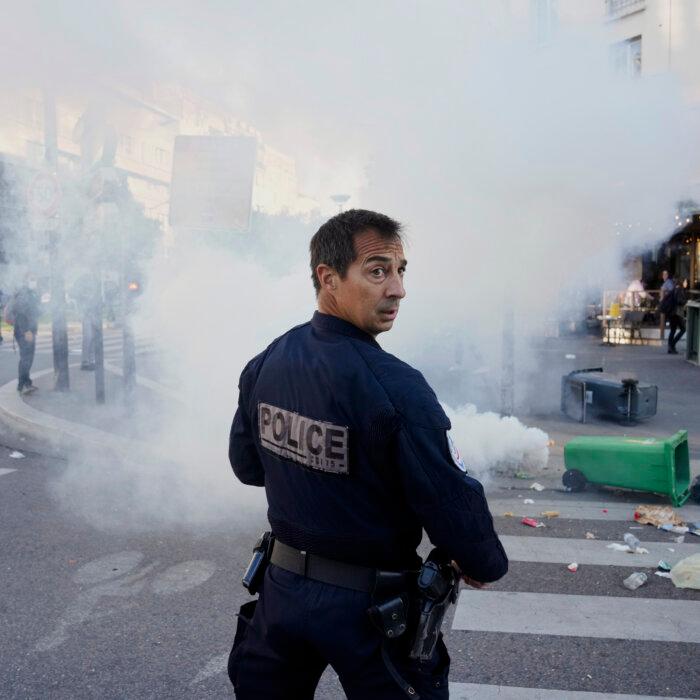
Teachers, train drivers, pharmacists, and teenagers all took part in the Sept. 18 protest against looming budget cuts.
Disruptions are expected in multiple sectors, including public transportation, hospitals, and schools.
Social media footage showed flares outside the Ministry of Economy and Finance at Bercy, set off by railway workers from Lyon, as well as roads and tram lines blocked in Paris by masked youths.
“Supporting the strikers is fighting for all of us, for our rights, for our future,” the left-wing France Insoumise (LFI) party posted on X on Sept. 18.
LFI politician Louis Boyard urged youth organizations to mobilize “against Macronist authoritarianism.”
“The young generation is taking its destiny into its own hands,” he said.
Jean-Luc Mélenchon, the LFI party’s figurehead, said on X: “Refuse any disorder, because that is what the Interior Minister hopes for to justify his habitual violence against the people. Never forget: when the people mobilize, its enemies do too.”
France’s main high school union, SNES-FSU, posted on Bluesky that 45 percent of its members were on strike.
“The anger is great. Let’s step up the mobilisation!” the post stated.
The Confédération Paysanne farmers’ union also called for mobilization.
“We must build a balance of power strong enough to bring about radical change in public policies, including agricultural policies,” it said in a Sept. 18 statement.
Pharmacies staged visible walkouts; 95 percent closed their doors.
The pharmacist union, USPO, said that new rules capping discounts on generic drugs could wipe out 30 percent of pharmacies nationwide.
Laurent Wauquiez, leader of the liberal-conservative party Les Républicains, said on X on Sept. 18 after visiting the wholesale food market in Corbas near Lyon: “While there are those who block everything and destroy everything, there is a France that works, gets up early, and pays its taxes. It is the voice of this silent majority that must be defended.”
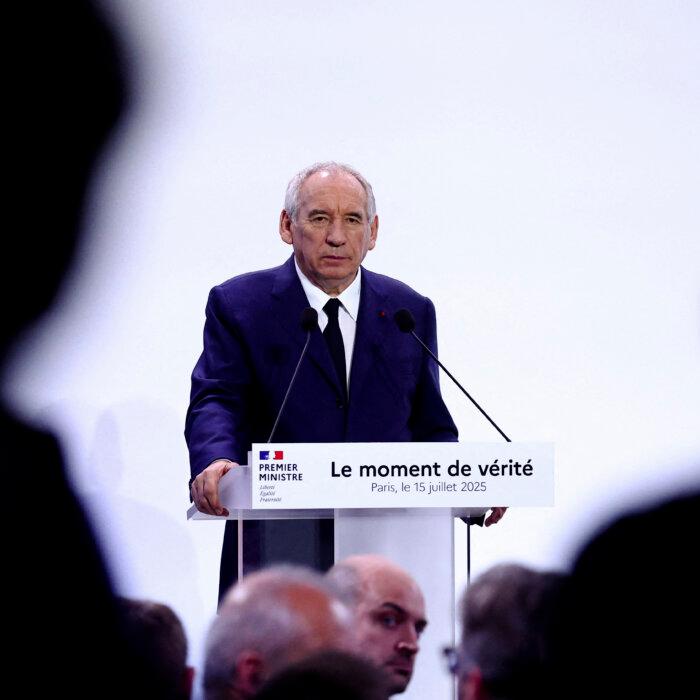
The protests are in response to former Prime Minister François Bayrou’s austerity plan.
Officials in Brussels forecast that the deficit will remain above 5.5 percent of GDP through 2026.