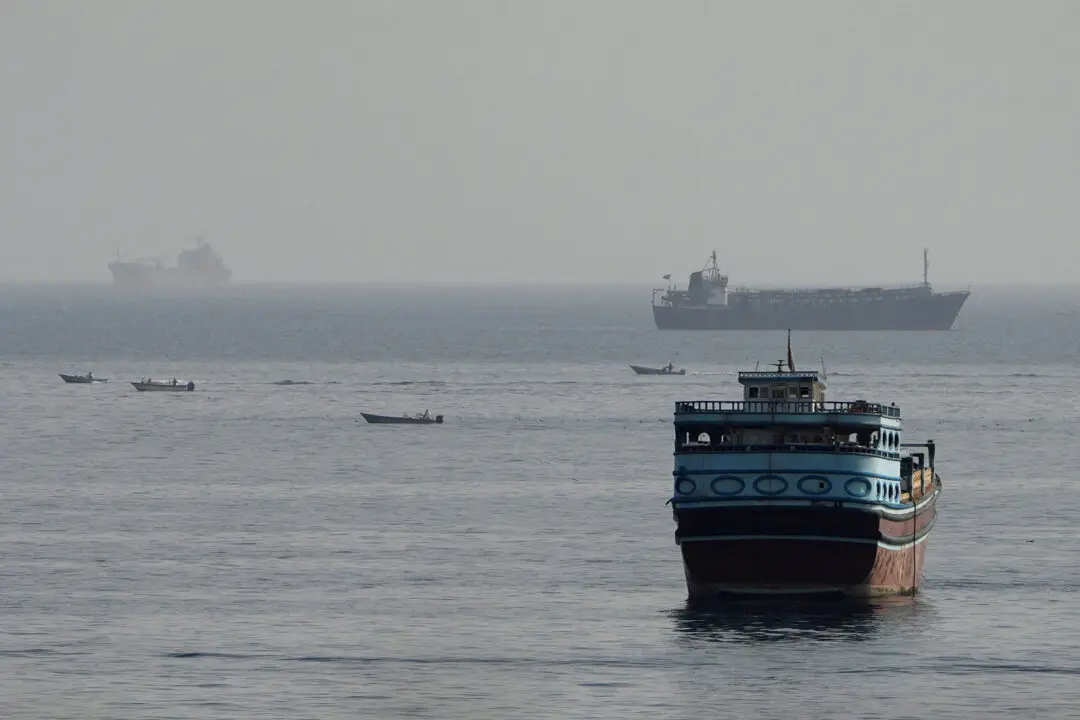
HOUSTON—Any negotiated accommodation by Iran to open the Strait of Hormuz and cease attacks on Gulf states that leaves Tehran’s repressive regime intact will be heralded as a victory by emboldened survivors and leave the vital waterway at Iran’s mercy for years, former U.S. Defense Secretary Jim Mattis warned.
“If you were to declare victory and basically pull out our armada, remove the number of forces you’ve sent there, they would say, ‘We now own the strait,’” the retired Marine Corps general said at a conference on March 23.
“I think you could see a tax for any ship going through.
“We’re in a tough spot, ladies and gentlemen, and I can’t identify a lot of good options.”
Mattis, who served as defense secretary during the first Trump administration for nearly two years before resigning in December 2018, joined Brookings Institution Foreign Policy Program Director Suzanne Maloney and S&P Global Commodity Insights Senior Vice President Carlos Pascual in a 45-minute discussion on the war during the first day of the March 23–27 annual CERAWeek by S&P Global conference at the Hilton Americas–Houston.
“The bottom line is, you can say it’s over, and you can even declare victory, and guess what? The enemy gets a vote, and that will undo everything you think you set out to accomplish,” he said.


President Donald Trump on March 23 postponed threatened strikes against Iran’s power plants for five days, citing productive conversations with Tehran.
Pascual, a former U.S. ambassador to Mexico in the Obama administration and to Ukraine in the Clinton administration, asked what the ramifications would be if the fundamentalist Shia regime in Tehran “see themselves as having survived” the aerial onslaught unleashed by the United States and Israel since Feb. 28.
“Unfortunately, I think they see themselves with the upper hand and in the ascendant,” Maloney said. “This is a regime that believes simply by holding firm, simply by living to fight another day, simply by being able to reconstitute their own authority—even after the elimination of a number of senior security officials—that they are very much in control of where this conflict will go, which is why I think they’re determined to escalate” before conceding to U.S. demands.”
Mattis agreed.
“In [the Tehran regime’s] own mind—and that’s what counts right now—it’s stronger now,” Mattis said. “It’s a regime that is quite willing to murder its own people at the industrial level. So even as it looks to be weaker externally, it’s stronger internally.”

‘Total’ Versus ‘Limited’ War
Maloney said that 12 days of U.S.–Israeli bombings of uranium enrichment sites in June 2025, and mass protests in January—with some taking to the streets “in the name of” Reza Pahlavi, the eldest son of Iran’s last shah who has lived in United States since the 1979 revolution—“obviously frightened the regime” into even more drastic repression, gunning down thousands and publicly executing dissenters even while under attack.“Now it’s clear to the Iranian side that, from their perspective, this is now an existential issue,” she said. “I think the likelihood of any popular revolution ... is even less likely under the current circumstances. Iranians are deeply dissatisfied with the regime, but they’re also terrified.”
Mattis said that the Iranian regime “is fighting a total war right now.”
“The Americans are fighting a markedly limited war. We have confined our military operations to air power alone,” Mattis said. “On the Iranian side, they have shown that even weakened militarily, a weakened adversary has got cards to play.”
And those cards are menacing the Strait of Hormuz, where 20 percent of the world’s oil and liquified natural gas is exported from the Persian Gulf, into a standstill while launching missile and drone attacks on Gulf states, he said.
Attacking neighboring nations “is a tried-and-true pattern Iranians have deployed over the years,” Mattis said. “They want to cause pain—partly as retaliation, because from their perspective, they believe their neighbors ... have facilitated these attacks by hosting [U.S.] military bases, by cooperating and being strategic partners with Washington.”
He indicated that Iran’s widening the war is no surprise.
“The U.S. military has always thought they will try to close the strait and would attack Gulf states,” he said.
“Matter of fact, I was sitting one night at dinner with the chief of defense of one of those front-line states, and I asked him, ‘Just the two of us sitting here where you can speak very candidly, what happens if the U.S. goes to war with Iran?’
“This is 10 years ago, and I remember he just waved his fork and said, ‘Flames. Flames.’ In other words, we all knew this could happen.”
Launching Operation Epic Fury without notice has created “discontent among some of those Gulf states,” he said. “They got brought into this without consultation, without trying to prepare better for it, and the idea they were going to have a stable future for investment and for society to thrive in has been called into question. So, I don’t think we can just walk away now and say we won and it’s over.”
The Pentagon reports that 15,000 targets have been hit, Iran’s air force and navy have been devastated, and missile and drone capacities have been dramatically degraded, all “significant military successes,” Mattis said.
“But they are not matched by strategic outcomes. And that’s a bad thing. That means we’re now in a position where either one side or the other side escalates,” he said.