
The first group of British nationals have left Gaza via its Rafah border with Egypt, the Foreign, Commonwealth and Development Office (FCDO) confirmed on Wednesday.
Officials believe there were some 200 British nationals trapped in Gaza. They did not specify how many have left on Wednesday.
The FCDO said the Rafah crossing “will be open for controlled and time-limited periods to allow specific groups of foreign nationals and the seriously wounded to leave.”
Prime Minister Rishi Sunak thanked Egyptian President Abdel Fattah el-Sisi in a phone call on Wednesday, and said the UK will “continue to work closely with Egypt and Israel to ensure all British citizens can leave Gaza safely,” according to a readout issued by Downing Street.
A spokesperson for the FCDO said: “We will continue working with partners to ensure the crossing is opened again, allowing vital aid into Gaza and more British nationals to leave safely.
“We are regularly updating all British nationals registered us.
“The crossing will be open for controlled and time-limited periods to allow specific groups of foreign nationals and the seriously wounded to leave.
“We have agreed a list of British nationals that want to leave Gaza with Egyptian and Israeli authorities. We will be informed in advance when those on the list can use the crossing to ensure we can provide assistance.”
In-laws of Scotland’s First Minister Humza Yousaf remain trapped in Gaza, Mr. Yousaf’s spokesman said.
The minister’s parents-in-law, Elizabeth and Maged El-Nakla, from Dundee, travelled to Gaza to visit family before the Israel-Hamas war erupted.
Mr. Yousaf’s spokesman said in a statement, “We continue to liaise with the UK government and urge them to work with the Egyptian authorities so that all UK nationals can urgently leave Gaza as quickly as possible.
“The first minister’s wife, Nadia, spoke to her mother this morning. The family remains trapped in Gaza, without clean drinking water, and rapidly diminishing supplies.”
Speaking to Mr. Sisi on Wednesday, Mr. Sunak “welcomed the opening of the Rafah crossing today for the first British and other nationals and injured Palestinians to leave Gaza,” Downing Street said.
The two leaders discussed work to increase the flow of humanitarian aid, including plans for a second UK aid flight to support the work of the Egyptian Red Crescent, as well as diplomatic efforts to secure the release of hostages held by Hamas, prevent escalation in the wider Middle East, and achieve long-term peace and prosperity for the Palestinian people, No. 10 said.
The opening of Rafah came after weeks of talks among Egypt, Israel, the United States, and Qatar, which mediates with Hamas. It was first time people left Gaza other than four hostages released by the terrorist group and another rescued by Israeli forces.
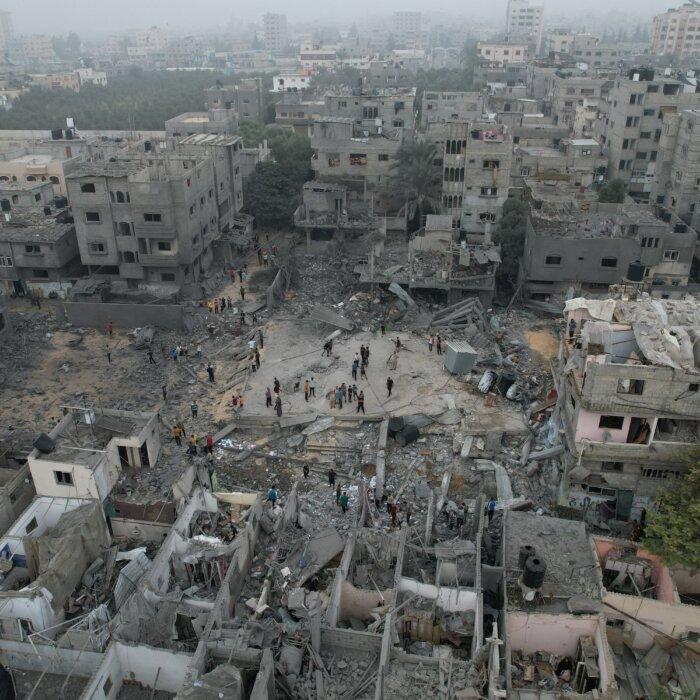
The evacuation followed another day of bloodshed in Gaza in which an Israeli air strike on Tuesday killed about 50 people in a refugee camp, according to Hamas-backed Palestinian health officials.
Israel said the attack killed a senior Hamas commander and many other combatants.
Asked whether Israel has broken international law, Deputy Prime Minister Oliver Dowden told Sky News, “We continue to urge the Israeli government to abide by international law. I believe that the Israeli government is continuing to do so against an enemy that hides among civilians.”
Foreign Secretary Jame Cleverly previously said Hamas “habitually embed military capabilities within civilian infrastructure” and it has “consistently bombarded Israel from Gaza from amongst civilian infrastructure” along with other terrorist organisations since Oct. 7.
Israel sent its forces into Hamas-controlled Gaza following weeks of air and artillery bombardments in retaliation for a deadly attack by the Islamist terrorist group on southern Israel on Oct 7.
The Hamas attack killed about 300 soldiers and some 1,100 civilians, Israeli figures say. Some were found to have been raped, decapitated, and burnt.
At least 8,525 Palestinians, including 3,542 children, were killed in retaliatory Israeli strikes on Gaza since Oct.7, the Gaza health ministry claimed. In past conflicts, some Palestinian deaths were attributed to missiles from Gaza that fell short. U.S. and British analysis suggest a recent bomb that blasted an Arab hospital in Gaza was likely not from Israel.
Israel has vowed to wipe out Hamas. But the civilian death toll in Gaza and the desperate humanitarian conditions have caused great concern across the world as food, fuel, drinking water, and medicine run short and hospitals struggle to treat casualties.
“It’s hard to have completely reliable conversations with Hamas when you’re dealing with a terrorist organization, which is obviously present on the ground,” he said, adding that he remains ”cautiously optimistic that the flow of aid should and will increase across the Rafah crossing.”