Firefighters are battling nearly 200 wildfires across northern Ontario, with roughly half of them out of control, according to provincial officials.
At least one remote northern community has seen heavy destruction, with residents in the path of wildfires having only a short time to escape the approaching flames.
Ontario Premier Doug Ford said the government’s first priority is evacuating residents from communities that are threatened by the fires.
“This is a very difficult situation, even to fly in to these communities on dirt runways, when the fire is going and the smoke, our number one priority is to make sure they’re safe, and that’s what we’ve accomplished,” Ford said during a July 17 press conference in Toronto.
Ford, accompanied at the press conference by Minister of Emergency Preparedness Jill Dunlop and Minister of Natural Resources Mike Harris, said that over 150 firefighting crews and more than 80 helicopters and water bombers have been deployed to help assist in battling the fires.
The premier noted that despite ongoing efforts, approximately 190 fires are still active in the north of the province, 81 of which are considered out of control.
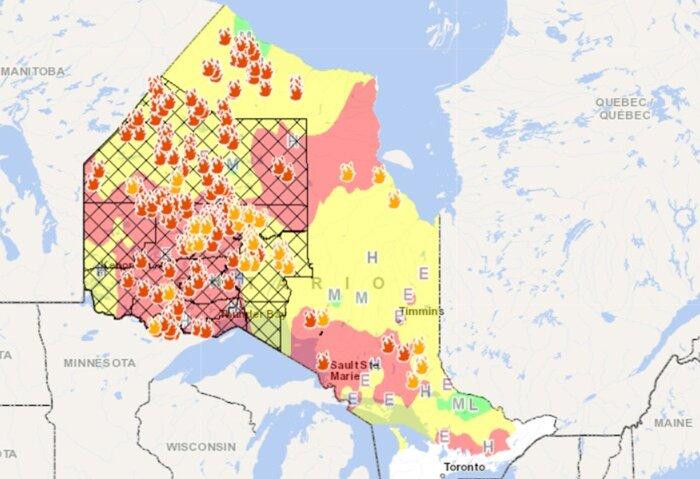
Data from the ministry of natural resources shows 20 new fires had been confirmed in the northeast of the province on July 17 alone.
“Last year we had over 600,000 hectares on fire. This year, and it’s changing on a daily, hourly basis, it’s 650,000 acres already,” Ford said. “Thank God, no one has died.”
Evacuations Ongoing
At least 10 northern Ontario communities have finished evacuating residents or are in the process of doing so, and another four are preparing to evacuate if it becomes necessary, Ford said.Communities currently covered by evacuation orders include Armstrong, Lac La Croix First Nation, Whitesand First Nation, Gull Bay First Nation and Lac des Mille Lacs First Nation.
On July 17, the province also put out an additional evacuation order covering an area along Highway 11, east of Atikokan and south of Lac des Mille Lacs First Nation.
Several First Nations leaders have criticized the provincial response and communications with affected indigenous communities in the north of the province.
The concerns have focused around Whitesand First Nation and Namaygoosisagagun First Nation, also known as Collins First Nation, where residents were evacuated without provincial assistance.
Images posted on social media from the evacuation of Namaygoosisagagun First Nation, which does not have road access, show residents fleeing by boat as smoke and flames billow behind them.
Anishinabek Nation Grand Council Chief Linda Debassige has said the wildfire destroyed more than 30 homes, the school, community centres and other buildings, leaving much of Namaygoosisagagun First Nation uninhabitable.
Minister Harris said that the fire that threatened Namaygoosisagagun First Nation started very close to the community and was spreading at an “unheard of” speed of four kilometres per hour.
This rapid spread left officials with little time to send crews to the area, he said.
Heavy Smoke
Smoke generated by the northern Ontario fires has travelled south, leading to air-quality warnings in much of the province including Toronto and as far south as the midwestern and northeastern United States.Environment Canada said the smoky conditions may temporarily ease before getting worse again in coming days, and said that smoky conditions may keep impacting Ontario over the weekend.
Environment Canada said smoky and hazy conditions could temporarily ease before deteriorating again. The agency warned that smoke may continue affecting the province into the weekend.