Finland’s national prosecutor’s office said on Aug. 11 that it had brought charges against the captain and first and second officers of the Cook Islands-registered Eagle S oil tanker over the cutting of undersea cables in the Gulf of Finland in December 2024.
The Eagle S, which left Russia’s Ust-Luga with a cargo of oil products, is suspected of cutting five undersea cables in the Gulf of Finland by dragging its anchor on the seabed for about 90 kilometers (about 56 miles), Finland’s national prosecutor’s office said.
“The disruption of electricity transmission and telecommunications cables with very high transmission capacity is also suspected to have caused a serious risk to energy supply and telecommunications in Finland, although services could be secured by using alternative connections,” the authorities stated.
The defendants have denied committing the offences and believe that Finland lacks jurisdiction in the case, as the incident took place outside Finnish territorial waters, according to the statement.

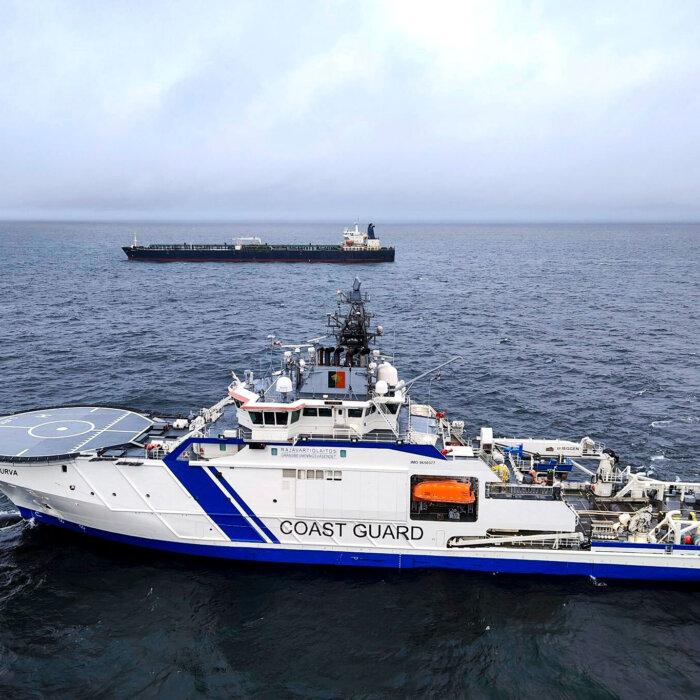
The damage to the Estlink-2 power cable followed similar incidents impacting undersea infrastructure in the Baltic Sea.
Telia Lietuva’s 135-mile cable between Lithuania and Sweden’s Gotland went offline on Nov. 17, 2024, at 8 a.m. GMT, followed by the 745-mile Cinia C-Lion1 cable linking Finland and Germany, which failed on Nov. 18, 2024, at 2 a.m. GMT.
In April, a probe by the Swedish Accident Investigation Authority found no conclusive evidence to suggest that the Chinese ship had deliberately dragged its anchor to sever the cables.
Russia’s dark fleet has an estimated 1,600 vessels that continue to engage in illicit activity operations, the core of which is dedicated to Russia’s oil trade, according to the report.
Countries such as Gabon have played an increasingly prominent role in registering Russian-linked vessels.
The report said that while the deliberate severing of cables constitutes a hostile act, proving intent remains challenging.
This is because cable-severing incidents are common, with accidental damage occurring regularly as the result of anchor drags and fishing activity.
RUSI pointed to the 1884 Convention for the Protection of Submarine Telegraph Cables, saying it was never meant to deal with today’s hybrid threats.
“Under this framework, if a country discovers a Russian vessel interfering with cables, the prescribed legal procedure involves collecting evidence and referring the matter to Russia for action, an entirely unrealistic scenario given current geopolitical tensions,” RUSI stated.