Fiji’s Deputy Prime Minister and Minister for Finance Biman Prasad has revealed the small Pacific nation will spend FJ$4.8 billion (US$2 billion) in this year’s budget.
It means each of its approximately 933,000 citizens gets around $5,145—almost the same as the Australian federal budget allocates to each of its citizens.
But unlike resource-rich Australia, the Fijian economy derives most of its income from tourism, agriculture, and remittances (money sent home from Fijians working overseas).
At a news conference, Prasad told reporters that insulating Fiji from potential global shocks affecting its overseas earnings was one of the key budget drivers, because the measures it contains will build the country’s domestic industry.
“It kills two birds with one [stone],” he said. “It addresses any big shock we might get ... plus it also helps the people who would be affected.”
Fiji presently faced “one of the most uncertain global economic environments that [it has] gone through,” he said, citing ongoing uncertainties around U.S. tariffs and their flow-on effect on the country’s other trading partners as well as hostilities in the Middle East and the potential effect on global oil prices.
Set against that, “We have never had this kind of interest in Fiji from overseas investors or diaspora, and we are doing a lot more work to get our diaspora to come back.”
The 2025/26 budget includes spending increases across almost every sector of the economy, accompanied by cuts to the cost of government services.
Education, already the largest budget item, gets an increase of $69 million to $847 million. Also boosted are spending on health, at $611.6 million; road infrastructure, at $388 million; and police, which receives $240.3 million.
Fijians are also to receive cost-of-living assistance worth $800 million, including a cut in value-added tax (VAT) from 15 to 12.5 percent.
In addition, a wide range of import duties will also be reduced, such as chicken pieces from 42 to 15 percent and frozen fish from 15 percent to nil.
While this will widen the deficit, Prasad said the government needed to boost consumer spending.
“If the Middle East crisis deepens and oil prices go up, the first thing that will be affected will be the supply chain ... prices could go up, people could be affected more,” he said.
Bus fares will also be reduced by 10 percent, and civil servants will get a 3 percent pay rise from August.
The World Bank, in its Pacific Economic Update, projected Fiji’s economic growth would reach 2.6 percent in 2025, after a drop from 7.5 percent in 2023 to 3.8 percent in 2024.
Fiji was one of the countries that suffered the sharpest post-COVID shock, as tourism virtually came to a halt, dropping from $2.2 billion in 2019 to just $519 million a year later. However, it recovered to $2.4 billion in 2023, and last year it was $2.5 billion.
Australians contributed almost half that figure—$1.27 billion—and New Zealanders the second most, at $548 million.
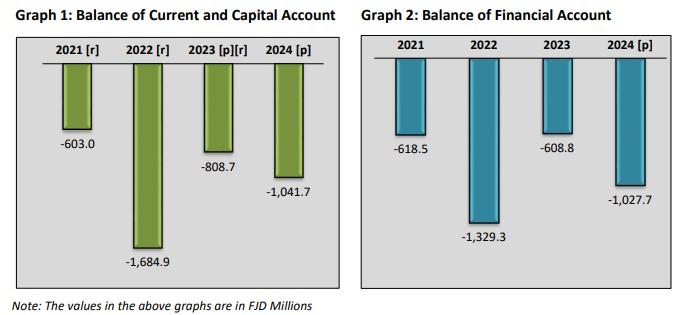
The latest deficit contributes to years of negative current account balances.