North Queensland conservationist Steven Nowakowksi has renewed calls for regulation of renewable industry development as a new “truth map” reveals 1,250 projects currently in the pipeline for Australia.
The sector has been expanding rapidly, with the Clean Energy Council saying 39.4 percent of electricity in the national grid was generated by renewables in 2024, with that number at 36 percent in 2023.
Conservationist Says Untouched Wilderness at Risk
Nowakowski’s map has been the subject of criticism with some saying land clearing for renewables pales in comparison to similar activities for agriculture.“I used to work as a photographer for Greenpeace, the Australian Conservation Foundation and Queensland Conservation Council—going out and photographing broad scale land-clearing events for beef and clearing,” Nowakowski told The Epoch Times.
“And yes it is an issue, but what’s happening is that land clearing is happening on land that is considered regrowth, or what they call category X [under the Vegetation Management Act], so those land owners are able to do that legally.
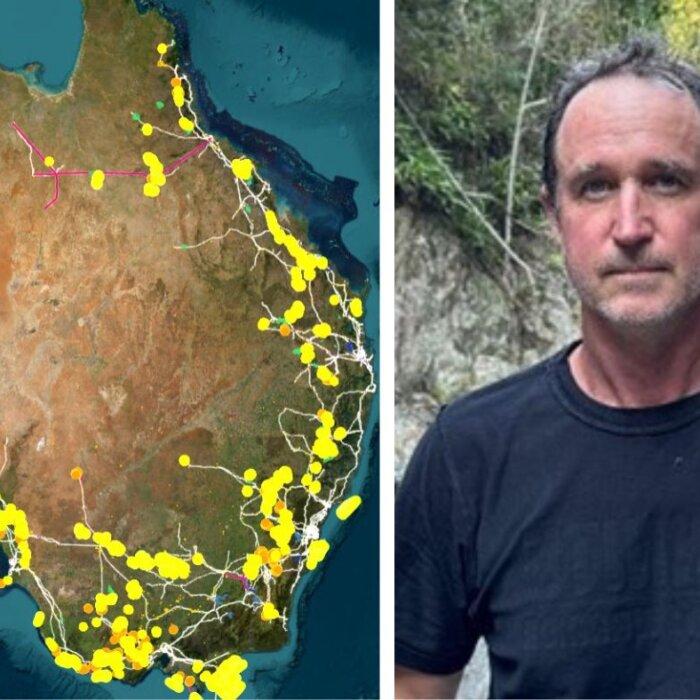
“However what we’re seeing with renewables here in Queensland is the clearing of land that’s actually remnant, it’s never been touched. So it’s old-growth forest.”
He points to the 320-turbine Whaleback Ridge wind farm in Tasmania, and the $100 billion Western Green Energy Hub slated for the Nullarbor Plains, which aims to include a massive 3,000 turbines over the world’s largest limestone cave system.
The Upper Burdekin windfarm, meanwhile, will clear around 700 hectares of old forest, which is home to rock wallabies, sugar gliders and koalas.
Lack of Accountability
Under current Australian laws, it is not a hard requirement for renewable project developers to pay environmental bonds like the mining sector.While the requirement can be written into individual agreements, Nowakowski wants to see the rules tightened so renewables companies face the same strict processes.
A Patchwork of Regulation
Due to the speed of development over the past decade there isn’t quite a unified framework for dealing with environmental approvals across state and federal governments.Currently, projects are assessed mainly under state planning laws and, if they trigger national environmental concerns—such as impacts on threatened species—they can fall under the federal Environment Protection and Biodiversity Conservation Act.
However, some environmental advocates say the process is inconsistent, leaving gaps in oversight when it comes to cumulative impacts or the clearing of remnant vegetation for renewable energy zones.
Climate Change the Ultimate Threat, Says Climate Council
The Climate Council responded to the truth map saying evidence shows climate change is the single biggest threat to Australia’s natural environment, not renewables.“The CSIRO’s GenCost analysis shows the fastest and cheapest way to secure Australia’s energy supply is to switch to renewable power such as wind and solar,” a spokesperson told The Epoch Times.
“This new infrastructure needs to be planned and developed in consultation with communities and in a way that has minimal impacts on nature and the environment. When done well, communities can realise benefits beyond reducing emissions and having access to clean energy.”
Koala Habitat Lost Due to Coal Mining: Council
According to its own research, the Climate Council says renewable infrastructure needs only 0.02 percent of the nation’s landmass—roughly about three times the size of the city of Brisbane.“It’s important to remember that land clearing for coal-fired power plants has destroyed koala habitat,” the spokesperson said.
“During the last term of parliament, the Albanese government approved plans allowing more than 1,790 hectares of koala habitat to be cleared for four coal mines, 10,614 hectares of habitat remains on the chopping block, and would be cleared as part of 24 proposed new and expanding coal mines—the area of habitat is equivalent to 8,845 Suncorp stadiums.”
The comments come in response to concerns by zoologist Roger Martin who previously warned about excessive noise from turbine developments in heavily forested regions.
Meanwhile, the Council also pointed to new developments in renewable technology.
Haystacks Solar Garden is currently pioneering an effort in Australia to allow people renting or living in apartments to have a stake in small-scale solar farming in order to receive rebates for the electricity sold on to suppliers.
The Climate Council says other renewables projects, like the Bomen Solar Farm, are making efforts to encourage more women into the sector. And virtual solar farms, which connect panels and battery systems across numerous households, could be a way to cut power bills for lower income earners.
The Australian federal government aims to cut national emissions by 43 percent below 2005 levels by 2030, requiring a massive expansion of renewable energy generation and transmission.