EU Presents 5-Year Strategy to Tackle Illegal Immigration, Overhaul Border Management

‘We must notably sustain the reduction in illegal arrivals,’ the EU Commission’s executive vice-president said.
EU Presents 5-Year Strategy to Tackle Illegal Immigration, Overhaul Border Management
The German federal police controls vehicles coming into Germany from Austria at the border control station Kiefersfelden, in Germany on May 9, 2025. Michaela Stache/AFP
|Updated:
0:00
The European Commission on Jan. 29 presented a five-year strategy that aims to curb illegal arrivals, overhaul border management, and increase deportations, while creating more legal pathways for skilled workers.

The European Asylum and Migration Management Strategy, outlined in Brussels, lays out political priorities for the bloc through 2030. This includes the prevention of illegal immigration and the dismantling of criminal smuggling networks.

It also aims to attract foreign talent to address labor shortages and boost Europe’s economic competitiveness, the commission said.

“The priority is clear: bringing illegal arrival numbers down and keeping them down,” EU Migration Commissioner Magnus Brunner said. “Abuse gives migration a bad name - it undermines public trust and ultimately takes away from our ability to provide protection and undercuts our drive to attract talent.”

Part of the EU plan to manage border control is the implementation of the Entry/Exit System (EES) and launch of the European Travel Information Authorisation System (ETIAS), similar to the U.S. ESTA program.

Under the Pact on Migration and Asylum, adopted in June 2024 and set to be applied from mid-2026, all irregular arrivals will be screened and subject to border procedures starting in June this year.

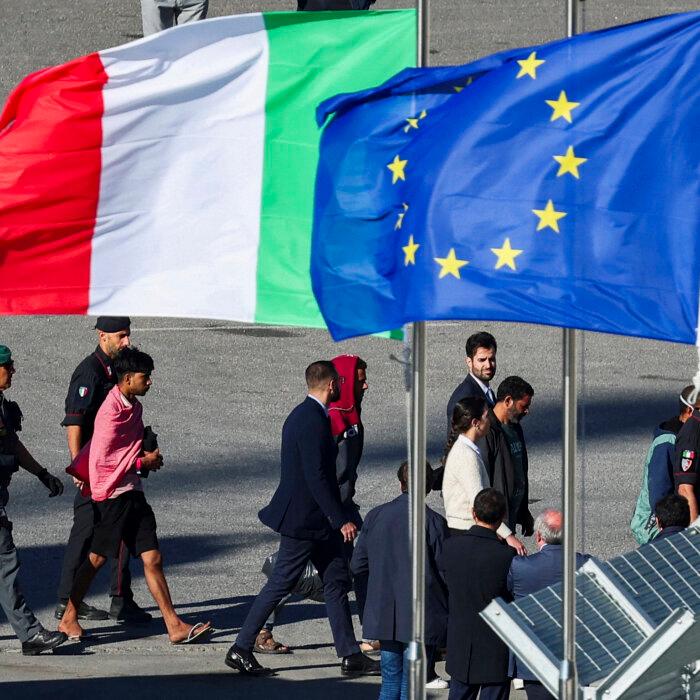
The pact’s provisions allow EU member states to strike agreements with non-EU countries to handle asylum claims extraterritorially, potentially setting up processing centers in North Africa or beyond.
European Commission Executive Vice-President Henna Virkkunen said now is the time to look ahead.

“We must fully implement the Pact and make our asylum and migration system future-proof,” Virkkunen said. “We must notably sustain the reduction in illegal arrivals, while at the same time encouraging legal pathways to the EU.”

A member of the Libyan Coast Guard stands on a boat during the rescue of 147 illegal immigrants attempting to reach Europe off the coastal town of Zawiyah, west of the capital Tripoli, on June 27, 2017. (Taha Jawashi/AFP/Getty Images)
A member of the Libyan Coast Guard stands on a boat during the rescue of 147 illegal immigrants attempting to reach Europe off the coastal town of Zawiyah, west of the capital Tripoli, on June 27, 2017. Taha Jawashi/AFP/Getty Images
According to Eurostat data, 918,925 non-EU nationals were recorded as illegally present in the bloc in 2024. Syrian citizens (140,500) made up the largest share of those cases that year.

Afghans (60,060), Algerians (58,165), and Turks (57,880) followed, and together, those four nationalities made up about 34.5 percent of the total.

The commission said that about one-quarter of people ordered to leave the EU return to their countries of origin. In 2024, the number of third-country nationals ordered to leave stood at 453,380.
To improve outcomes, the EU will work toward a common European system for returning illegal immigrants. It was first proposed in March and is now under negotiation.

The commission also plans to revise the founding regulations for Frontex, the EU’s border agency, to strengthen its role.
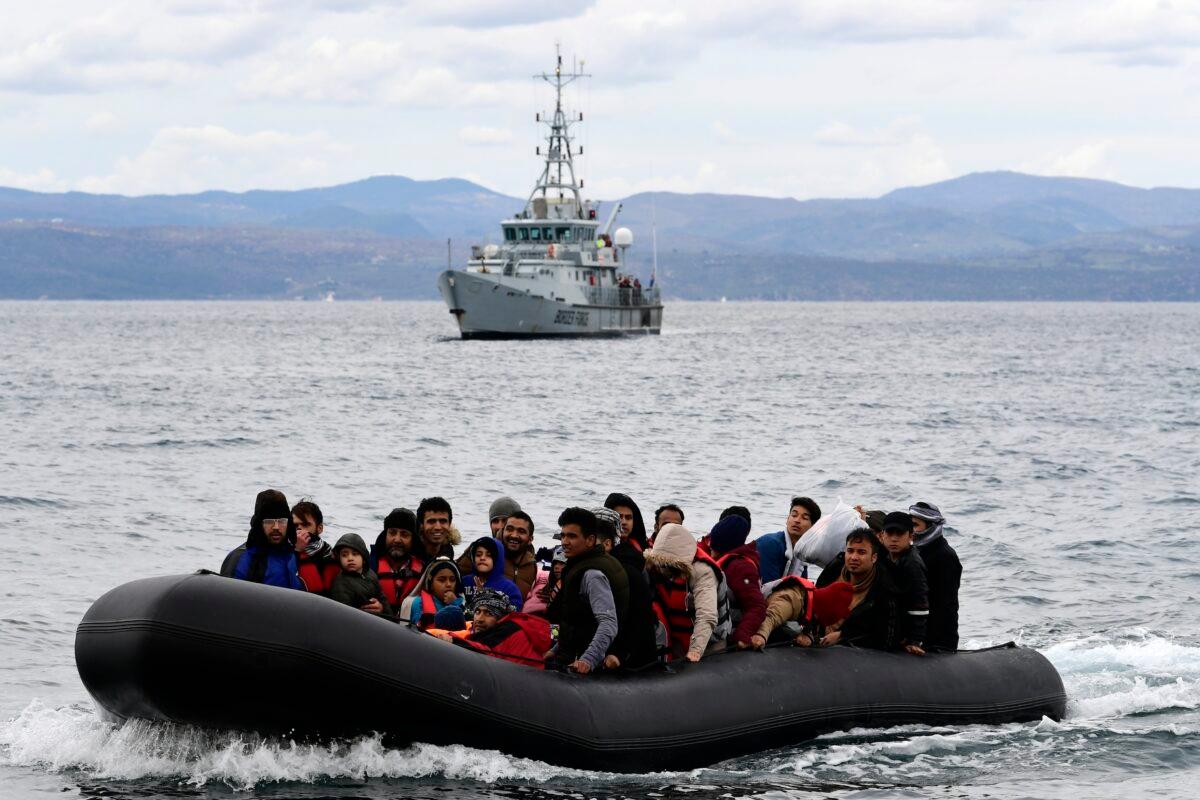
Illegal immigrants arrive in a dinghy accompanied by Frontex vessels at the village of Skala Sikaminias, on the Greek island of Lesbos, after crossing the Aegean Sea from Turkey, on Feb. 28, 2020. (Michael Varaklas/AP Photo)
Illegal immigrants arrive in a dinghy accompanied by Frontex vessels at the village of Skala Sikaminias, on the Greek island of Lesbos, after crossing the Aegean Sea from Turkey, on Feb. 28, 2020. Michael Varaklas/AP Photo

Attracting Talent to Fill Labor Gaps

The commission said demographic trends will intensify labor shortages in key sectors over the next five years.

To compete globally for skilled workers, the EU will expand talent partnerships with third countries and integrate talent recruitment into broader cooperation agreements.

The strategy calls for simplifying and accelerating procedures to recognize foreign qualifications. It also aims to fight illegal employment and exploitation while improving integration in host countries with EU funding, according to the commission.

“In order to protect those who really need protection and to win the global race for the best minds, we have to control our borders effectively, limit illegal migration and prevent abuse of our systems,” Brunner said.

A drone photo shows a group of illegal immigrants as they get on an inflatable dinghy to leave the coast of northern France and to cross the English Channel, in Wimereux near Calais, France, on Dec. 16, 2021. (Pascal Rossignol/Reuters)
A drone photo shows a group of illegal immigrants as they get on an inflatable dinghy to leave the coast of northern France and to cross the English Channel, in Wimereux near Calais, France, on Dec. 16, 2021. Pascal Rossignol/Reuters

To help carry out the strategy, the EU plans to use funding outlined in the commission’s proposal for the 2028–2034 long-term budget.

The proposal earmarks at least 81 billion euros ($96.5 billion) for home affairs policies and for the Global Europe instrument, which is intended to support a more strategic approach to international partnerships in line with EU priorities, including migration.

EU agencies are also expected to step up operational support for member states.

Google LogoMark Us Preferred on Google
Evgenia Filimianova
Evgenia Filimianova
Author
Evgenia Filimianova is a UK-based journalist covering a wide range of international stories, with a particular interest in foreign policy, economy, and UK politics.