This copy is for your personal, non-commercial use only. Distribution and use of this material are governed by our Subscriber Agreement and by copyright law. For non-personal use or to order multiple copies, please contact The Epoch Times Reprints.
European Council President António Costa (L) reads a statement next to European Commission President Ursula von der Leyen, at the presidential palace in Baabda, east of Beirut, Lebanon, on Jan. 9, 2026. Hussein Malla/AP Photo
Senior European Union (EU) officials on Jan. 9 met with Syrian leader Ahmed al-Sharaa in Damascus, pledging financial, economic, and political support to help rebuild the country following years of civil war that became a multi-sided conflict involving global and regional powers.
European Commission President Ursula von der Leyen told Sharaa during a meeting at the Syrian presidential palace that the EU is proposing a new cooperation framework with Damascus.
This includes a financial support package of 620 million euros ($722 million) for the next two years, comprising humanitarian aid as well as funds to help support the country’s recovery.
Von der Leyen, who was joined on the trip by European Council President António Costa, said that the funding package was necessary “to support the [Syrian] government in restoring the essential services for the population and to rebuild the state institutions.”
The EU president said the bloc will launch a new “political partnership” with Syria, starting this year, involving high-level dialogue on how Brussels can help the country on its path to reconstruction and peace.
Following the EU’s lifting of all economic sanctions—which were put in place when the country was still under the control of Bashar al-Assad—last year, von der Leyen said that the bloc now seeks to deepen economic cooperation with the Middle Eastern country. This, she said, would begin with discussions on a cooperation agreement “so that Syria can start to benefit, once again, from access to the European economic market.”
On Dec. 8, 2025, Syria marked the first anniversary of the toppling of the Assad regime.
The year before, terrorists led by Hayat Tahrir al-Sham (HTS), then headed by Sharaa, seized Damascus and declared the end of more than 50 years of Ba'athist rule. The ousting followed 13 years of civil war that was triggered by the 2011 Arab Spring and a series of pro-democracy protests and uprisings. Assad fled to Moscow.
Diplomatic Efforts
Costa said in a Jan. 9 post on X that the fall of the Assad regime offered some hope to the Syrian people.
“We are here today to show the EU’s continued support to Syria,” Costa said. “There is still a long way ahead but you have already taken the first steps.”
Sharaa also spoke with French President Emmanuel Macron via telephone on Jan. 9, according to Syrian state-owned news agency SANA, to discuss bilateral cooperation and updates within the region.
Syrian President Ahmed al-Sharaa addresses the 80th United Nations General Assembly at the U.N. headquarters in New York on Sept. 24, 2025. Jeenah Moon/Reuters
Hayat Tahrir al-Sham
HTS began as Al-Nusra Front, an affiliate of al-Qaeda, the Islamist terrorist group founded by Osama bin Laden. The group was designated a foreign terrorist organization by the U.S. State Department in 2018, but was removed from the list last year.
In December 2024, the United States dropped a $10 million counterterror bounty against Sharaa, who was previously known as Abu Muhammad al-Golani and Muhammad al-Julani. The decision coincided with a U.S. diplomatic visit to Syria on Dec. 20, 2024.
A now-deleted bounty notice against Sharaa notes his role in founding the Al-Nusra Front terrorist group and leading it through its reorganization into HTS. The bounty notice further stated that the group had taken part in kidnappings and killings in Syria over the years, including the 2015 slayings of 20 Druze villagers in Idlib Governorate.
Since assuming the presidency, Sharaa has visited—and received the endorsement of—several regional states, including Turkey, Qatar, Saudi Arabia, Bahrain, and the United Arab Emirates.
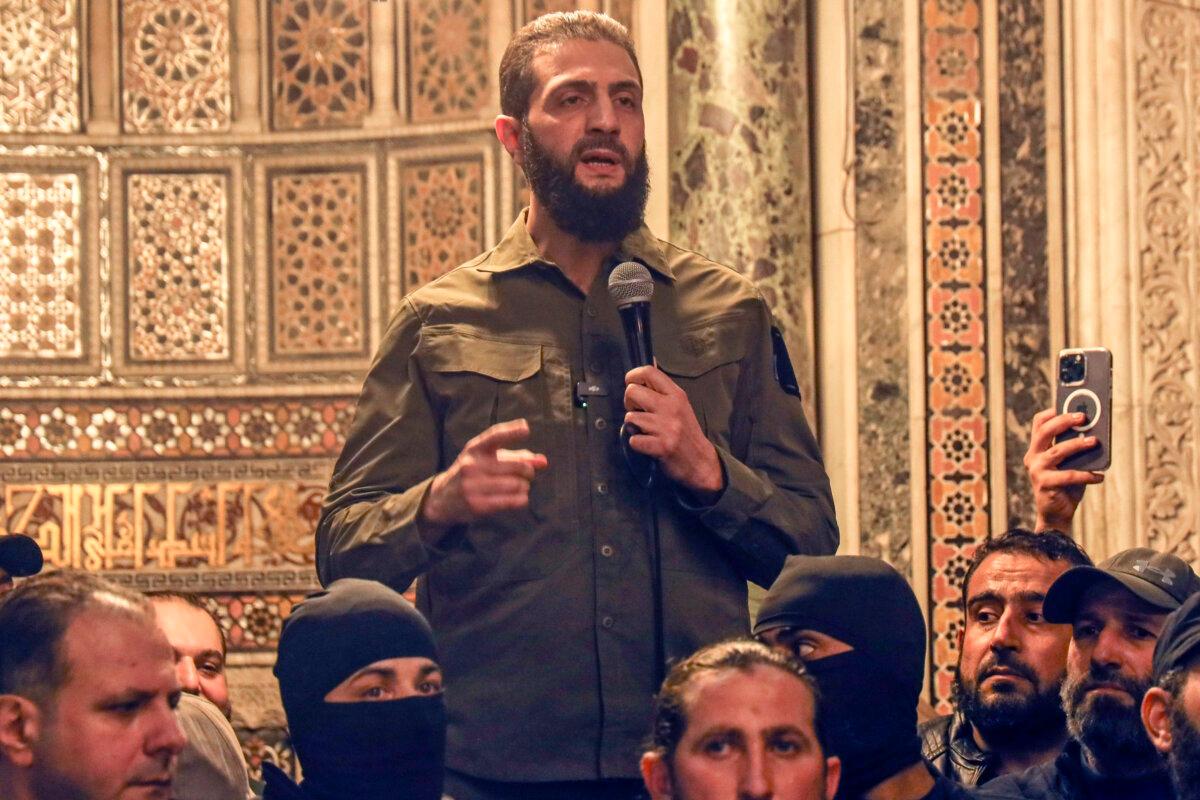
Ahmed al-Sharaa, also known by the nom de guerre Abu Mohammed al-Golani, speaks at the Umayyad Mosque in Damascus, Syria, on Dec. 8, 2024. The Canadian Press/AP/Omar Albam
On Nov. 10, U.S President Donald Trump welcomed Sharaa to the White House, days after the United States and the U.N. lifted terrorism-related sanctions on the Syrian leader.
White House press secretary Karoline Leavitt said on Nov. 4 that the meeting between the president and Sharaa is part of Trump’s efforts to meet “anyone around the world in the pursuit of peace.”
Days before the meeting, Trump said Syria had made “a lot of progress.”
“I think he’s doing a very good job,” Trump said. “It’s a tough neighborhood, and he’s a tough guy, but I got along with him very well.”
Victoria Friedman is a UK-based journalist covering a wide range of international stories, with a particular interest in technology, eastern Europe, and defense.