A drone found at an airport in Leipzig, Germany, was fitted with an explosive device in what prosecutors have described as a “serious attack” on Germany’s infrastructure and national security.
The German Federal Prosecutor’s Office said in a statement on Aug. 6 that there was “sufficient factual evidence to suggest that an explosion was intended to be caused by a drone on the grounds of Leipzig/Halle Airport on the evening of August 4, 2026.”
“Professional explosives and a detonator had been attached to the drone for this purpose,” the statement said. “A cargo plane, which had to abort its landing due to the incident, collided in mid-air with an object, presumably another drone, in the extended area of the airport.”
The Federal Prosecutor’s Office announced that it was taking over the investigation from local prosecutors in Dresden due to the serious nature of the case.
“This constitutes a serious attack on the transport and logistics infrastructure in Germany,” the Federal Prosecutor’s Office said, adding that the planned attack threatened the security of Germany.
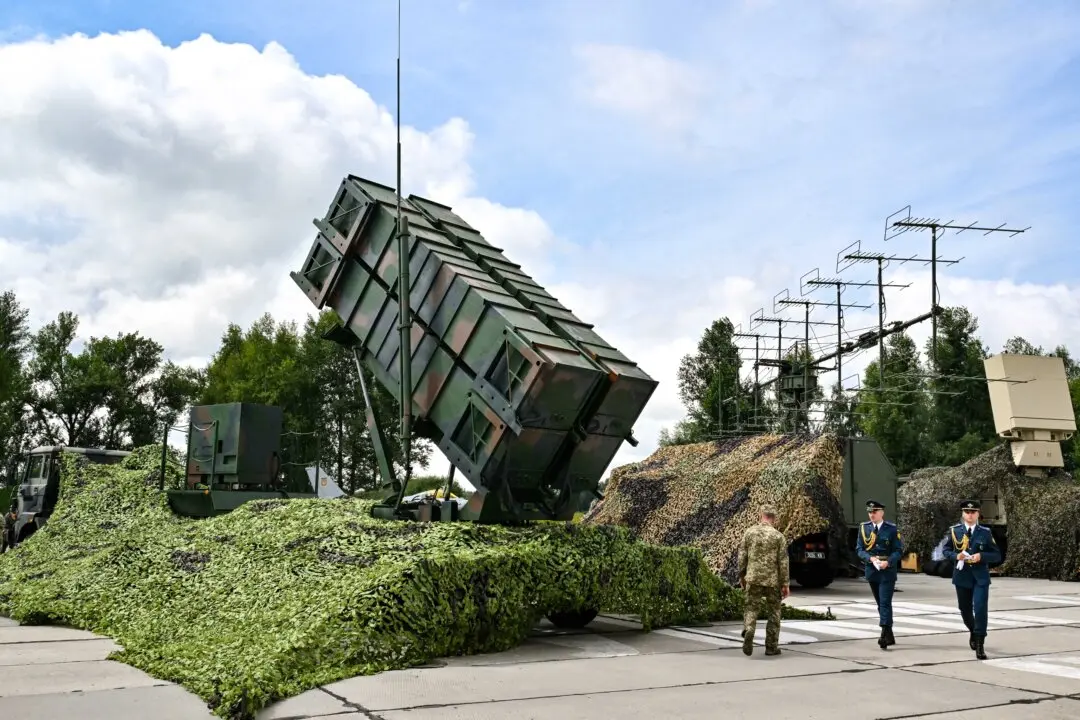
Leipzig/Halle Airport is a key cargo hub and military airport in the eastern German state of Saxony.

It is the main base for NATO’s Strategic Airlift International Solution. Among other functions, it delivers equipment to strengthen the defense pact’s eastern flank, using a small fleet of Ukrainian-made Antonov cargo planes.
Bus Driver Intervened
Airport workers discovered the drone late on Tuesday.
Senior German lawmaker Detlef Seif told reporters on Aug. 7 that a bus driver who was working at the airport kicked the low-flying, explosive-laden drone out of the air. It then crashed nearby.
“A bus driver kicked the drone away while it was flying low. It then crashed and came to rest on the ground,” said Seif, who is a member of the German parliament’s interior committee.
“The bus driver’s action was very daring and courageous, but also very dangerous,” Seif said. “It is possible that his intervention prevented the intended attack.”
Saxony Interior Minister Armin Schuster praised the bus driver’s actions, but said it was “not a model to be emulated.”
“Letting us know would be enough,” Schuster told broadcaster MDR.
‘Hybrid Attack’
Flights were suspended following the incident, impacting other companies that use the airport as a cargo hub, including German logistics group DHL, German Lufthansa Cargo, and Amazon. On Aug. 6, an airport spokesperson said that operations had returned to normal and no additional security measures had been put in place.
Interior Minister Alexander Dobrindt described the incident as a “hybrid attack.”
A hybrid attack is one which falls short of acts of war and can include sabotage, propaganda, and other non-overt tactics.
“All measures have been initiated in a highly professional manner. We have experienced an excellent collaboration between the state police, the federal police, [and] also all other authorities,” Dobrindt told reporters on Aug. 5.
German authorities have yet not identified any suspects, but Dobrindt said he could not rule out “foreign powers.”
In the past, German lawmakers have blamed Russia for hybrid attacks—accusations that Moscow has repeatedly denied.
Commenting on the incident, the Russian Embassy in Berlin denied that Moscow was involved in any hybrid attacks and expressed its concern at “the new round of anti-Russian hysteria in Germany.”
The embassy said in an Aug. 7 post on Telegram that the incident was a “hastily concocted provocation” that “serves exclusively the goals of Kyiv and the militaristic wing of the European political class.”
“We would like to add that the main danger for Germany today is not Moscow’s notorious ‘hybrid attacks,’ which do not exist, but rather politicians enthusiastically developing scenarios for an imminent war with Russia and inviting German citizens to participate in it,” the statement said.