“We ask that your Administration take further action to prohibit Chinese vehicles manufactured or titled in Canada and Mexico from entering the United States and work with our allies around the world to address the serious threat posed by Chinese vehicles,” the senators wrote, noting that they are also concerned the White House could allow the manufacture of Chinese autos stateside.
They cited comments made by Trump to the Detroit Economic Club in January during which the president said he would be open to Chinese automakers building U.S. factories. “If they want to come in and build a plant and hire you and hire your friends and your neighbours, that’s great, I love that,” he said at the time.
The senators described such a scenario as a major national security concern. Addressing the letter, the White House said in a media statement that “while the administration is always working to secure more investment into America’s industrial resurgence, any notion that we would ever compromise our national security to do so is baseless and false.”
Chinese automobiles have faced 100 percent tariffs in the United States since 2024. The U.S. administration under former President Joe Biden also enacted extensive regulations last January that effectively prohibit Chinese automakers from selling passenger vehicles in the United States, citing national security concerns related to the ability of such vehicles to gather information.
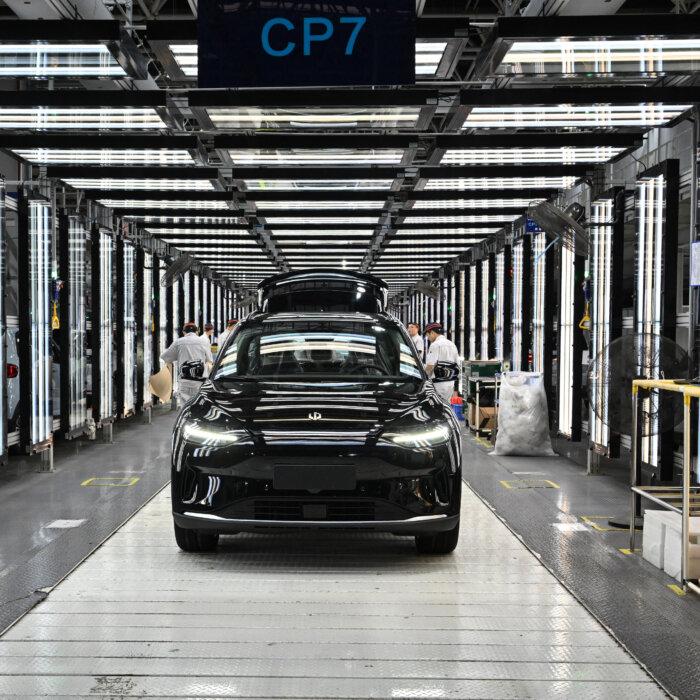

Similar concerns have been raised in Canada about the deal Prime Minister Mark Carney signed with Chinese leader Xi Jinping on Jan. 16.
Carney agreed to cut the 100 percent tariffs on Chinese electric vehicles (EVs) to 6.1 percent, allowing 49,000 cars into Canada in 2026, rising to 70,000 annually by 2030. China agreed to lower tariffs on Canadian canola and other agricultural products in exchange.
Ottawa’s deal with Beijing on Chinese EVs has been criticized extensively by Conservative MPs and China experts, as well as by the U.S. administration.
The senators’ letter was also critical of the deal Carney forged with China.
They noted that Canada initially followed the U.S. lead by placing a 100 percent tariff on Chinese vehicles in 2024 “to preserve our intertwined auto manufacturing sectors.”
Stellantis Deal
The senators’ letter comes as Stellantis is reportedly exploring the possibility of building Chinese EVs at its stalled plant in Brampton, Ont., in collaboration with Chinese automaker Leapmotor.Stellantis acquired a roughly 21 percent stake in the Chinese company Leapmotor in 2023 and the two automakers later formed a joint venture, Leapmotor International, to expand production outside China, with Stellantis holding a 51 percent stake.
“We can’t have cheap Chinese parts and kits coming over to be assembled” at the Brampton plant, he said. “We’re dead against this.”
The new electric SUV was originally scheduled to hit production lines in the Brampton plant late last year, but the company announced in the fall a plan to shift production of the Jeep Compass to Illinois, as part of a US$13 billion investment in the company’s manufacturing operations south of the border. The move impacted some 3,000 jobs in Brampton.
Industry Minister Mélanie Joly told reporters last week that Stellantis needs to ensure there are proper labour standards and conditions for workers and that all production in Brampton supports the local supply chain before resuming operations at the plant.
Stellantis must also ensure vehicle software is secure, Joly said, noting that is key for the company to meet its obligations under the USMCA.
He told podcast host Steven Bartlett that should China choose to take “a very aggressive, bellicose approach—using technology for espionage, interference in foreign countries, as they have done in Canada, invading Taiwan—then China and Beijing, in particular, the regime, could become the biggest risk and threat to our country and our world.”