Laura Fernández, a protégé of outgoing President Rodrigo Chaves, won Costa Rica’s presidential election on Feb. 1, and her ruling Sovereign People’s Party is on course to gain a majority in Congress, according to preliminary results.
Results announced in the early hours of Feb. 2 showed that Fernández, regarded as a populist and a conservative, had secured nearly half of the votes with 88.43 percent of ballots counted.
Fernández will avoid an April 5 runoff, as she needed only 40 percent of the vote to win outright and become Costa Rica’s second female president.
Fernández pledged to continue Chaves’s tough stance on law and order, echoing his anti-establishment message.
Although consecutive reelection is not allowed in the Central American country, Fernández has said she will include Chaves in her government when she assumes office in May.
In her victory speech, Fernández said that Costa Rica is entering a new political era.


“Change will be deep and irreversible,” Fernández said.
She said that the Central American country’s second republic, which began after the 1948 civil war, “is a thing of the past.”
“It’s up to us to build the third republic,” the president-elect told supporters in the capital, San Jose.
Supporters of Fernández gathered at the Hispanidad Fountain, waving flags and stuffed jaguars, a symbol adopted by her party.
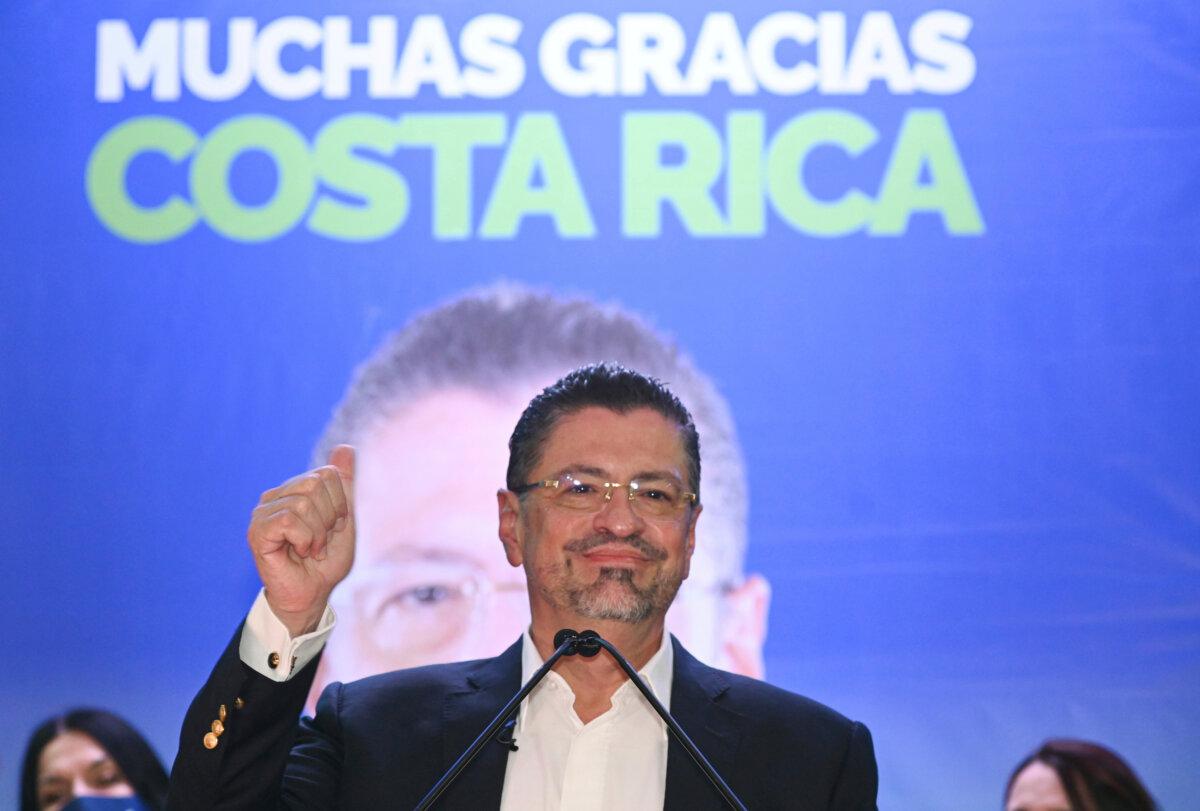
Her closest contender, economist Álvaro Ramos—regarded as a centrist—had secured one-third of the ballot by the latest update, and leftist candidate and former First Lady Claudia Dobles achieved less than 5 percent of the vote.
‘Wounded Country’
Ramos said during his concession speech that he would support Fernández in decisions that benefitted the country while opposing her where he believes they are not in the national interest.“We need to keep fighting. That’s our job, that’s our commitment,” Ramos said. “We'll keep calling for the country’s unity and to heal a wounded country.”
The Sovereign People’s Party was on course to win a majority of 30 seats in the 57-seat Congress, an increase from its current eight seats but short of a supermajority that would give it more powers, such as being able to appoint Supreme Court magistrates.
Gabriela Segura, a 25-year-old business administrator, said that crime was one of her biggest concerns in this election but that she also wanted a candidate who would protect the country’s highly rated public health system.
“You can see the rise in murders, in femicides. As a woman, I’m afraid to go out on the street, a lot more than before,” Segura said.
María Fernanda Bozmoski, a director at the Atlantic Council, a Washington-based think tank, said Costa Rica, “like the rest of the region, wanted that strong discourse when it comes to security, and Fernández had that rhetoric.”