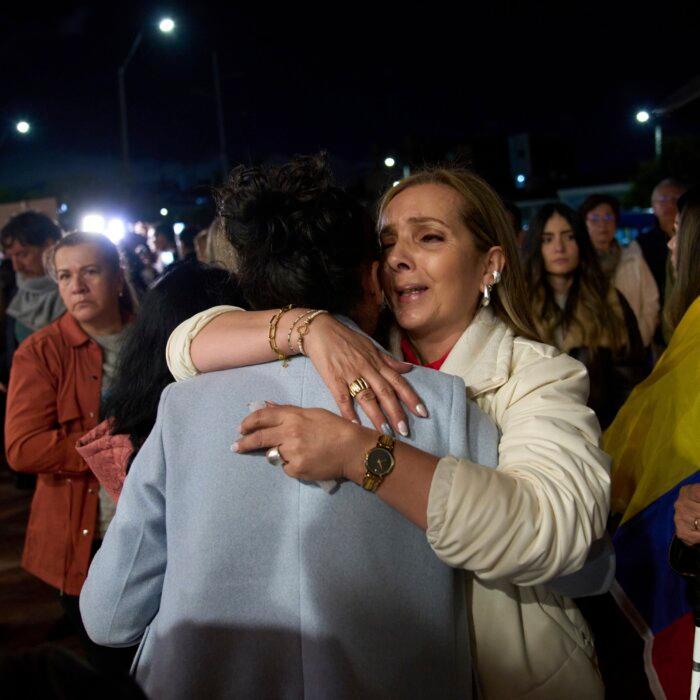
Hundreds of Colombians gathered on June 15, both inside and outside the country, to march for peace and the recovery of presidential candidate and Senator Miguel Uribe Turbay, who was seriously injured in an attempted assassination on June 7 in Bogotá.
The “March of Silence,” called by Colombian presidential candidates and congressmen, took place in 30 cities in Colombia and several cities in the United States, including Miami, Weston, Orlando, Houston, Los Angeles, New Jersey, and New York.
Participants attended the marches dressed in white and carrying Colombian flags, in a symbolic act calling for peace in the face of a recent wave of violence. After the attack on Uribe Turbay, a subsequent 24 attacks were seen in the southwest of the country that claimed the lives of four police officers, one patrolman, and three civilians.
In Bogotá, the massive march began at 9 a.m. (local time) from the National Park to Plaza de Bolívar. In attendance were other oppositional presidential candidates including Maria Fernanda Cabal, Paloma Valencia, David Luna, Gustavo Bolívar, Vicky Dávila, Federico Gutierrez, and Claudia López, who all suspended their candidacies due to the lack of guarantees from the ruling party for their safety and protection in the upcoming 2026 presidential elections.
Also in attendance were Colombian Minister of Finance and Public Credit José Manuel Restrepo, Bogotá Mayor Carlos F. Galán, former President Álvaro Uribe Vélez, former Vice President Francisco Santos, former Mayor Enrique Peñalosa, and other figures who joined the call for illegal armed groups to stop the political violence.
Senator and presidential candidate for the Democratic Center political party, Paloma Valencia, told Colombians in a video shared on her X account: “Today we draw a line between those on the side of democracy and the violent ones we left on the other side. We will not allow you to write the future of this country.”

Vicky Dávila, journalist and presidential candidate, noted that Colombians “silently and bravely” marched “for Miguel and against the violent ones.”
“Today’s unity is the essence of our country. It’s a demonstration that together we are stronger, that we have more in common than differences. ... We Colombians who do things right are millions, we are the majority. ... We are going to take back Colombia. Let’s put our egos aside, always put our country first,” Dávila said in a video shared on his X account.
Colombian President Gustavo Petro called the marches a hoax and urged citizens to support his proposal for a referendum on his labor reform.
“Ideas must not be silenced; that’s what murderers want when they kill. The people will not be fooled; they are for life for all Colombians, including Senator Uribe, and for the Popular Consultation. There are no more slaves who demand and get killed by slavery and chains. The Colombian people want peace, zero deaths, a popular consultation, and rights and freedoms. So if the march was a hoax, then let’s take to the streets,” the president wrote in a post on X.
On May 17, the Senate approved some points of the labor reform that they said are beneficial to Colombians, and the document returned to the House for conciliation. Both chambers must appoint senators and representatives to review the differences and issue a single text, which will be voted on again in the two plenary sessions. Congress must complete the entire process within the legislative period that ends on June 20.
The labor reform, one of the most ambitious projects of the Petro administration, was approved by the House of Representatives on Oct. 17, 2024, and seeks to establish permanent contracts as the norm for the public and private sectors, reduce working hours, and protect vulnerable groups, among other things.
On June 18, the Council of State of Colombia, through the Fifth Section of the Administrative Court, suspended the legal effects of Petro’s labor reform referendum Decree 0639 of 2025, which called for a national referendum on labor issues.