This copy is for your personal, non-commercial use only. Distribution and use of this material are governed by our Subscriber Agreement and by copyright law. For non-personal use or to order multiple copies, please contact The Epoch Times Reprints.
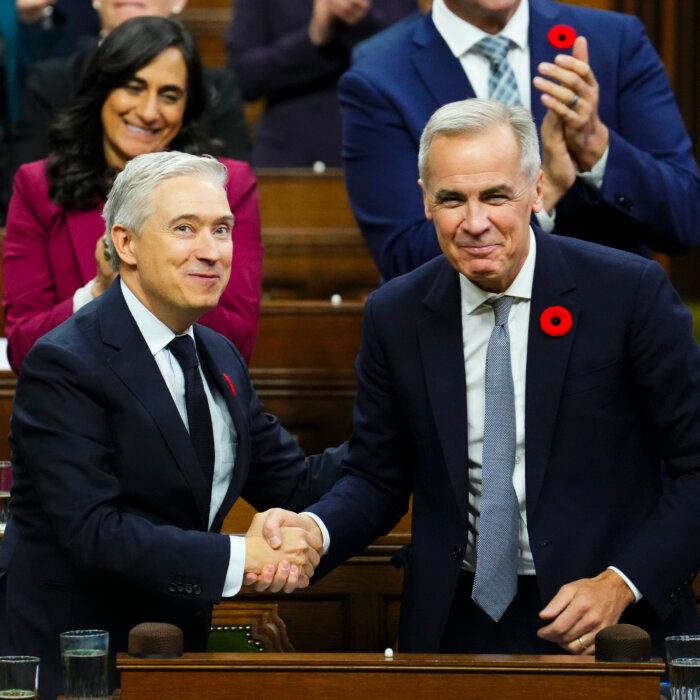
Prime Minister Mark Carney has defended increasing the debt burden with his fiscal plan, saying the greater risk to the economy is sluggish growth.
“Our risk is the economy doesn’t grow fast enough,” Carney told a business audience at an event in Toronto on Nov. 7. “In other words, we don’t get the productivity up, and that’s what gradually gets you into a more difficult debt.”
The prime minister was responding to a question from the audience about how the expenditures in the budget, dubbed “generational investments” by the government, will shape opportunities for younger Canadians in the coming years, given that a large deficit can potentially be “a tab for a future generation.”
Carney said Canada is in a position “where there’s a fairly substantial restructuring of this economy that needs to happen because of the change in the world.” He noted that his government aims to accomplish this through investment.
“We are only running a deficit for investment, and we’re not reclassifying things that are current spending as investment,“ he said. ”It’s only for long-term investment.”
Carney’s budget bill, tabled on Nov. 4, projects a $78.3 billion deficit this fiscal year and a debt-to-GDP ratio that is expected to climb before stabilizing in the years ahead. The budget says more than 75 percent of the measures the government is taking in the current fiscal year are to respond to “significant global economic shifts.”
Carney told the audience on Nov. 7 that the budget’s “generational investments” will benefit Canada’s younger generation by creating jobs in skilled trades and increasing the likelihood that the economy will grow.
“The risk is not to take risk,” Carney said, adding that Canada has not taken risk in investment for “too long.”
Shortly after launching his candidacy for Liberal Party leader in January, Carney said he would “build the strongest economy in the G7.” He repeated his promise to build the “fastest-growing economy” in the G7 throughout the general election campaign, but he didn’t cite a specific time frame for the goal.
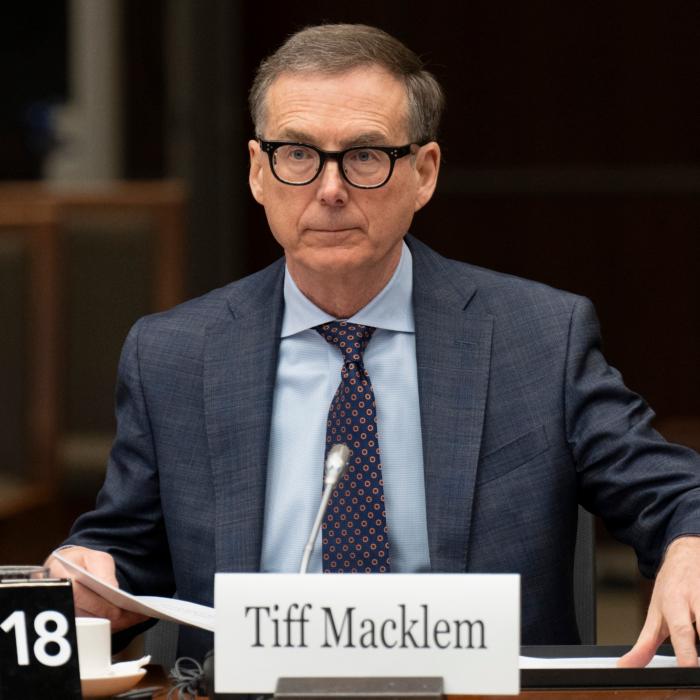
Bank of Canada Governor Tiff Macklem told the House of Commons finance committee on Nov. 5 that Canada’s economic growth will be outpaced by other countries in the G7, as the country goes through a “structural adjustment” to tariffs imposed by the United States.
“I don’t have all the G7 forecasts in front of me, but ... we’re not going to be the fastest-growing economy in the G7 over the next year,” Macklem told the committee.
The Conservatives have accused Carney of breaking his “promises,” saying he has instead delivered the “fastest-shrinking economy” in the G7. The Conservatives want the government to reduce spending, eliminate taxes such as the industrial carbon levy, and scrap policies they say restrict developments in the energy sector.
Energy Projects
Carney took questions on a variety of other topics at the Nov. 7 event, including on energy projects like pipelines and LNG. When asked whether Canada could expect to see a pipeline project in the works soon, he responded by calling that a “boring” question.
“Don’t worry, we’re on it,“ he said. “Don’t worry, it’s going to happen. ... Well, something’s going to happen, let’s put it that way.”
A pipeline wasn’t included in the first five projects deemed to be of national interest announced in September to be referred to the Major Projects Office. The office was created under the newly passed One Canadian Economy Act, which is partly intended to streamline the approval process for major projects selected by the government.
Alberta Premier Danielle Smith has pitched an Alberta-B.C. pipeline project to the Major Projects Office, saying she wants to advance the project through the initial regulatory requirements to attract private investment for it. Meanwhile, B.C. Premier David Eby has repeatedly expressed skepticism about the prospects of a pipeline to the West Coast.
“It’s an easy conversation to have about a pipeline, because it’s one thing we can see,” Carney said. “But the reality is that there’s much, much more to the Canadian economy, and there’s much, much more to the future Canadian economy, and so we’re attacking it on all sides.”
Meanwhile, he said Canada can grow its clean energy grid by 50 percent over the next decade, and noted the scale of LNG exports that could be on the horizon. He said that while he was in Asia last week for the Association of Southeast Asian Nations (ASEAN) and Asia-Pacific Economic Cooperation (APEC) summits, “every single government” he spoke with wants Canada’s LNG.
When asked why the government is deciding what’s in the national interest when it comes to major projects, as opposed to all Canadians having an input, Carney said, “There are certain things you want your government to do.” He said the federal government determines with the provinces, along with input from the private sector and other stakeholders, which projects will generate the highest return.
“The vast, vast majority of the investment that’s catalyzed by this budget is decided in rooms like this,” he said.