This copy is for your personal, non-commercial use only. Distribution and use of this material are governed by our Subscriber Agreement and by copyright law. For non-personal use or to order multiple copies, please contact The Epoch Times Reprints.
Prime Minister Mark Carney, left, shakes hands with Ontario Premier Doug Ford after the two made an announcement at the Darlington Energy Complex in Courtice, Ont., on October 23, 2025. The Canadian Press/Laura Proctor
Ottawa and Ontario are contributing a total of $3 billion toward a project to build four small nuclear reactors in the Greater Toronto Area.
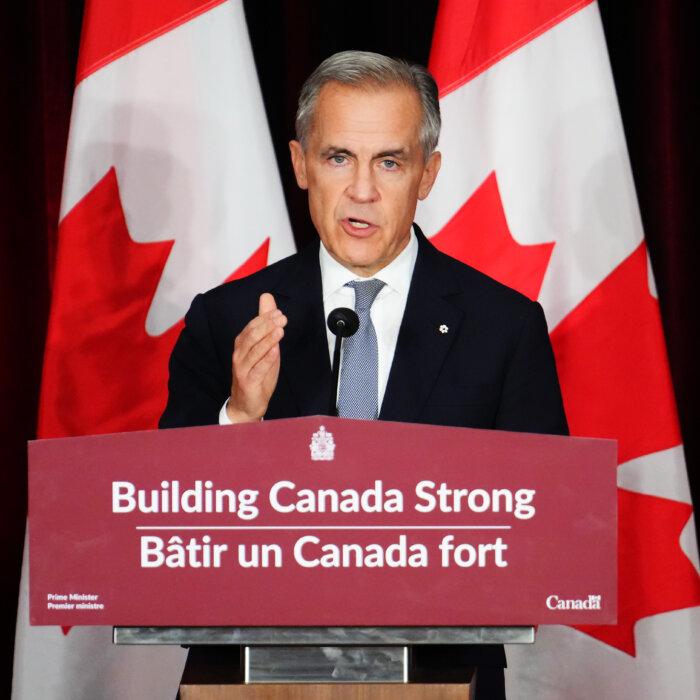
Prime Minister Mark Carney announced in September the Darlington New Nuclear Project was part of the first tranche of five major projects he deemed to be in the national interest and worthy of fast-tracking.
Ottawa will provide $2 billion in funding to support the construction and operation of the four small modular reactors (SMRs) at the Darlington New Nuclear Project in Bowmanville, Ont., Carney announced at an Oct. 23 press conference.
Carney called the funding “a generational investment,” saying the project would make Canada the first in the G7 “to have an entirely new kind of nuclear reactor.”
The prime minister was joined by Ontario Premier Doug Ford, who announced his province would provide $1 billion in funding to support the project.
“Today’s investment to support the first SMRs in the G7 is a downpayment on Ontario’s nuclear energy future,” Ford said in an Oct. 23 statement. “We’re protecting Ontario by supporting good-paying, long-term jobs for Ontario workers and building the energy infrastructure—including both SMRs and new, large-scale nuclear—needed to make Ontario an energy superpower.”
The Prime Minister’s Office said Ontario Power Generation (OPG) remains the majority owner and operator of the project, noting that through its funding, the federal government will acquire a 15 percent stake in the project, and Ontario will acquire 7.5 percent ownership.
Carney said each new reactor will be able to power 300,000 homes once built, with the first phase of the project expected to generate $500 million annually for Ontario’s nuclear supply chain.
Ford said the project is also expected to sustain 3,700 jobs annually, as well as 18,000 additional jobs during the construction phase, and contribute more than $38 billion to Canada’s gross domestic product (GDP) over the next 65 years.
OPG received approval from the provincial government to begin the project’s construction in May, and was licensed by the Canadian Nuclear Safety Commission in April.
Ontario Energy Minister Stephen Lecce said the project would cost nearly $21 billion. Construction of the first reactor, estimated at $7.7 billion, is expected to conclude by 2029, and linked to the grid in 2030.
Once all four SMRs are up and running, they will produce 1,200 megawatts of electricity, which is enough to power 1.2 million homes, the province said.
The province is exploring multiple other new nuclear energy generation projects in addition to the Darlington New Nuclear Project as well as upgrades to the Darlington and Pickering nuclear generating stations and Bruce Power. This includes another OPG site in Port Hope, Ont., and working with nuclear generator Bruce Power to develop a large-scale nuclear site, the province said.
Non-US Exports
Reporters asked Carney if there have been any commitments or interest in the project from European countries. The prime minister noted an “energy surplus” is being built in Ontario, which he said can be exported to the United States and other countries around the world.
“If there’s better uses of it here at home, for example for manufacturing, for artificial intelligence development, that then gets exported around the world—that’s an opportunity there as well,” Carney told reporters.
Ford told reporters at the press conference that Lecce and federal Energy Minister Tim Hodgson have been working together and have signed memorandums of understanding in Europe, including one in Poland.
“As we ramp the production up over a number of years, we’ll be able to ship these SMRs all over the world,” Ford said, adding that SMRs will increase Canada’s global competitiveness in the fields of critical minerals and energy.
The upcoming federal budget will focus on growing non-U.S. exports, among other priorities, Carney said in a rare televised address on Oct. 22 related to the Nov. 4 budget.
He said his government is working to develop markets beyond the United States and has a goal of doubling non-U.S. exports over the next decade to generate $300 billion more in trade.
Jennifer Cowan, Omid Ghoreishi, Paul Rowan Brian, and The Canadian Press contributed to this report.