
Housing starts increased in July, but it is not enough to meet demand, according to a report from Canada’s housing agency.
The data shows that total monthly seasonally adjusted annual rate (SAAR) of housing starts for all of Canada was up 4 percent in July (294,085 units) compared to June (283,523 units).
“Canada needs to increase housing starts to around 430,000 to 480,000 units per year to restore affordability,” the report said.
It also noted that the need to increase housing supply was “critical.”
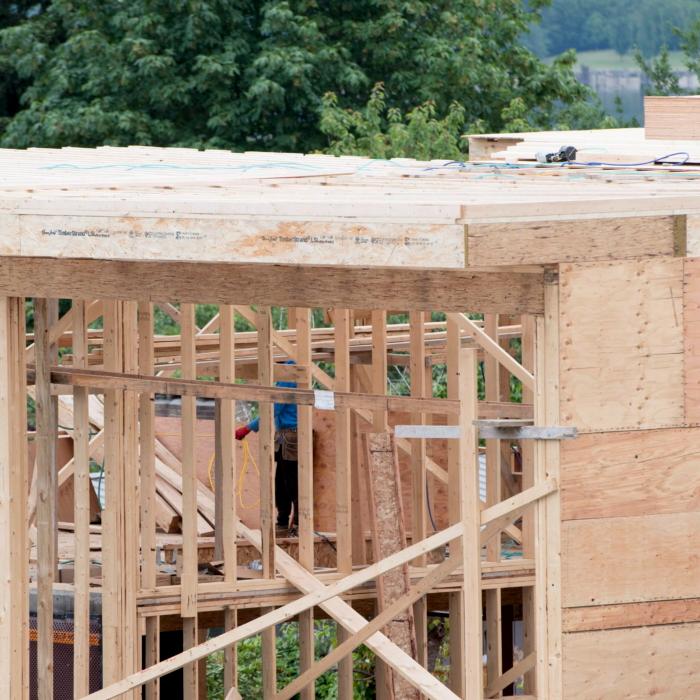
CMHC deputy chief economist Tania Bourassa-Ochoa said that housing starts have remained above 2024 levels in the first seven months of the year.
“These persistently elevated national results are reflective of investment decisions made months or even years ago, highlighting the influence of previous market conditions and builder sentiment on current construction trends,” she said.
CMHC data shows the monthly SAAR for municipalities with a population of more than 10,000 was up 5 percent in July (273,618 units) compared to June (261,171 units). Rural starts monthly SAAR estimates were 20,467 units, CMHC said.
Bourassa-Ochoa added the increase for 2025 was “primarily driven” by an increase in multi-unit starts in the prairies and Quebec.
Ontario saw the largest number of total SAAR housing starts at 74,348, followed by Quebec at 56,341 and B.C. at 54,347. Alberta saw 50,123, while Saskatchewan had 4,813 housing starts and Manitoba saw 5,031.
Among the Atlantic provinces, Nova Scotia saw the highest number of SAAR housing starts in July, at 16,704, followed by New Brunswick at 8,242 and PEI at 2,430. Newfoundland and Labrador saw 1,239 total housing starts in July.
CMHC noted that among the biggest cities, Vancouver saw a 24 percent increase in starts in July, which it said was driven by higher multi-unit starts.
Montreal saw a 212 percent year-over-year increase in actual housing starts, the report said. It too was due to higher multi-unit starts, according to CMHC.
Affordability Calculations
In the June report, CMHC said it was adjusting how it calculated “affordability” in the Canadian market.It said in previous reports it had developed a “comprehensive metric” of homebuying costs, but housing prices have risen so much in the most expensive cities that “the average household wouldn’t qualify to buy the average home.”
CMHC said that this metric had become “obsolete” as a result, and it had “adapted” how it measures affordability.
“We now use a more generic price-to-income ratio (or ‘homebuying affordability ratio’) with an adjustment factor to account for changes in mortgage rates and homeowner expenses,” the authors wrote.