Canada’s housing agency is updating its definition of affordability as the issue of unaffordable housing persists across the country. The agency says restoring affordability to levels experienced in the last two decades “isn’t realistic.”
There is no set definition of housing affordability, but it traditionally involves comparing housing costs to income, the report says. Specifically, it compares the monthly cost of purchasing an average home with the average or median income.
However, the federal agency says house prices have increased “so much in our most expensive cities” that the average household can no longer qualify to buy the average home under the current mortgage requirements.
“We therefore adapted how we measure homebuying affordability,” the report says. “We now use a more generic price-to-income ratio (or ‘homebuying affordability ratio’) with an adjustment factor to account for changes in mortgage rates and homeowner expenses.”
The agency says the new approach allows it to better monitor the affordability of buying homes, adding that a higher ratio indicates a less affordable market.

The decline in housing affordability has grown larger over the last 20 years and is still declining further. Therefore, the supply that would be needed to return affordability to levels from decades ago would put an “unrealistic strain” on resources, the agency says.
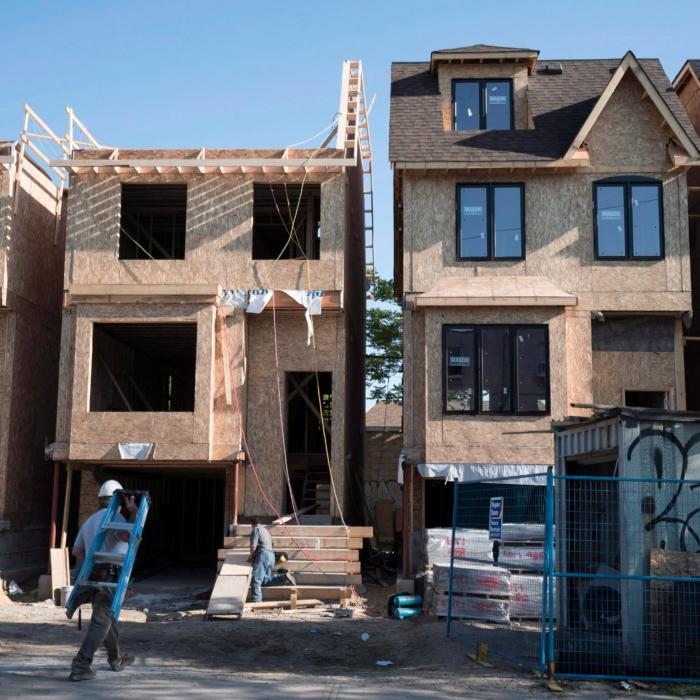
CMHC has emphasized that “increasing housing supply is the key to restoring affordability.” The report indicates that housing starts need to double over the next decade. This means that rather than the anticipated roughly 250,000 new housing units each year until 2035, housing starts must increase to approximately 430,000 to 480,000 units annually in order to regain affordability in Canada, the agency said.
Attaining these numbers will require a “significantly greater” workforce, more private-sector investment, and changes in technology and productivity, including more automation and modular construction, the report says.
Impact of Increased Supply
Increasing the housing supply in Canada will have various impacts on Canadians, the report indicates, such as increasing the number of households by roughly 2 percent in 2035.“As a result of lower prices, more households will be created,” the report reads. “As younger adult Canadians are able to leave the family home, there will be a notable increase in the number of households among younger age cohorts.”
Additionally, an increased housing supply and improved affordability will “create flows of households taking advantage of lower housing costs,” including some households leaving Toronto for the rest of Ontario where a greater supply of affordable housing may be, the agency says.
The report forecasts a similar pattern will take place in British Columbia. More Quebec households are expected to move to Montreal since a growth in housing supply in the city will restore affordability, the report adds.
If affordability levels are restored to those of 2019, house prices in 2035 will be roughly one quarter lower than what they would be otherwise, the report says.
“While there are concerns that increasing housing supply would cause house prices to fall rapidly and pose a risk to financial stability, this is unlikely,” the report reads. “Housing supply cannot be increased rapidly enough in reality to trigger such an event.”