Canadian Health Minister Eyes Possible Smoking Ban in Wake of Proposed UK Law

Canadian Health Minister Eyes Possible Smoking Ban in Wake of Proposed UK Law
Health Minister Marjorie Michel rises during question period on Parliament Hill in Ottawa, April 23, 2026. The Canadian Press/Adrian Wyld
|Updated:
0:00

Canada’s health minister says she is considering legislation aimed at permanently prohibiting the sale of tobacco products to people born after 2008.

Minister Marjorie Michel was asked by reporters during a press scrum on Parliament Hill whether Canada was contemplating legislation similar to a recently proposed bill in the United Kingdom that seeks to curb cigarette and vape use among youth.

“I’m looking into it right now,” Michel said after leaving the April 28 Liberal cabinet meeting. “We saw what the UK did, but I’m looking into it with all partners for now.”

Michel did not respond to any additional questions from reporters on the subject.

Both houses of the UK Parliament passed what’s being called the “Tobacco and Vapes Bill,” last week. The bill still requires royal assent from King Charles, who is currently on a four-day state visit in the United States. The legislation aims to create a “smoke-free generation” by permanently banning tobacco sales to anyone born on or after Jan. 1, 2009.

Justice Minister Sean Fraser was also questioned about the possibility of similar legislation in Canada. He told reporters he has not been part of any discussions that may be taking thus far, but he supports the idea.


“Obviously, doing whatever we can to reduce the consumption of tobacco products amongst young people is extremely important,” he told reporters. “When you look at the long-term harm that we know tobacco products can cause, preventing people from starting to use it early in life, is a key strategy.”

Fraser said he looked forward to discussing the matter with Michel, his seat-mate in the House of Commons, later that day.

“I’ve got a personal opinion on it but I have not been engaged formally in the policy development process,” he added.

A woman exhales while smoking a vape outside an office tower in downtown Vancouver on Feb. 28, 2017. (The Canadian Press/Darryl Dyck)
A woman exhales while smoking a vape outside an office tower in downtown Vancouver on Feb. 28, 2017. The Canadian Press/Darryl Dyck

Statistics and Strategies

A report published on the Government of Canada’s website evaluates the possible effects of a “smoke-free generation,” which includes a permanent ban on cigarette sales to individuals born after 2009. The study found the policy could lead to a reduction of $2.3 billion in health-care costs within 50 years.

This policy would also result in an increase of approximately 480,000 quality-adjusted life years, a measure used in economics to assess the advantages of medical interventions, the study found.

Health Canada implemented a plan in 2018 to address tobacco use in Canada. The plan, better known as Canada’s Tobacco Strategy, has been designed to help achieve the target of less than 5 percent tobacco use by 2035. The government has committed $66 million annually to the plan since its implementation.
Health Canada says youth smoking has hit an all-time low since it launched the strategy, but the popularity of vaping has increased.
Health Canada’s 2023-2024 survey on student alcohol and drug use indicated that 10 percent of Grade 12 students polled had smoked cigarettes and 27 percent had vaped during the previous 30 days.
The Substance Use Survey found that more than one million, or 48 percent, of Canadian teenagers aged 15 to 19 had tried vaping products, 681,000, or 30.5 percent, had used them in the past month, and 400,600, or 17 percent, were vaping on a daily basis.
The survey also found that 15 percent of students believed there was little-to-no risk of harm from regularly smoking cigarettes. Sixteen percent believed the same about vapes with nicotine, and 39 percent about vapes without nicotine.

Vaping and E-Cigarette Concerns

Health activists are voicing concern about the popularity of vaping and e-cigarettes among Canadian teenagers.
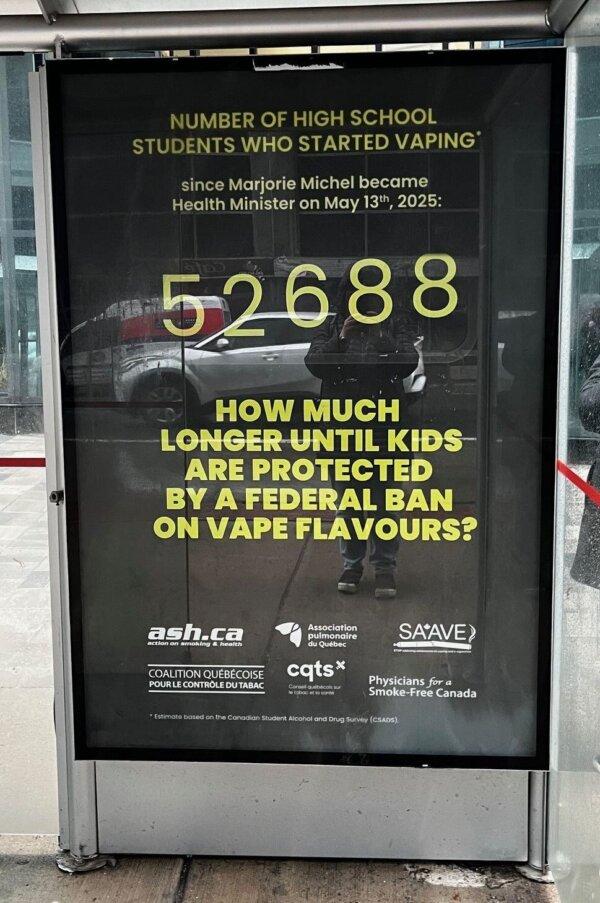
A joint press release this month from Action on Smoking & Health (ASH) Canada, Quebec Coalition for Tobacco Control, and Physicians for a Smoke-Free Canada said the number of kids using e-cigarettes now is well above that of 2018, the year the federal government legalized the sale and promotion of e-cigarettes in Canada.
An ad at an Ottawa bus shelter highlights the number of high school students that started vaping since Marjorie Michel was named federal health minister, on May 13, 2025. (CNW Group/Quebec Coalition for Tobacco Control)
An ad at an Ottawa bus shelter highlights the number of high school students that started vaping since Marjorie Michel was named federal health minister, on May 13, 2025. CNW Group/Quebec Coalition for Tobacco Control

The groups have been running transit shelter ads in Ottawa this month stating that more than 50,000 high school students have started vaping across the country since last May, when Michel was named health minister.

University of Ottawa Heart Institute cardiologist Dr. Hassan Mir said that flavoured vapes are a “key factor” in attracting teens to nicotine products.

“Most youth use e-cigarettes beginning with a flavoured variety,” said Mir, who is also an assistant professor of medicine at the University of Ottawa.

“The government must recognize that by allowing fruit and minty flavours in vaping products, it is helping a predatory industry addict youth to nicotine,” he said in the press release. “The government’s inaction regarding flavours comes at the cost of the wellbeing, health and freedom from addiction of tens of thousands of youths, with their number growing every day.”

Many popular vaping devices are equipped with Bluetooth functionality to stimulate their use and tracking, feature video games, appealing designs, and are wrapped in colours, patterns, and branding that attract young people, the groups said.

Physicians for a Smoke-Free Canada spokesperson Cynthia Callard called on Ottawa to approve amendments to the Tobacco and Vaping Products Act that were proposed in 2021 to restrict flavoured products.
“[Michel’s] first priority should be to strengthen and finalize the almost-five-year-old draft regulations that aim to restrict flavours in commercially-sold e-cigarettes,” Callard said in the press release.  “Most if not all the additives used to flavour e-cigarettes have never even been approved for inhalation.”

Mir said vaping elevates the risk of developing nicotine addiction, along with mental health disorders, cardiovascular issues, oral diseases, and lung injuries.