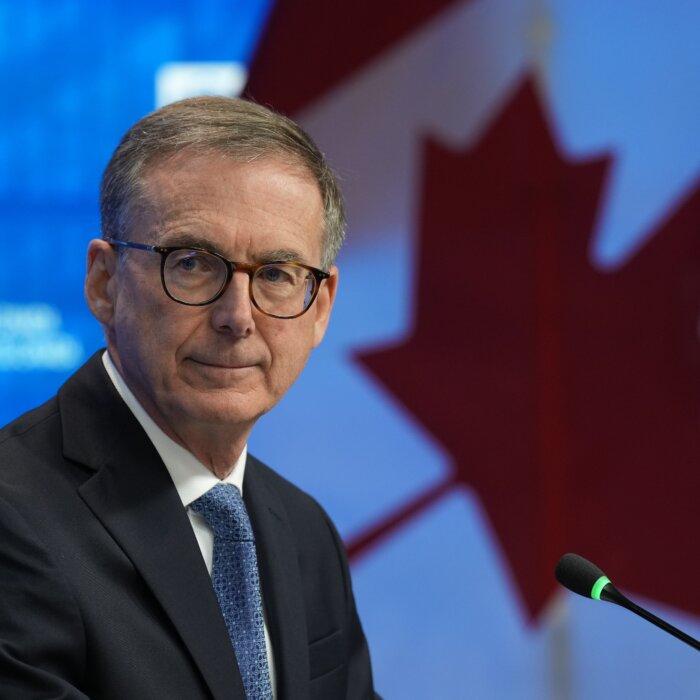
Bank of Canada Governor Tiff Macklem says Canada’s economic growth will be outpaced by other countries in the G7, as the country goes through a “structural adjustment” to tariffs imposed by the United States.
Macklem made the comments during an appearance before the House of Commons finance committee on Nov. 5, where he was asked by Tory MP Jasraj Singh Hallan what is Canada’s position in economic growth compared to other G7 countries, given campaign promises made by Prime Minister Mark Carney on building the economy.
“I don’t have all the G7 forecasts in front of me, but... we’re not going to be the fastest-growing economy in the G7 over the next year,” Macklem told the committee.
The G7, also known as the Group of Seven, is an intergovernmental political and economic forum consisting of Canada, France, Germany, Italy, Japan, the United Kingdom, and the United States.
Macklem told the committee in his opening statements that the Bank’s forecast on Canada’s economic growth for the remainder of 2025 is “very modest” and will average approximately 0.75 percent.

“We do expect it to pick up, but... this is a structural adjustment, and so that’s going to take some time,” he said.
Canada’s GDP on ‘Lower’ Path
Macklem told the committee U.S. tariffs have “diminished Canada’s economic prospects,” which limits the Bank’s ability to boost demand and keep inflation low. He said monetary policy cannot undo the damage caused by tariffs, and that Canada’s GDP is on a “lower” path because of the trade war.“But I will add, there are things the country can do to get on a higher path,” he said. “We don’t need to accept a lower standard of living.”
Macklem said the Bank of Canada had lowered its policy interest rate by 100 basis points since the start of the year, from 3.25 percent to 2.25 percent, to support Canada’s economy during the trade dispute. He said the bank’s governing council sees its current interest rate at the “right level to keep inflation close to 2 percent while helping the economy through this period of structural adjustment.”
“We will be assessing incoming data carefully relative to the bank’s outlook, and if the outlook changes, we are prepared to respond.”
Macklem said if Canada were to have productivity growth comparable to that experienced by the United States in recent years, “the standard of living of Canadians would be much higher than it is today.” Canada has had a “long-standing” issue with productivity, he said, adding that while Canadians are primarily concerned with the rising price of goods, higher productivity will increase affordability.
“We’re not going to lower the price level... that would have a very negative effect on the Canadian economy. You'd have to have a big recession. Nobody wants that,” Macklem said. “So the question is, how do you make things more affordable? Well, you have to grow the top line. If there’s more income, then things are more affordable.”