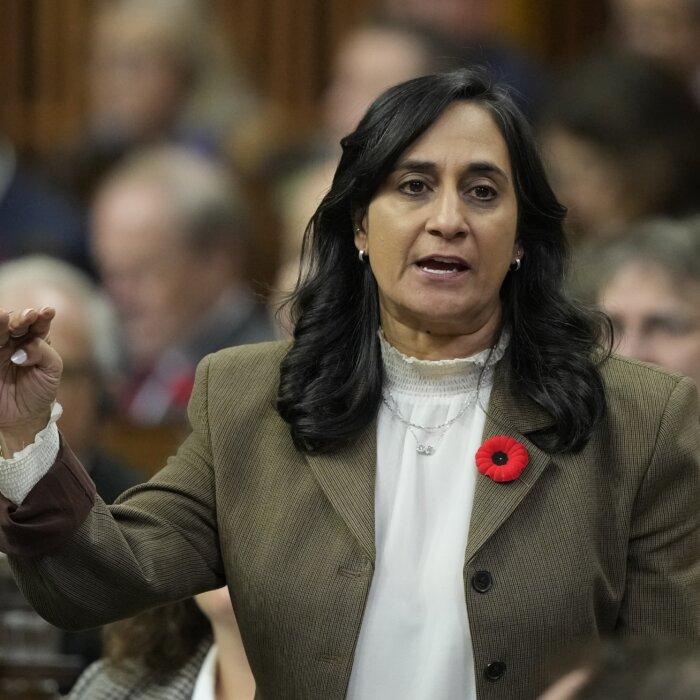
Foreign Affairs Minister Anita Anand announced Canada has imposed more sanctions on Russia while attending a meeting of G7 foreign ministers in Ontario’s Niagara region.
“We firmly believe that continued collective pressure on Russia is necessary… So today, we are announcing a new package of sanctions to further increase the economic costs to Russia of waging war,” Anand said at a press conference in Niagara-on-the-Lake on Nov. 12.
The sanctions also target entities supplying the cyber infrastructure Russia has used in cyberattacks against Ukraine, and a Kyrgyzstan-owned financial institution that has been enabling Russia to evade sanctions.
Also included in the sanctions are several Russian liquefied natural gas entities that provide energy revenues allowing Moscow to fund its war against Ukraine, the statement says, as well as 100 vessels from Russia’s “shadow fleet” used to transport oil while evading Western sanctions.
Ukrainian Foreign Minister Andrii Sybiha said during the press conference alongside Anand that the G7 meeting was “important for our peace efforts.” He said Ukraine wants to see an end to the war, and the leaders will be discussing “practical steps to bring it to a close.”
In addition to her counterparts from the G7, Anand also invited representatives from Australia, Brazil, India, Mexico, Saudi Arabia, South Africa, and South Korea to take part in the two-day gathering in Ontario. The gathering will include discussions on global economic and security challenges, energy security, and critical minerals.
The night before, the G7 foreign ministers held a working dinner to discuss global peace and security, including a peace deal between Israel and Palestine, security in the Indo-Pacific, and crises in Haiti and Sudan.
Since Russia first invaded and annexed the Crimea region of Ukraine in 2014, Canada has imposed sanctions on more than 3,300 individuals and entities related to Russia. Ottawa said this has included 400 vessels in Russia’s shadow fleet.
In August, U.S. President Donald Trump met with Russian President Vladimir Putin in Alaska to discuss an end to the Russia-Ukraine war. The meeting ended early without an agreement being announced.
Ukrainian President Volodymyr Zelenskyy and several European leaders then met with Trump to discuss an end to the Russia-Ukraine war. Trump said following the meeting that several countries could provide Ukraine with security guarantees, and that a trilateral meeting between himself, Zelenskyy, and Russian President Putin could soon be arranged.