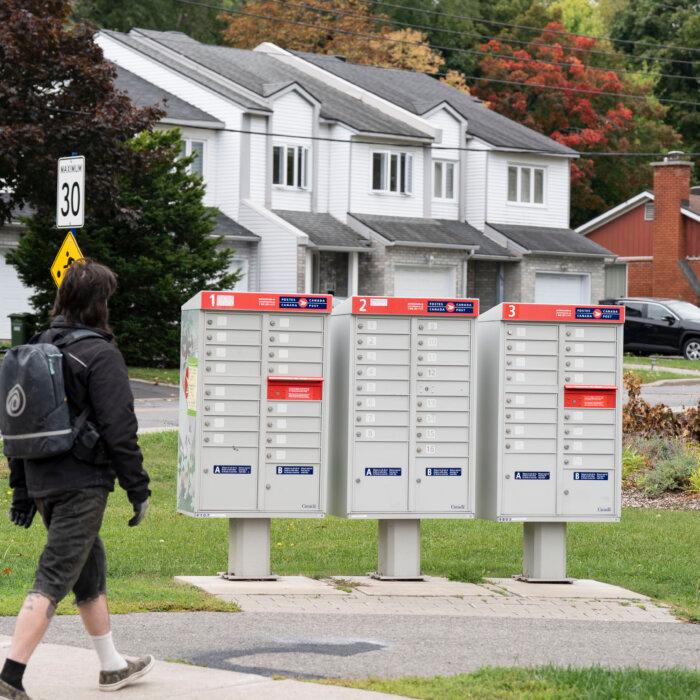
Canada Post has earmarked nearly half a million additional homes nationwide to shift from door-to-door delivery to community mailboxes in 2027, as part of its efforts to regain financial stability.
The upcoming stage of the transformation will impact 37 communities spanning seven provinces: British Columbia, Alberta, Manitoba, Ontario, Quebec, New Brunswick, and Nova Scotia.
Ontario will experience the highest number of conversions, impacting more than 158,000 addresses in Ajax, Brampton, Hawkesbury, Kitchener, London, Mississauga, Ottawa, and Pickering.
Following closely is Quebec, with 139,000 addresses affected in L’Ancienne-Lorette, Laval, Longueuil, Québec City, Saint-Hubert, and Trois-Rivières.
British Columbia will see 81,000 conversions in the communities of Burnaby, Colwood, Coquitlam, Esquimalt, Kelowna, Langford, New Westminster, Port Coquitlam, Port Moody, Saanich, Songhees Nation, Victoria, View Royal, Westbank First Nation, and West Kelowna.

Alberta will have 56,000 conversions in Calgary and Edmonton, while Manitoba will have 17,000 in Portage la Prairie and Winnipeg.
Nova Scotia and New Brunswick are also expected to have 17,000 conversions each. New Brunswick’s are slated for Fredericton and Oromocto and Nova Scotia’s will be solely in Halifax.
Community Mailbox Plan
Canada Post plans to convert four million addresses that continue to receive door-to-door delivery to community mailboxes equipped with lock boxes for individual addresses. The initiative, which is expected to unfold over a period of five years, is expected to result in an annual savings of $400 million.“Community mailbox conversions are a key element of Canada Post’s plan to transform the postal service to meet the evolving needs of Canadians without becoming a recurring burden on taxpayers,” the agency said in its press release.
The Crown agency said its poor financial performance in 2025 along with another “significant loss in the first quarter of 2026, underscores the urgency of this transformation.”
Lightbound described Canada Post as “effectively insolvent” last year when the agency faced a record loss of $1.5 billion.
He announced last September that Ottawa plans to adopt all the recommendations made by Industrial Inquiry Commissioner William Kaplan in a report he submitted to the government in May of the same year. The report contained several suggestions to improve Canada Post’s fiscal situation, including the elimination of door-to-door delivery.
Also topping the list of needed changes in the report was the closure or conversion of some post offices. Canada Post said it is already reviewing its retail network in preparation for closures of urban and suburban post offices in areas that it described as “over-served.”
The government has also authorized Canada Post to change its delivery standards for non-urgent letter mail, allowing for ground transportation instead of air to reflect the reduced volume of mail.