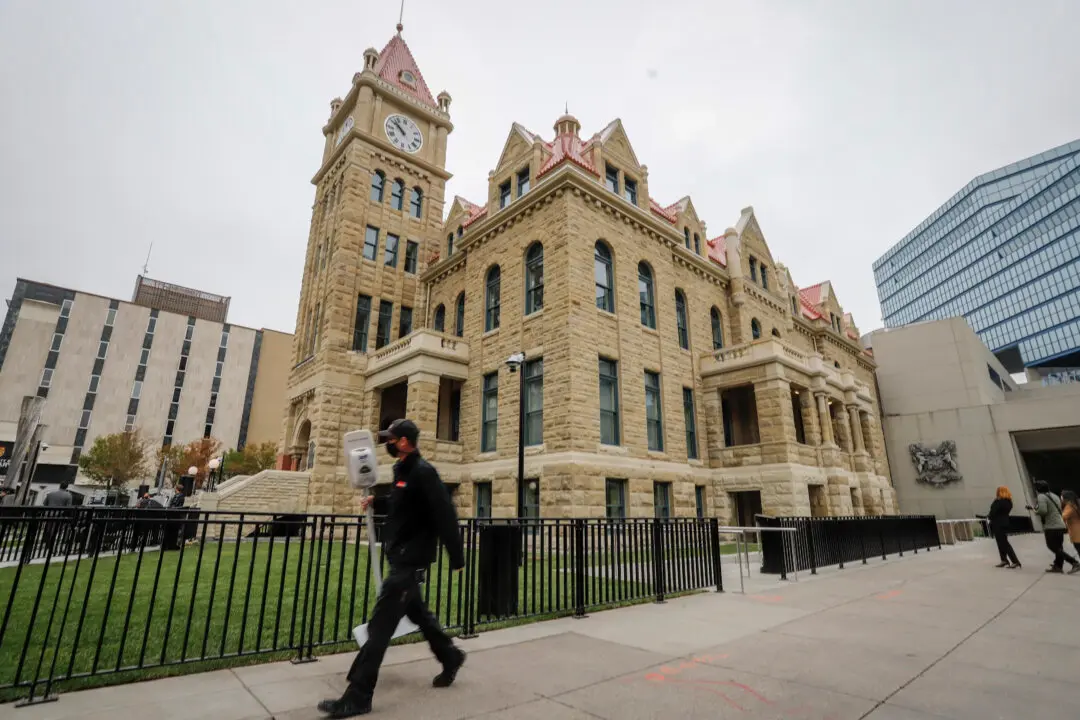
The Canada Border Services Agency (CBSA) says it has opened a temporary immigration facility for “high-risk detainees” that will hold up to 25 men with criminal convictions.
It said the centre will be for those who “require a high degree of supervision and control.”
“Detainees placed at the designated immigrant station may have prior convictions or outstanding charges for violent crimes, such as assault with a weapon, attempted murder, assaulting an officer with a weapon, and aggravated sexual assault and/or who have demonstrated violent, non-compliant or unpredictable behaviour that places themselves, staff, medical personnel, and other detainees at risk, thus requiring a higher degree of supervision and control,” the CBSA said.
An individual risk assessment is done on each person to identify those deemed in need of higher supervision.
CBSA said that it is “solely responsible” for the care and management of the detainees kept at the site under the Immigration and Refugee Protection Act, noting the area is separate from CSC spaces.

It said that detainees are given care “in line with domestic and international standards.”
Detainees are permitted legal representation, medical services, recreation areas, and specific rooms to host visits from legal representatives or those from non-governmental organizations.
An agreement between CSC and CBSA sees the correctional agency provide some essential services, such as food, sanitation, and infrastructure maintenance, CBSA said.
CSC may also provide “emergency interventions” if there are safety or security risks, according to CBSA.
The agreement expires in June 2029.
“The CBSA grants access to independent third-party service providers, such as the Canadian Red Cross and the United Nations High Commissioner for Refugees, to observe and evaluate detention conditions,” it added.
CBSA said it was the responsibility of the Immigration Refugee Board to determine if a detainee should be held in detention, noting that individuals who fail to comply with a CBSA removal order and could be a flight risk “may be subject to detention.”
Detention reviews are done every 30 days, according to the CBSA.
“The CBSA has a legal duty to remove inadmissible individuals as soon as possible from Canada, and actively works to secure travel documents and finalize removal plans promptly to avoid situations of prolonged detention.”
Additional Centres
CBSA already operates three other immigration holding centres, including in Toronto; Laval, Que.; and Surrey, B.C.Three Chilean nationals escaped from the Laval centre in December 2024.
Bryan Ulises Moya Rojas, Diego Nicolas Flores Sepulveda, and Daniel Eliseo Gonzalez Ihrig escaped on Dec. 7, 2024, CBSA said, noting that arrest warrants had been issued.
It advised the public not to try to apprehend the men, but to contact the Criminal Information Centre of Quebec at 1-800-659-4264.
Deportees Missing
Recently released data from the CBSA showed that nearly 600 foreign nationals with criminal records set to be deported failed to show up for proceedings. It included 431 individuals who had committed serious crimes, according to the CBSA.Data provided to The Epoch Times by CBSA spokesperson Luke Reimer shows that 1,635 foreign nationals with criminal records were facing deportation as of July 16, but 599 had “failed to appear for a scheduled removal proceeding” and been placed on the agency’s “wanted” list.
Of those on the CBSA wanted list, 315 have been deemed “wanted” for more than three years, and 46 have been missing for at least two years.
The CBSA data showed that 401 of the total foreign nationals facing deportation were currently in jail and were to leave Canada when released.
Reimer told The Epoch Times in an email that the agency has an obligation to remove those under “enforceable removal orders” as soon as possible for the “protection and safety of Canada and the Canadian public.”
Conservative MP and immigration critic Michelle Rempel Garner expressed concern that the number could go higher than 600.
Border agents regularly conduct warrant reviews to “identify new leads” that could help them locate those on the wanted list or confirm they have left the country, Reimer said.
He also noted that those facing deportation “have incentive not to be found,” adding they may be relying on family and community members to hide them. He also said they may resort to using “alternative identities” to avoid detection.