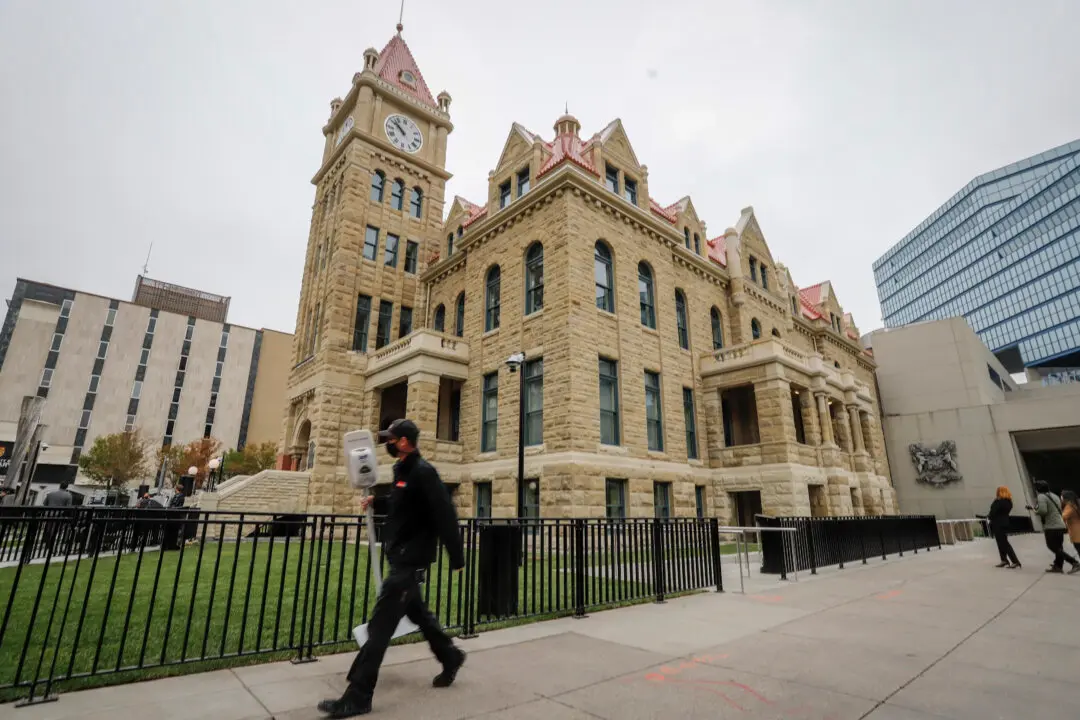
Calgary residents have seen their property taxes nearly double since 2016, making it the city with the highest tax burden in Canada, according to a new report.
Released on Oct. 8, the analysis by the Aristotle Foundation for Public Policy used Statistics Canada 2016 and 2021 census data to compare property tax rates “in absolute and relative terms” across major cities in each province.
It found that in those five years, Calgary’s “nominal” property tax rate, which is the rate given by each municipality based on assessed value, increased by 28 percent, resulting in the average annual property tax paid rising from $2,736 to $3,496. However, the authors argued that the “effective rate” of property taxes, meaning as a percentage of home value, needs to be taken into account as well. They noted that home values in Calgary dropped by 7.3 percent and the average household income declined by 13.2 percent during the census years studied.
“Therefore, taken together, Calgary’s total property tax burden rose 47 percent—almost double the increase of Saskatoon and more than triple Vancouver’s,” the foundation said in a news release.
“For a city known for opportunity, Calgary’s steep rise in the tax burden is deeply concerning,” said report co-author Jeff Park. “Clearly, greater fiscal discipline is needed to protect affordability and restore confidence in the local housing market.”
The report noted that Calgary’s population grew by 67,564 people between the two censuses. The number of residential units also grew, with the city adding 41,412 units, for a total of 531,062 units at the time of the 2021 census.

Toronto saw the second-highest increase in property taxes between the census dates, with a 25.5 percent increase, reaching $4,640. It was followed by Vancouver, which saw property taxes jump 24.7 percent to $5,016, and Saskatoon, which saw a 20.8 percent increase to $3,412. Montreal saw a 15.8 percent increase in property taxes in the city to $4,248.
Montreal and Toronto had “relatively strong economic performance” over this period in terms of income and property value growth, according to the report. Still, the overall property tax burden did increase, especially in Toronto, at 19.3 percent, the authors wrote.
In Montreal, homeowners saw just a 5 percent increase in the tax burden, with report authors citing a declining effective property tax rate, alongside increasing household incomes.
Between the two censuses, Toronto and Montreal also saw high real estate appreciation, according to the report, at 38.6 percent and 25.6 percent respectively.
The report also noted the change in household income for each city, and found that in Montreal, there was a 10 percent increase in household income between the two censuses. That number was 9.9 percent in Vancouver, and 5.2 percent in Toronto.
The report’s authors said that the data showed Saskatoon also had “concerning trends” and “considerable economic strain,” which includes falling incomes and dropping home values. Homeowners in Saskatoon have also experienced high increases in the property tax rate and tax burden.
“These concerns are not uniform across Western Canada, though, as Winnipeg and Vancouver both show moderate increases across all measures,” the authors wrote.
The authors concluded that “given the challenges of affordability for Canadians across the board, greater fiscal discipline is needed in Canada’s municipalities.”