This copy is for your personal, non-commercial use only. Distribution and use of this material are governed by our Subscriber Agreement and by copyright law. For non-personal use or to order multiple copies, please contact The Epoch Times Reprints.
Prime Minister Mark Carney checks out an Orion-H9 Counter-UAS, a directional drone disruptor, as he visits a vehicle display at the Adazi Military base in Adazi, Latvia, on Aug. 27, 2025. The Canadian Press/Christinne Muschi
The Liberal government’s 2025 budget is proposing to provide more than $81 billion over five years to build up the Canadian Armed Forces (CAF), as Canada works toward meeting NATO’s defence spending target of 5 percent of GDP by 2035.
Prime Minister Mark Carney’s first budget, tabled on Nov. 4, proposes to provide $81.8 billion starting this fiscal year to “rebuild, rearm, and reinvest” in the CAF, including more than $9 billion that was announced by Carney in June. Carney had said at a June 9 press conference that this increased military spending would help meet NATO’s spending target of 2 percent of GDP this fiscal year.
The Liberal government’s proposed “key investments” in the CAF over the next five years include spending $20.4 billion on recruitment and retention, including pay raises, as well as $19 billion to repair and sustain CAF capabilities and defence infrastructure.
The budget also proposes spending $10.9 billion over five years to upgrade digital infrastructure for the Department of National Defence, the CAF, and the Communications Security Establishment. Budget 2025 also allocates $17.9 billion to expand Canada’s military capabilities, such as in utility and armoured vehicles, counter-drone and long-range precision strike capabilities, and ammunition production.
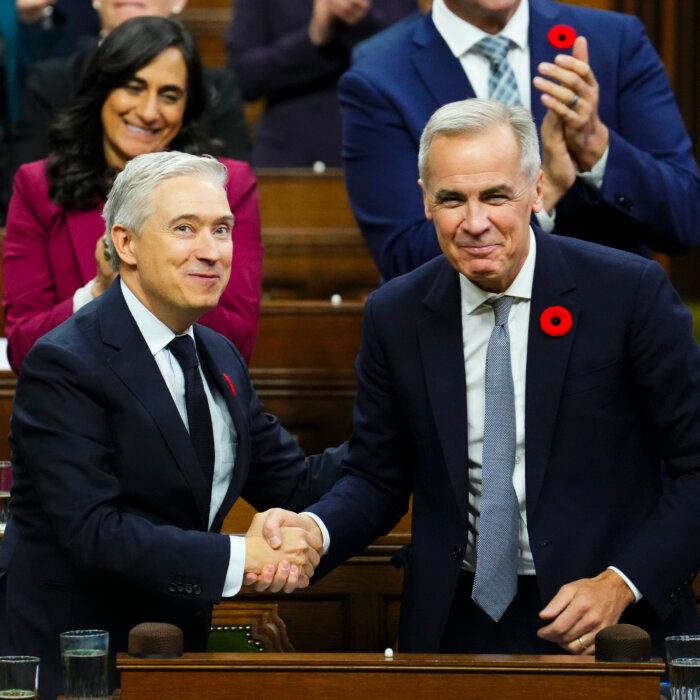
Finance Minister François-Philippe Champagne said Budget 2025 contains “the largest defence investment in decades.”
“Our military infrastructure and equipment need to be upgraded and updated, our defence capabilities need to be rebuilt and reasserted, and we need to work with partners to further research, investment, and procurement,” the budget document reads.
The Liberal government has also earmarked $6.6 billion over five years for its new Defence Industrial Strategy, which is to be unveiled “in the coming months.” The budget says the strategy would “improve access to capital, drive research and innovation, bolster domestic supply chains, and grow critical resource stockpiles.”
The budget proposes that Ottawa’s new Defence Investment Agency, which is tasked with speeding up military hardware purchases within the federal procurement department, will receive $30.8 million over four years, starting next fiscal year.
The budget also earmarks $6.2 billion for “defence partnerships,” which will include “expanded military assistance” to Ukraine, as well as $805 million for the Canadian Coast Guard, the Canadian Security Intelligence Service, and Public Services and Procurement Canada for “complementary initiatives to support Canada’s defence capabilities.”
Auditor General Karen Hogan issued two new reports last month saying the CAF is struggling to recruit enough members to meet its operational needs and doesn’t have adequate housing for its members.
The report on recruitment indicated that the CAF only successfully recruited 1 in 13 applicants over the last three years, that it faces ongoing challenges maintaining its workforce across various occupations, and its recruiting targets were not sufficient to maintain the optimal workforce.
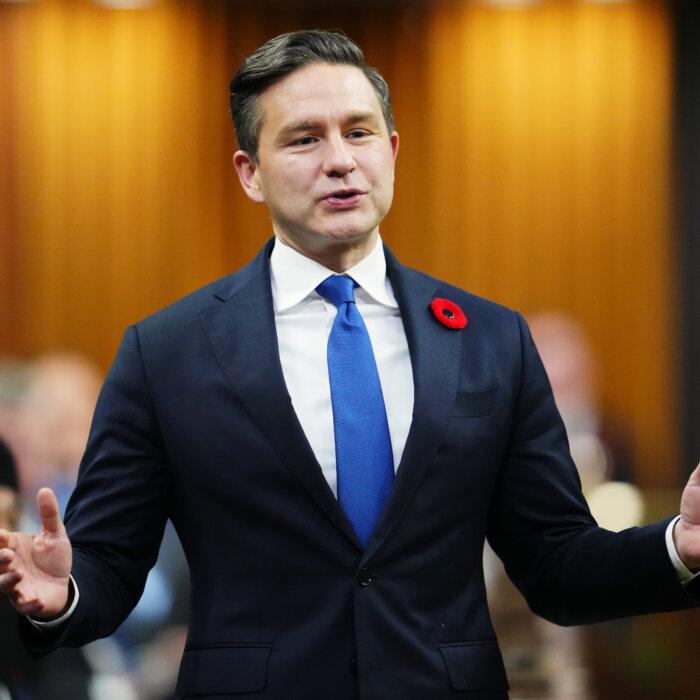
Conservative MP and defence critic James Bezan said the “serious problems” in the CAF are owing to “a decade of Liberal mismanagement.”
“Over the lost Liberal decade, our military has been plagued by the erosion of operational readiness, which led to a recruitment and retention death spiral at a time when the world has become a more dangerous place,” Bezan said in an Oct. 21 statement posted to X.
NATO Target
Prime Minister Mark Carney announced in June that Canada would massively increase military spending to meet NATO’s defence spending target of 2 percent of GDP per year by the end of the current fiscal year, on March 31, 2026.
Ottawa also agreed in June to a proposal calling for NATO allies to spend 5 percent of GDP per year on defence by 2035, including 3.5 percent of GDP on “core defence spending” and 1.5 percent on “defence and security-related investment, including in infrastructure and resilience.”
Budget 2025 says Ottawa will spend 3.5 percent of GDP by 2035 on core military needs, such as supporting the CAF, upgrading military equipment and technology, and building up defence industries.
The budget also says the additional 1.5 percent of GDP will be defence and security-related spending by all levels of Canadian government, such as on telecommunications and emergency preparedness systems that serve national defence and national security purposes. It notes that Ottawa expects that currently planned spending by federal, provincial, territorial, and municipal governments will meet this 1.5 percent commitment.
Meanwhile, the budget doesn’t outline how Canada’s new defence spending will stack up over time under the NATO accounting framework. Champagne also didn’t comment on how much closer Canada is to meeting the 3.5 percent spending target on core military needs. When asked for further details by reporters in Ottawa on Nov. 4, he said that “we’re going to make the defence investments that are needed to reach our NATO target.”
“We will meet our 2 percent commitment this year,” Champagne said in the House of Commons on Nov. 4. “We will modernize NORAD [North American Aerospace Defense Command], we will reinforce our Arctic defence, and we will equip our brave men and women of the Canadian Armed Forces.”
Former Prime Minister Justin Trudeau’s government, in the last major defence policy update, “Our North, Strong and Free,” in 2024, earmarked $8.1 billion for defence over the next five years. The Trudeau government also pledged $73 billion over the next 20 years.
Some of the government’s large defence purchases are still up in the air, with the review of the 16 F-35 fighter jets purchase not yet completed. In addition, Ottawa has yet to choose between the two finalists for a contract to build new Canadian submarines—South Korea’s Hanwha and its KSS-III submarines, and Germany’s ThyssenKrupp Marine Systems and its Type 212CD submarines.
Matthew Horwood and The Canadian Press contributed to this report.