Sydney’s affluent eastern suburbs continue to dominate the list of Australia’s wealthiest postcodes, according to fresh data from the Australian Taxation Office (ATO).
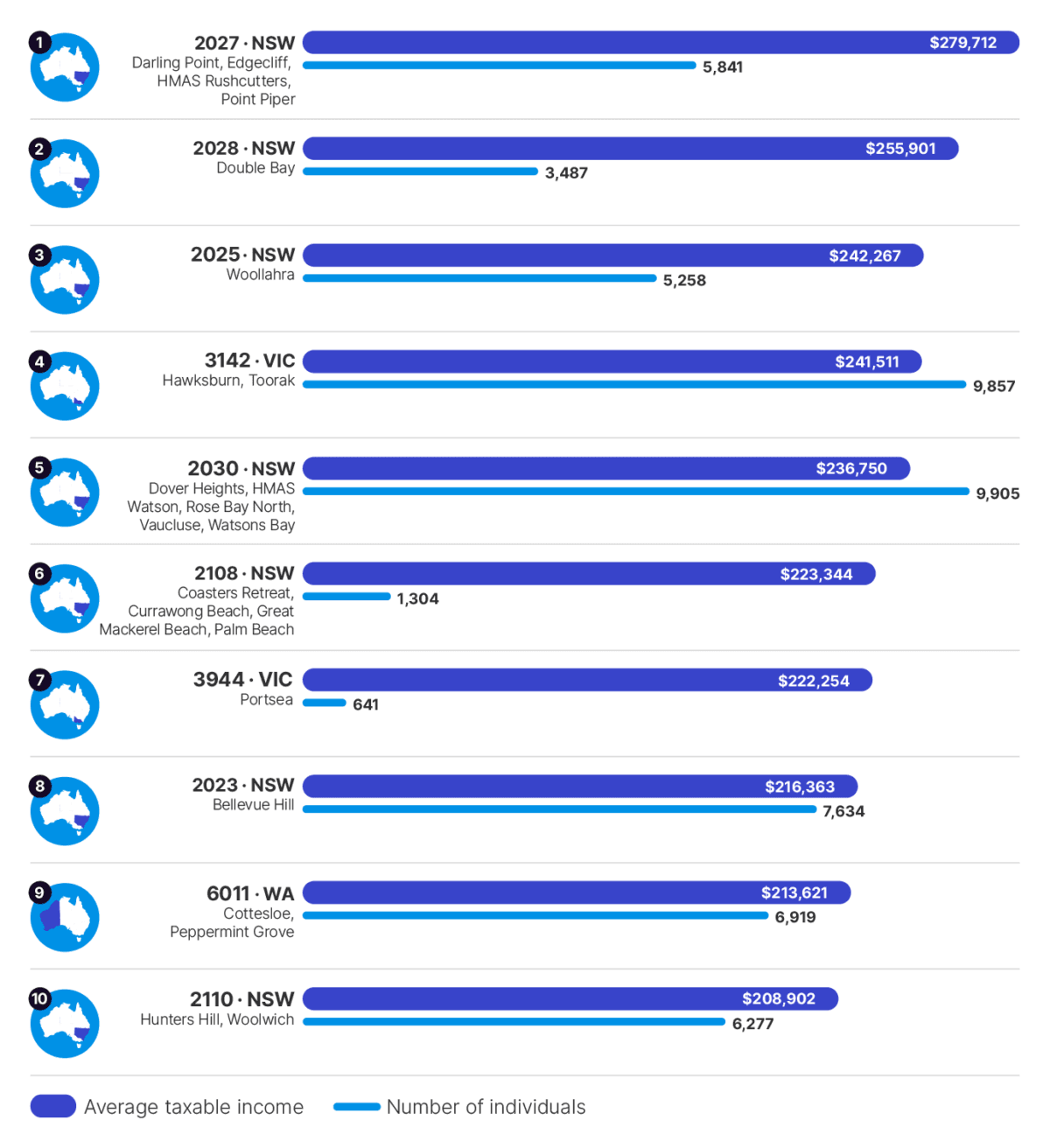
The highest average taxable income in the country was reported in postcode 2027—covering Point Piper, Darling Point, Edgecliff, and HMAS Rushcutters—with residents earning an average of $279,712 in the 2022–23 financial year.
Not far behind were two neighbouring eastern suburb postcodes: Double Bay (2028) with $255,901 and Woollahra (2025) with $242,267.
Victoria’s contribution to the top end of the list included the inner-eastern Toorak and Hawksburn (postcode 3142) in fourth place, averaging $241,511, and the seaside enclave of Portsea (3944) ranking seventh with $222,254.
Student Suburbs Comprise Lowest Income Earners
While Sydney and Melbourne’s wealthiest suburbs continue to soar, unsurprisingly, postcodes anchored by universities rank at the opposite end of the income scale.Newcastle’s Callaghan campus (postcode 2308), which includes students from the University of Newcastle, recorded the lowest average taxable income in the country at $20,878.

Medical Profession the Highest Earners
From surgery suites to general practitioners, medical professionals continue to dominate Australia’s top income bracket.Surgeons have once again emerged as the country’s highest-paid professionals with an average taxable income of $472,475 across a small pool of 4,247 individuals.
Anaesthetists followed closely at $447,193 (3,658 individuals), while financial dealers (stockbrokers) came in third with $355,233 spread across 5,147 individuals.
The rest of the top 10 featured internal medicine specialists ($342,457), psychiatrists ($288,146), other medical practitioners ($259,802), mining engineers and legal professionals (both at $206,408), CEOs and managing directors ($194,987), and financial investment advisers ($191,986).
10 Million Australians Claimed Work Expenses
The data set revealed that over 16 million Australians submitted tax returns in 2022–23.Of those, 10.3 million individuals claimed a collective $28.3 billion in work-related deductions—amounting to an average of $2,739 per person.
Companies Paid More Tax
Company tax receipts increased significantly, climbing 9.2 percent to $140 billion compared to $128 billion in the previous year. The mining sector was responsible for the lion’s share—39 percent—of net company tax, with its contribution rising from $42.3 billion to $54.4 billion over the period.Millionaires Claim Major Tax Deductions
Among the ATO’s most surprising revelations was the number of ultra-high-income individuals who paid no tax at all.In 2022–23, 91 Australians with income exceeding $1 million managed to reduce their tax bills to zero through legal deductions.
These high-income earners claimed $390 million in total deductions. A significant portion—$291 million—came from just 19 individuals who donated to tax-deductible charities, averaging roughly $15.4 million each.
In addition, this group claimed $62.8 million to cover the cost of managing their tax affairs—an average of $690,815 per person.