This copy is for your personal, non-commercial use only. Distribution and use of this material are governed by our Subscriber Agreement and by copyright law. For non-personal use or to order multiple copies, please contact The Epoch Times Reprints.

The Epoch Times
The Epoch Times
AD
The Epoch Times
Australia News

Australian Business Insolvency Rate Stabilises, But Remains at High Levels: Report

CreditorWatch CEO Patrick Coghlan said new data indicated that Australia might have passed the peak of insolvency but future outlook remained uncertain.
Google LogoMark Us Preferred on Google
Australian Business Insolvency Rate Stabilises, But Remains at High Levels: Report
People enjoy dining at cafes and restaurants in Melbourne, Australia, on June 1, 2020. Daniel Pockett/Getty Images
Alfred Bui
Alfred Bui
7/22/2025|Updated: 7/23/2025
0:00

Australia’s business insolvency rates remain high in 2025, with restaurants and construction enterprises being the most affected by economic strain.

New data from the credit reporting company CreditorWatch revealed that 14,716 Australian businesses became insolvent in the 2025 financial year.

This figure represented an annual increase of 33 percent and accounted for 0.6 percent of the total number of operating businesses in the 2024 financial year.

Amid the overall elevated trend, insolvencies have slowed down in recent months, with the June figure remaining 10 percent below the November 2024 high.

In addition, there have been improvements in the cash flow situation of many businesses.

Business-to-business trade payment defaults dropped 6.5 percent in June 2025, the lowest level of reported invoice defaults since July 2024 and 25 percent lower than the high recorded in December 2024.

Related Stories
The Epoch Times
Australia’s Jobless Rate Edges up to 4.3 Percent, the Highest Point Since the Pandemic
The Epoch Times
Cost of Living a ‘Handbrake’ on the Birth Rate in Major Australian Cities

CreditorWatch CEO Patrick Coghlan said the data indicated that Australia might have passed the peak of insolvency.

However, he noted that the business environment was still highly uncertain.

“The decline in trade payment defaults is a promising signal that business cash flow pressures may be easing, but with insolvencies still running 33 percent above 2024 financial year levels, and particularly elevated in hospitality and construction, I’m not getting too excited just yet,” he said.

“The sharp rise in closures across sectors traditionally seen as more stable—like Healthcare and education—underlines the breadth of the economic strain.”

The Australian Capital Territory reported the highest rate of business closure at 5.55 percent (up from 4.6 percent), followed by New South Wales at 5.3 percent (up from 4.4 percent), and Queensland at 5.2 percent (up from 4.4 percent).

Restaurants and Construction Firms At Highest Risk

Among the sectors, construction and hospitality reported the highest share of all insolvencies at 20 percent and 17 percent, respectively.

Overall, 1 in 50 (2.2 percent) of accommodation and food services businesses were unable to pay their debts.

While the number of insolvent construction firms topped the chart (3,595), they accounted for only 0.8 percent of all businesses in the industry.
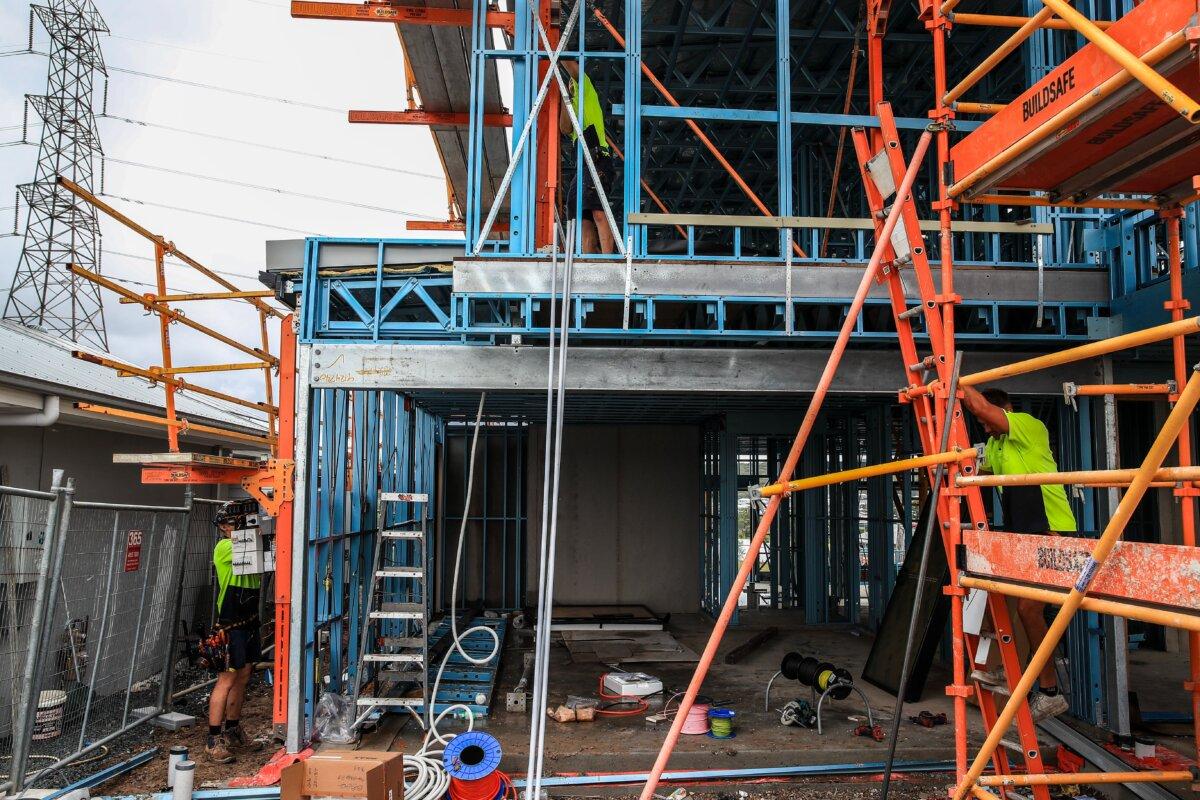
Construction workers at a building site in Lake Macquarie, Australia, on March 24, 2024. (Roni Bintang/Getty Images)
Construction workers at a building site in Lake Macquarie, Australia, on March 24, 2024. Roni Bintang/Getty Images

The utilities and mining sectors were also among the top, with insolvency shares of operating businesses reaching 2 percent and 1.7 percent, respectively.

On the other hand, agriculture, farming and fishing had the lowest insolvency rate as a share of operating businesses at 0.1 percent, reflecting the strong performance of the sector in previous seasons.

A notable trend was the sharp rise in insolvency rates in the education and healthcare sectors, which soared by 74 percent and 71 percent, respectively, compared to the previous financial year.

According to CreditorWatch, the increases were unusual, given that the two industries had received significant government support.

“Changes to immigration and foreign student policies are likely impacting the education and training sector,” the report said.

Uncertain 2026 Outlook

CreditorWatch pointed out that the outlook for the 2026 financial year was not so optimistic for Australian businesses.

A major concern is the high input costs that remain elevated despite a slowdown in inflation.

While there have been signs of further interest rate drops in 2026, high uncertainty continues to remain with the global economic conditions and the Trump administration’s tariff policies.

“While Australia is not directly impacted as much as many other countries, given the U.S. is a small export market for us, large indirect linkages are present via the large Asian economies, which are our largest export markets,” the report said.
Google LogoMark Us Preferred on Google
Alfred Bui
Alfred Bui
Author
Alfred Bui is an Australian reporter based in Melbourne and focuses on local and business news. He is a former small business owner and has two master’s degrees in business and business law. Contact him at [email protected].
Author’s Selected Articles
Australia Will Struggle to Develop All 31 of Its Critical Mineral Reserves, Inquiry Told
Jun 29, 2026
Australia Will Struggle to Develop All 31 of Its Critical Mineral Reserves, Inquiry Told
Australia’s Green Transition Bumps up Against a New Hurdle: Water
Jun 29, 2026
Australia’s Green Transition Bumps up Against a New Hurdle: Water
Climate 200-Backed MPs Launch New ‘Centrist’ Political Party in Australia
Jun 24, 2026
Climate 200-Backed MPs Launch New ‘Centrist’ Political Party in Australia
Labor Amends Tax Overhaul Amid Backlash From Small Businesses, Start-Up Community
Jun 18, 2026
Labor Amends Tax Overhaul Amid Backlash From Small Businesses, Start-Up Community
AD
Add to My List
Save
The Epoch Times
Copyright © 2000 - 2026 The Epoch Times Association Inc. All Rights Reserved.