Australia has added more public servants to the workforce in the past financial year, with the increased volume along with pay rises costing taxpayers a quarter of a trillion dollars, or $249.5 billion (US$162.53 billion).
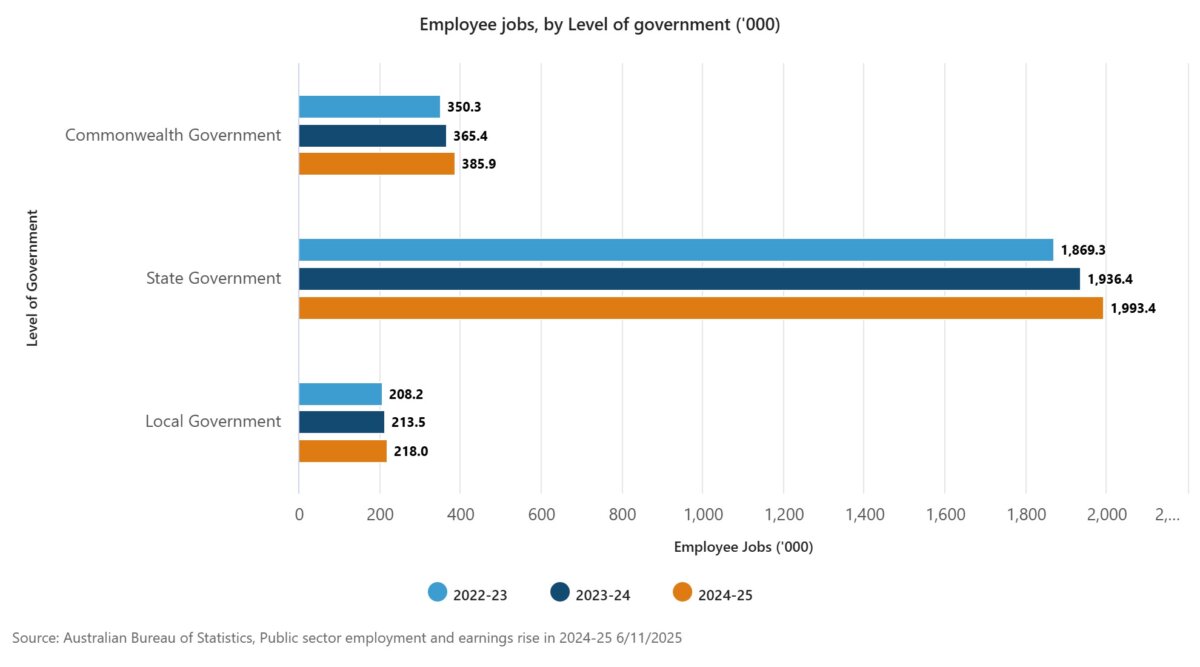
The federal government’s workforce grew by 5.61 percent, while state and territory government numbers rose 2.94 percent last year.
Local governments grew the least, at 2.11 percent.
In terms of workforce size, however, the combined eight states and territories—at 1,993,400 personnel—dwarf both local government (218,000) and the Commonwealth (385,900).
Averaged across the three sectors, public sector jobs rose 3.3 percent between June 2024 and June 2025, according to Sean Crick, Australian Bureau of Statistics (ABS) head of labour statistics.
“State government continued to be the largest employer of public sector employees, making up 77 percent of [the total]. This was followed by the Commonwealth government (15 percent) and local government (8 percent).”


The combination of more employees and wage rises won in negotiations over new enterprise agreements pushed up the government wages bill by 7.6 percent.
How Much Did Salaries Increase By?
Local governments had the lowest increase in salaries at 6.88 percent to $17.6 billion, compared with a 7.3 percent rise the year before.The pay of state and territory government workers rose by 7.32 percent, accounting for $191.1 billion. In 2023/24, they also received a rise of 7.6 percent.
Federal employees gained an additional 9.48 percent, bringing their salary bill to $40.9 billion, on top of the 10 percent bump they got the previous year.
Across all three levels of government, the rise averaged to 7.6 percent, slightly less than the 8 percent annual growth seen in 2023/24.
Dividing the number of employees in each sector by the total salary figures gives federal employees an average income of $105,877 a year, while those in local government average just $80,631.
State and territory government workers fall in the middle, with an average gross income of $95,855.
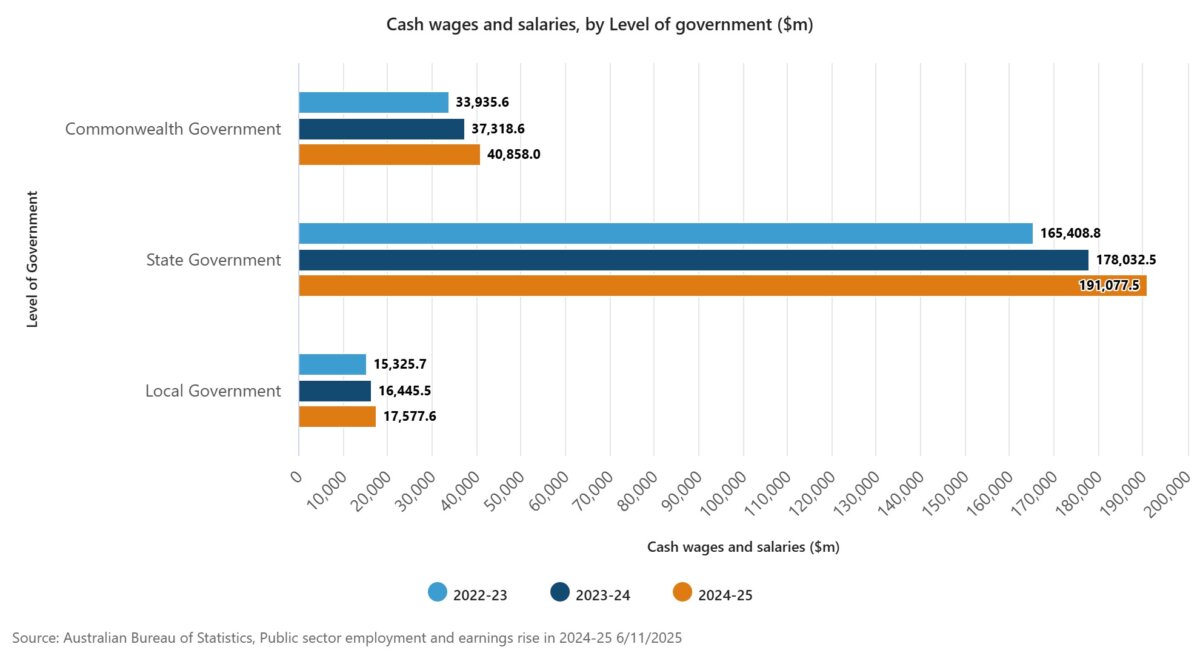
“The rise in the public sector wage bill reflected a combination of underlying wage growth driven by new enterprise agreements and growth in employment,” Crick explained.
‘The public sector is concentrated in three key industries: public administration and safety, education and training, and health care and social assistance. Together, these three industries account for nearly 90 percent of public sector employment and wages.
“Of these three industries, public administration and safety had the highest growth in both employee jobs and wages,” he said.

It is a broad classification that covers everything from policy advisers to police officers and includes anyone responsible for enforcing law and regulations, from food hygiene inspectors to prison officers and state prosecutors.
Jobs within that category rose by 31,200 (3.7 percent) to 880,600 between June 2024 and June 2025. This was followed by healthcare and social assistance, which rose by 26,300 roles (4.1 percent), to 668,600.
Education and training increased by 14,400 employee jobs (1.9 percent) to total 768,300.
As a result of additional numbers being added to public administration and safety roles, wages for that sector increased by $6.8 billion (8.1 percent) to $90.2 billion, meaning workers in those jobs account for 36.15 percent of the entire public sector salary bill.

This was followed by healthcare and social assistance, which increased $4.5 billion (7.3 percent) to $66.2 billion, or 26.53 percent of the total. Education and training increased by $3.5 billion (6.0 percent) to $61.4 billion, accounting for 24.61 percent of total government salary payouts.
Concerns About Dominance of Public Sector Jobs in the Economy
In response to the data, the free market Institute of Public Affairs released a statement warning that the Australian economy was increasingly dominated by taxpayer-funded jobs.“While frontline public sector jobs play a key role in maintaining a civil society, many bureaucratic roles are inefficient and counterproductive. These roles restrict, rather than expand, economic output, and are an increasing burden on taxpayers,” said senior research fellow Kevin You.
“Worryingly, even the private sector is now increasingly reliant on taxpayer funding, with renewable handouts, consultancy fees, and subsidies for the support sector propping up private sector growth.”
If that figure is combined with those receiving some type of welfare support, then 50 percent of the Australian voting population is now reliant on public money.
“A vast network of lobby groups and organisations has evolved to safeguard and increase social spending,” the report pointed out.
“The growth of government becomes self-sustaining as it nourishes the powers that demand it continue.”