The Albanese Labor government will spend an extra AU$14 billion (US$10 billion) on defence over the next four years, a figure that brings its commitment closer in line with expectations from the Trump administration.
The 2026 National Defence Strategy, released this week, outlines an additional $53 billion over the next decade—a rate of increase that is more rapid than what was promised in the 2024 version of the same document.
It sets spending at about 3 percent of gross domestic product (GDP) by 2033, above the previous 2.3 percent target.
The increase brings the total additional investment to $117 billion over the decade to 2035/36, with $30 billion of that added over the next four years.
“The main concern the United States should press with Australia, consistent with the president’s approach, is higher defence spending,” Colby said at the time.
“Australia is currently well below the 3 percent level advocated for NATO by NATO Secretary General Rutte, and Canberra faces a far more powerful challenge in China.”
Launching the document at the National Press Club on April 16, Defence Minister Richard Marles said Australia was now spending more than “any other equivalent, like-minded country in the Indo-Pacific and more than most countries of NATO, [and] more than all the G7 countries in NATO, with the exception of the United States.”Spending Calculated Differently
However, the new commitment sits alongside a redefinition of what constitutes defence spending, now calculated in the same way NATO does—a formula that includes spending on peripheral items such as defence force pensions and housing.
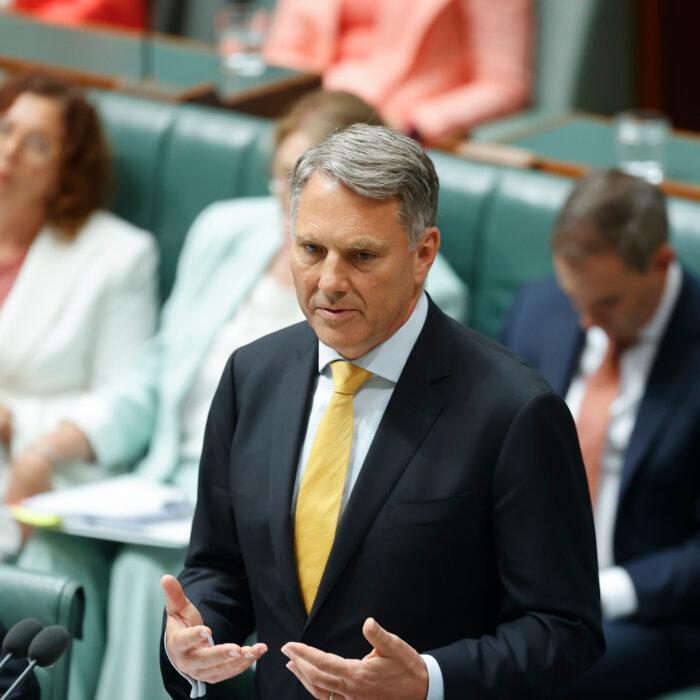
Calculated on that basis, Australia’s current commitment comes to 2.8 percent of GDP.
Marles defended the switch to the NATO measure several times, saying it was a logical way “to compare apples with apples” and refusing to provide an equivalent figure for earlier strategies.
Some Projects to be Cancelled, Private Equity Expected
Within the additional spending, about $5 billion is being “reprioritised” to new projects such as drones, but Marles refused to give specifics on which initiatives would be cut, citing commercial confidence.He also admitted that the cost of AUKUS had risen, but wouldn’t go into details.
However, the National Defence Strategy shows spending on the submarine programme will have totalled between $71 billion and $96 billion by 2036, when two Virginia-class submarines are due for delivery.
China Threat Still Real: Minister
The minister repeatedly emphasised the strategic importance of U.S. engagement in the area.“There is no world in which you create a balance of power within the Indo Pacific without a continued American presence,” he said, noting that the deputy commanders in the U.S. Army, Navy and Air Force in the Pacific were all Australians.
“We are throughout the Indo-Pacific Command, and that relationship, which is at the heart of the alliance, is fundamental to Australia’s own national security and national defence. We make that point really clearly.”
He pointed to the continued threat from the Chinese Communist Party (CCP), which he said was deploying its navy farther afield in the Pacific, Southeast Asia, and the Indian Ocean.
Iran War ‘Complicates’ the Situation
The war in the Middle East, and the shift of American armed forces from the Pacific to that region “greatly complicates the global strategic landscape,” Marles said, but Australia “very much supports the strategic objective of denying Iran a deployable nuclear weapon.“What this conflict bears out, and Ukraine does as well, is that we live in a really interconnected world, and one can’t intelligently focus on the Indo-Pacific and all the challenges there without understanding how we mesh into the rest of the world and how conflicts elsewhere can impact us,” he said.
That would take spending as a share of GDP to 2.5 percent, with a further pledge to reach 3 percent within a decade.
Responding to Marles announcement, Opposition Leader Angus Taylor told reporters, “You don’t defend any Australian by changing the accounting rules. You do it by spending on the capability we need in the most dangerous times we’ve seen—according to the government—since the Second World War.”