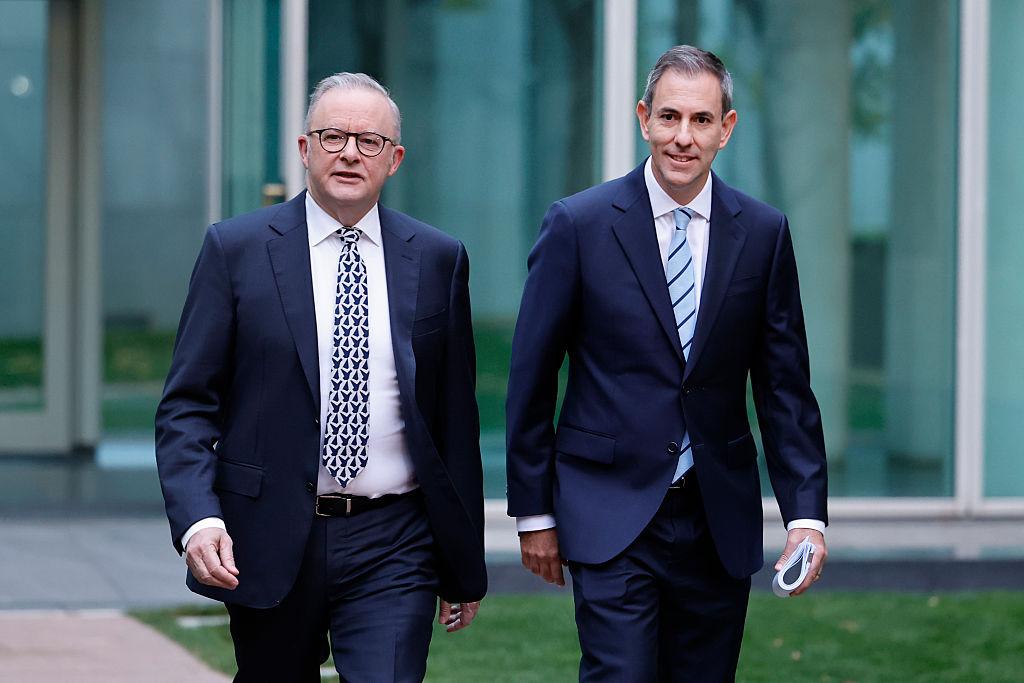
Prime Minister Anthony Albanese has urged Australia to step up as a stabilising middle power in an Indo-Pacific he says is becoming more contested and unpredictable.
Speaking at the APEC Study Centre in Melbourne, Albanese—without directly naming China—warned the region was entering a more volatile phase driven by cyber operations, military build-ups and escalating strategic rivalry.
“Strategic competition in our region is real,” he said, describing the Indo-Pacific as “more fragmented and uncertain” than it has been in decades.
He argued that countries such as Australia, neither superpowers nor minor players, have a critical role in managing risk and preventing tensions from escalating.
“Middle powers like Australia can help ensure competition does not tip into conflict,” he said. “We can help lower the temperature, not raise it.”
The comments came as Australia confronts its most serious cyber intrusions in years, with ASIO warning that Chinese state-backed hackers are probing critical infrastructure for potential “high-impact sabotage.”
ASIO revealed last week that groups linked to Beijing, including Salt Typhoon and Volt Typhoon, had targeted electricity, telecommunications and other essential networks in both Australia and the United States.
Director-General Mike Burgess said espionage and foreign interference had already cost the national economy $12.5 billion in the past year.
APEC’s Expanding Role in Regional Stability
Albanese said economic forums such as APEC were becoming essential stabilising structures as tensions deepen.
He noted that APEC remains one of the few spaces where the United States, China, Russia, and Indo-Pacific nations continue to meet on equal terms, even as broader geopolitical friction escalates.
Last month’s meeting between President Donald Trump and Chinese Communist Party leader Xi Jinping on the sidelines of the APEC summit showed that trade-focused platforms still provide opportunities for de-escalation.
“It demonstrated how the habits of dialogue built through trade can help reduce tensions,” he said.
Albanese said trust underpins both economic cooperation and regional calm.
“For economic benefits to flow at home, you need to be able to trust partners overseas,” he said.
He noted that three-quarters of Australia’s trade is with APEC economies and “one in four Australian jobs depends on trade.”
The Opposition has often criticised Albanese for continuing diplomatic engagement with Beijing despite warnings about its behaviour, but he defended the approach as essential middle-power diplomacy.
“Our responsibility is to step up, to keep dialogue open, and to reflect the aspirations of our region,” he said.
A Broader Regional Footprint
Albanese said Australia’s recent diplomatic moves reflect a deliberate push to reinforce its middle-power role.
He pointed to a near-completed security treaty with Indonesia, describing it as a significant step forward for the two countries that have become increasingly aligned on regional security.
He also highlighted the Pukpuk Treaty with Papua New Guinea, which formally elevates PNG to alliance status—only Australia’s third alliance in more than 70 years.
Albanese said Australians should be proud that their closest neighbour has become “our newest ally,” calling the pact a “historic moment” for both nations.
Australia has also expanded defence and technology cooperation with India and Singapore, part of a broader effort to build a resilient network of regional partners.
Albanese said these new and strengthened relationships give Australia more capacity to respond to both economic shocks and security pressures.
Leadership, he argued, is built on predictability rather than posturing.
“When we act in pursuit of Australia’s national interest, in line with Australian values, without arrogance or bluster, we can provide leadership to others,” he said.
Trade, Industry and a ‘Decisive Decade’
Albanese also emphasised the domestic importance of strong regional partnerships.
He said APEC’s growth, from 12 economies in 1993 to 21 economies today, representing more than 60 percent of global GDP, had shaped Australia’s economic resilience.
He pointed to his recent visit to POSCO Steelworks in Korea, the country’s largest commercial customer, describing its $18.2 billion trading relationship with Australia as “jobs and industry on a mind-boggling scale.”
He said holding a piece of zero-emissions steel at the plant symbolised how Australian minerals and technology partnerships are driving future energy and industrial opportunities.
Albanese also highlighted the APEC Centre of Excellence for Paperless Trade, a collaboration with Singapore, designed to streamline exports and strengthen digital supply chains.
He said Australia was entering a “decisive decade” shaped by artificial intelligence, the clean-energy transition, and shifting global trade patterns, and warned against inward-looking policies.
“We cannot find our prosperity, or our place in the world, by only looking inward,” he said. “Our future depends on the partnerships we build across this region.”