Oil and gas companies in Alberta that fail to pay municipal property taxes on time could risk losing their operating licences under a new proposal.
It’s one of the suggestions in the Property Tax Accountability Strategy released this week by the province and the Rural Municipalities of Alberta to tackle the persistent problem of unpaid property taxes from some members of the energy industry.
Alberta’s rural communities were owed more than $250 million as of last year, according to the 47-page report presented March 16 by Municipal Affairs Minister Dan Williams.
Williams told reporters at a press briefing in Edmonton that while the report offers a possible way forward, it would be overly optimistic to expect all current debts to be paid.
“The majority of past arrears are fundamentally unrecoverable,” Williams said at the start of the spring convention for the Rural Municipalities of Alberta (RMA). “We can’t go back and collect from companies that don’t exist anymore.”
He said the policies outlined in the strategy would give the provincial energy regulator “real teeth” in its enforcement capabilities.
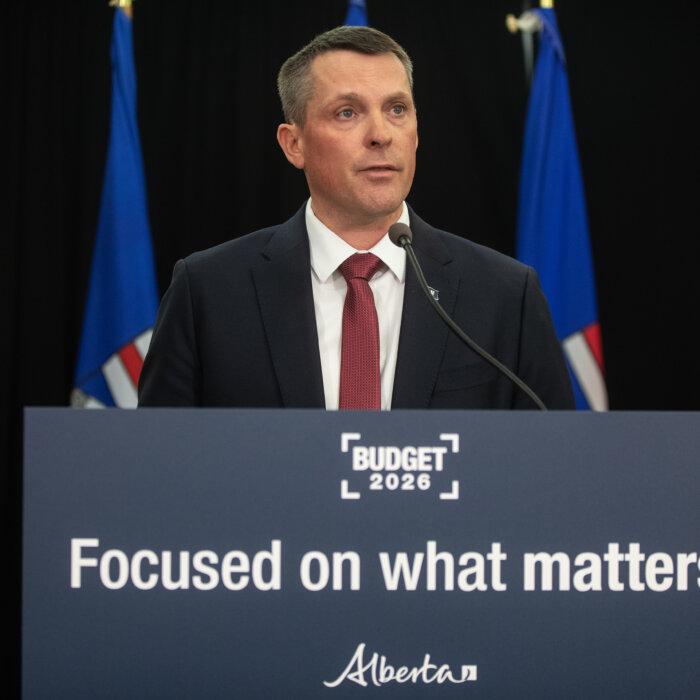
“There’s no reason we can’t have strong enforcement going forward, and that’s what this is about,” he said.
RMA President Kara Westerlund, also speaking at the convention, said she hopes at least some of the $250 million can be recouped, pointing to the financial implications of such lost opportunities for the 69 counties and municipal districts represented by the group.
“We are facing, probably by the end of 2026, a close to $25 billion deficit in infrastructure needs across rural Alberta,” said Westerlund, a councillor in Brazeau County. “We’re talking roads, bridges, culverts, wastewater, and water.”
The report suggests that requiring oil and gas companies to pay property taxes on time to obtain an operating licence is one example of the “teeth” the province could grant to the Alberta Energy Regulator (AER).
“While the AER can take certain actions in response to non-payment under specific circumstances, municipal tax obligations are not formally embedded within the licensing regime itself,” the report says. “By making tax compliance a fundamental requirement of responsible resource development, this approach seeks to strengthen both prevention and recovery of tax arrears.”
Report Recommendations
The report, which includes 17 recommendations, also urges the province to prohibit companies from securing new leases or wells if they are not in good standing on their property taxes. Currently, only companies owing more than $20,000 are barred from acquiring new leases.Another recommendation would prompt the province to implement a financial aid program that municipalities could access when facing substantial payment deficits from one or more businesses. Another urges improved data sharing between municipalities, the province, and Alberta’s energy regulator.
Williams told reporters the government plans to evaluate the proposals over the next few months. He said the recommendations could be implemented quickly if the province chooses to move ahead with them because most do not require legislative action.
Landowners and municipalities have also criticized Alberta’s energy regulator for failing to take action against non-compliant companies, criticism the regulator’s CEO Rob Morgan says likely stems from a misunderstanding of current policy.
“The regulator follows policy and, up to this point in time, it was a consideration—unpaid municipal taxes and taking enforcement action—but it wasn’t a sole element of that,” said Morgan, who spoke alongside Williams and Westerlund. “Changes like this allow us then to take more action where it’s appropriate.”
Opposition NDP municipal affairs critic Rob Miyashiro said in a video uploaded to Facebook that it was “about time” the province tried to address the issue, but added he wasn’t confident the problem will be solved.
The Canadian Press contributed to this report.