This copy is for your personal, non-commercial use only. Distribution and use of this material are governed by our Subscriber Agreement and by copyright law. For non-personal use or to order multiple copies, please contact The Epoch Times Reprints.
Workers unload pipe to start right-of-way construction for the Trans Mountain Expansion Project, in Acheson, Alta., on Dec. 3, 2019. The Canadian Press/Jason Franson
The Alberta government says it will introduce legislation to fast-track major projects by setting a 120-day approval deadline.
The province says the accelerated process would improve coordination between government and regulatory bodies, and provide industry with the certainty needed to make investments.
“Every delay impacts jobs, investment and the opportunity Alberta needs,” Alberta Premier Danielle Smith said in a March 23 statement. “Setting a firm 120-day approval timeline brings discipline to the process, restores investor confidence and ensures Alberta is one of the most competitive places in the world to build major energy projects.”
The move comes after Smith directed Alberta Energy Minister Brian Jean in a letter last October to develop an “expedited 120-day provincial approval process for priority projects designated to be in the provincial interest.”
“We cannot afford to spend years waiting for major project approvals after consultation and environmental assessments are completed,” Jean said in a March 23 post on X. “In an increasingly unstable global environment, there is a growing need for a reliable and responsible energy producer. Taking this step shows the world Alberta is ready to help meet this demand.”
The government said indigenous consultation and environmental protections “will remain a priority and integral to the process” after the new expedited timeline is implemented.
The legislation would “send a clear, positive signal to investors that Alberta is committed to getting major projects built,” the government said, without specifying which projects the proposed legislation would affect.
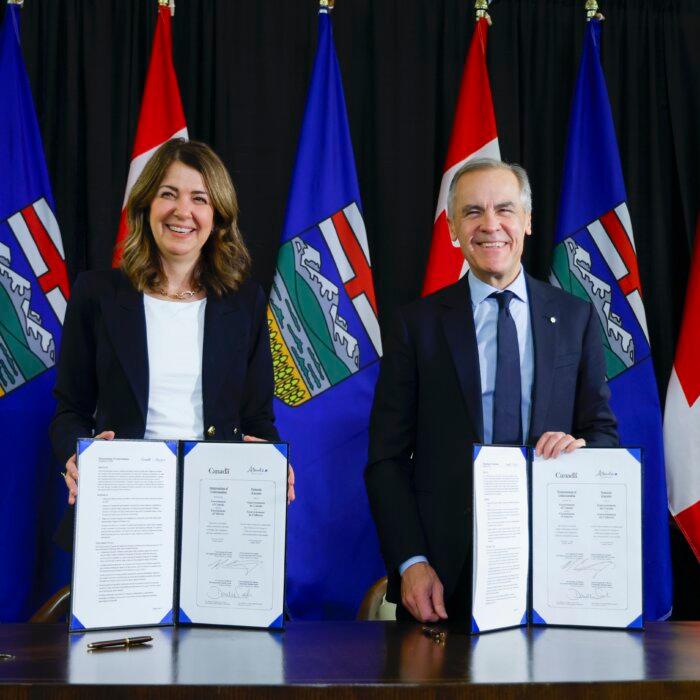
The move also follows a tentative agreement the province signed with Ottawa earlier this month to streamline the approval process for major projects. The agreement in principle will implement a “one project, one review” approach to assess potential impacts of major projects, especially those concerning the environment, the province said in a March 6 press release.
A preliminary version of the agreement indicated projects within Alberta’s jurisdiction would rely on the province’s regulatory processes, and Alberta’s process will be integrated with Ottawa’s for projects that involve federal land and jurisdiction.
Prime Minister Mark Carney said the new agreement represents the next phase of the federal government’s partnership with Alberta following the energy deal established last year.
Ottawa and Alberta signed a memorandum of understanding (MOU) last November to pave the way for a new West Coast oil pipeline if a private proponent comes forward by allowing for one or more privately financed pipelines.
The agreement also commits Ottawa and Alberta to curb redundant environmental reviews under the Impact Assessment Act, which Alberta has long criticized as impeding major projects such as pipelines.
Ottawa and Alberta have until April 1 to reach an agreement on an industrial carbon price and methane emissions, as pledged in the MOU last year. As part of securing the MOU with Ottawa, Alberta agreed to raise the province’s industrial carbon tax and reduce methane emissions.
Alberta said negotiations are “ongoing” between the provincial and federal governments, and the province is “confident” an agreement that supports Alberta’s ability to boost oil and gas development will be reached.
Before the agreement is finalized, the Impact Assessment Agency will post the draft agreement for a public comment period of 21 days. The feedback will then be reviewed and the agreement between Alberta and Ottawa will be finalized.
Jennifer Cowan and Matthew Horwood contributed to this report.