Alberta will conduct public consultations this fall on integrating nuclear power into its energy portfolio, as it strives to find better ways to power remote rural areas with high energy demands, Premier Danielle Smith says.
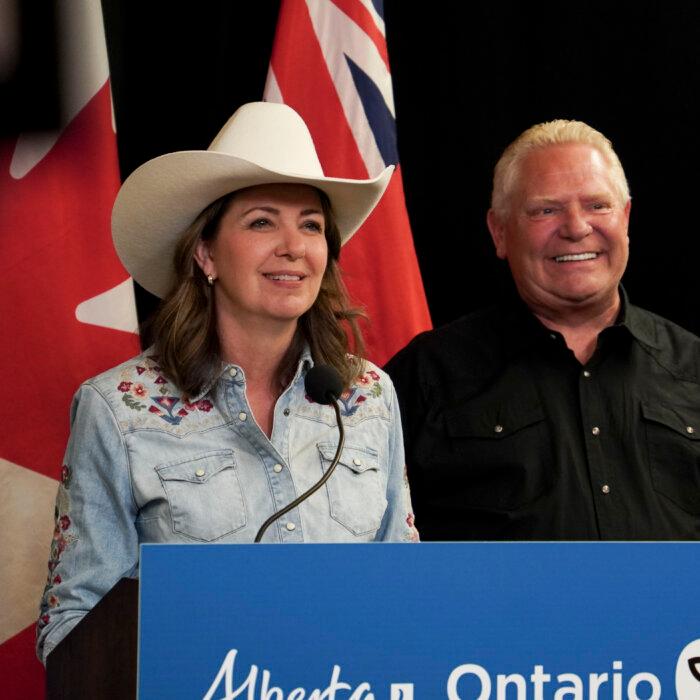
The topic of constructing reactors in Alberta has long been under discussion, Smith said during a July 7 press conference hosted with Ontario Premier Doug Ford.
Alberta is interested in units capable of supplying power to the province’s oilsands operations rather than relying on natural gas, a source that emits greenhouse gases, she noted.
Discussions are set to begin anew in September or October, when Alberta’s parliamentary secretary for affordability and utilities Chantelle de Jonge will conduct nuclear consultation sessions.
“We want to talk to Albertans, because it’s new for us,” Smith said alongside Ford after the pair signed two interprovincial trade agreements.
“Small modular reactors probably make the most sense at rural, remote sites that also have a very heavy energy use. Our oilsands projects are perfect for it, if you can get both the power and steam, power and heat.”

Small modular reactors (SMRs) produce approximately one-third of the power generated by conventional nuclear power plants.
Ontario Power Generation (OPG) is constructing an SMR at its Darlington plant an hour east of Toronto, making it the first power company in North America to integrate such a facility into the electrical grid.
The estimated construction cost of the first reactor is $7.7 billion, with work set to start this year and conclude by 2029 with connection to the grid in 2030. There are also plans to develop three more SMR units at the site.
Ford told reporters that while SMRs do not directly employ a large number of workers, they could provide the opportunity for technology giants such as Amazon or Google to establish electricity-demanding artificial intelligence data centres.
“And that’s where the jobs are created because they just suck an endless amount of energy,” said Ford.
“These data centres are the way of the future. We’re leading the world and we’re going to make sure we share that technology right across the country.”
SMR Market
At least one American developer of SMRs has its sights on Alberta as a potential growth market.X-Energy, a private American nuclear reactor and fuel design engineering company, is exploring opportunities to contribute to Alberta’s grid in general. It also wants to connect with steam-assisted gravity drainage oilsands initiatives that extract bitumen from deep underground via wells instead of mining it.
OPG is looking at using X-Energy plants at industrial sites in Ontario and a much larger conventional plant is also in the works in northwestern Alberta.
Energy Alberta is developing a power station in the Peace River region, which is expected to feature two to four Candu reactors, with a total capacity reaching up to 4,800 megawatts. This would account for as much as one-quarter of the current electricity generation in the province.
“When we first started to talk about a Candu reactor … we initially thought, ‘Wow, that would swamp our power grid,’” Smith said. “And now with all the demands for AI data centres, we’re thinking, ‘Hmm, that’s maybe exactly what we need.’”
A preliminary project description was submitted in April for the Peace River Nuclear Power Project, initiating the federal review process.
Interest in Nuclear
Alberta’s interest in nuclear power dates back several years. The province joined Saskatchewan, Ontario, and New Brunswick in a Memorandum of Understanding in 2021 to collaborate on the development of nuclear power, specifically focusing on SMRs.The partnership seeks to promote the implementation of SMRs in Canada to help support each of the province’s need for cost-effective, dependable, and sustainable power grids.
An interprovincial strategic plan for SMR development was released in March 2022.
Alberta also signed a bilateral agreement last May with Saskatchewan to work together on nuclear power generation in a bid to obtain affordable and sustainable electricity grids by 2050. The agreement adds areas of interest beyond SMRs such as industrial decarbonization and grid reliability.
SMRs are much more compact and offer greater versatility in their applications compared to traditional nuclear reactors, according to a government of Ontario SMR factsheet. SMRs are small enough to be built in a factory and shipped by truck, rail, or boat.
A traditionally sized nuclear reactor generates roughly 600 to 1,000 megawatts of energy, while small modular reactors produce up to 300 megawatts, which is still enough to power a village or small city.
SMRs can also be linked to multiple units when more power is required and are able to supply electricity for homes and business, as well as heat or steam for industrial processes.
The Canadian Press contributed to this report.