This copy is for your personal, non-commercial use only. Distribution and use of this material are governed by our Subscriber Agreement and by copyright law. For non-personal use or to order multiple copies, please contact The Epoch Times Reprints.
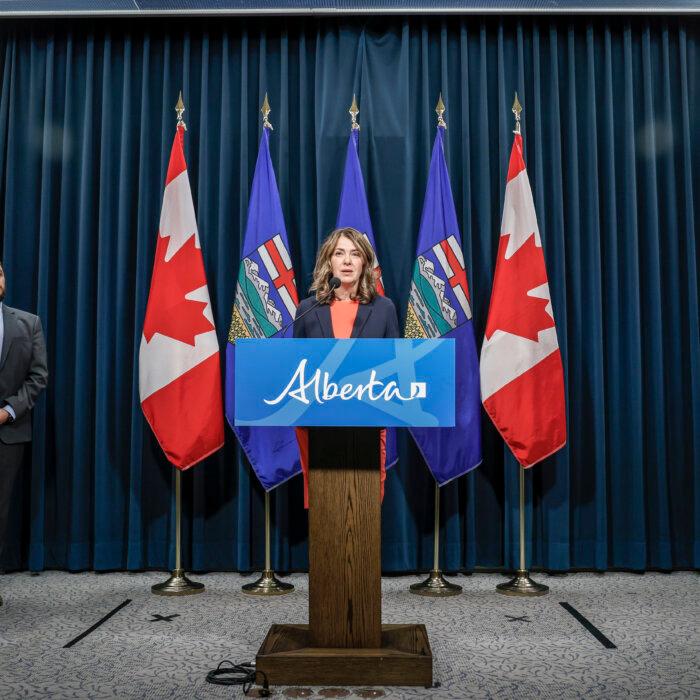
Alberta Premier Danielle Smith (R) stands with Minister of Education and Childcare Demetrios Nicolaides following a swearing-in ceremony in Calgary, on May 16, 2025. The Canadian Press/Jeff McIntosh
Alberta’s teachers union has announced its intention to take legal action following the passage of back-to-work legislation by the provincial government.
The teachers strike started on Oct. 6 after talks broke down between the Alberta Teachers’ Association (ATA) and the Teachers’ Employer Bargaining Association (TEBA), which bargains on behalf of school boards. Teachers said they were looking for a salary increase, and wanted the province to address classroom “complexity” issues.
Premier Danielle Smith’s government introduced the Back to School Act on Oct. 27, and the bill passed third reading early on Oct. 28. The back-to-work legislation requires royal assent from Lt.-Gov. Salma Lakhani to become law and will require teachers to return to the classroom once enacted.
The legislation includes hefty fines for both the Alberta Teachers’ Association and its members if they defy the back-to-work order, with fines reaching up to $500 per day for individuals and $500,000 per day for the union.
The government also invoked the notwithstanding clause, which protects the act from legal challenges. The notwithstanding clause can be used by governments to protect legislation from constitutional challenges for up to five years.
The Alberta Teachers’ Association vowed in an Oct. 28 statement to “pursue all legal alternatives“ to challenging Bill 2, calling the legislation an ”egregious assault on the collective bargaining rights of teachers and, by extension, all workers.” It noted that support from other unions is expected, saying the “fight has just begun.”
The union said that while the legislation would end the strike, it does not resolve “the underfunding and deterioration of teaching and learning conditions.”
During the bill’s debate, Education Minister Demetrios Nicolaides said the provincial government faced an “undeniable moral imperative” to stop a three-week strike that he said was harming students’ social and educational development.
“This strike has moved beyond the state of inconvenience,” Nicolaides told the provincial legislature.
The Opposition NDP voted against the bill, accusing Smith’s government of “unjustifiably violating the Charter-protected rights and freedoms of teachers, workers, and their unions.”
“What this government should be doing is getting back to the bargaining table with a fair offer that ends the strike properly,” NDP leader Naheed Nenshi said in an Oct. 27 statement. “Teachers should never have had to risk their own livelihoods just to stand up for themselves and their students.”
A coalition of more than 350,000 workers with other provincial unions, called the Common Front, has said there will be an “unprecedented response” to the government’s decision to invoke the notwithstanding clause.
Alberta Federation of Labour president Gil McGowan told reporters the organization is considering all options, including a strike, in support of Alberta’s teachers.
McGowan, who is also the point person for the Common Front, said in a series of social media posts, that meetings will be held to determine next steps.
Smith has previously described the Back to School Act as a “last resort” and noted during the legislature debate that the government had hoped to solve the issues through discussion.
“We came to an agreement at the table. They took it to their members. They came to an agreement a second time with enhancements to it, a $300 million enhancement to hire 3,000 more teachers, hire 1,500 more education assistants,” she said on Oct. 28.
“If that’s not what teachers wanted, that’s on the ATA leadership. What we have been asking from the beginning is for the ATA leadership to tell us what it is the teachers want and come to the table in good faith. We had hoped that that would happen through mediation. It didn’t.”
The act imposes a collective agreement previously put forward by the province and the union that teachers voted against. Under the terms, teachers will receive a 12 percent salary increase over four years, as well as the hiring of 3,000 more teachers and 1,500 more education assistants.
The three-week strike has disrupted instructional time for more than 700,000 Kindergarten to Grade 12 students across approximately 2,500 public, Catholic, and francophone schools.
The Canadian Press and Paul Rowan Brian contributed to this article.