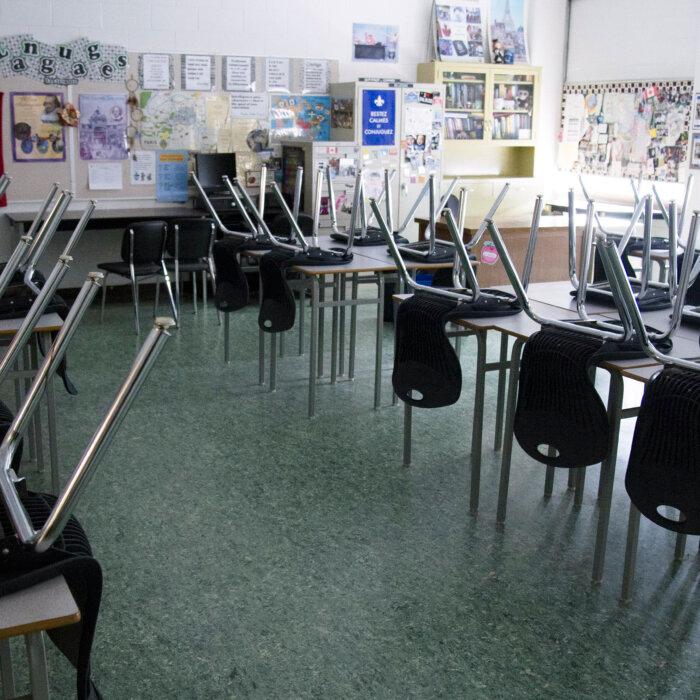
The largest teacher strike in Alberta’s history began today as 51,000 educators walked off the job amid a months-long contract dispute with the province.
The Alberta Teachers’ Association (ATA) was unable to reach a deal with the province at the bargaining table last week, leading to cancelled classes at roughly 2,500 public, Catholic, and francophone schools.
The strike interrupts class time for more than 700,000 Kindergarten to Grade 12 students as teachers protest what union president Jason Schilling described as “overcrowded classrooms” and “added workload.”
“We are striking to break the cycle and demand lasting change for future generations of students and teachers,” Schilling said in an Oct. 6 press release that cited inadequate funding and teacher supports in the face of increased student needs as a key bargaining issue.
Schilling told an Oct. 6 press conference that picket lines are not currently planned as part of the strike.
Alberta Premier Danielle Smith spoke about the strike during her weekend radio show, saying that the province is willing to negotiate and is awaiting a response from the union.

She was also critical of union representatives, saying they were not adequately explaining what teachers want.
“We’ve encouraged the ATA leadership to go back and find out what the real issues are, and then come to the table with a reasonable offer so that we can negotiate. We’ve been prepared to do that from the beginning,” Smith said during the Oct. 4 edition of “Your Province. Your Premier.”
“They’re the ones who put an arbitrary strike notice on the table, and unfortunately, at the moment, they haven’t come back to us to let us know what it would take to get a deal that their members would support.”
The offer rejected by the union on Sept. 29 included a 12 percent salary increase over a four-year period and a government commitment to hire 3,000 more teachers and 1,500 new educational assistants to tackle large class sizes and “classroom complexity pressures,” according to the province.
The deal also proposed transitioning most teachers to a unified pay grid in September 2026, which would have provided more than 95 percent of educators a wage increase of up to 17 percent. The proposed salary increase is identical to those in the recommendation rejected by teachers in May.
The union has said the strike is not only about pay, but about “the state of public education in Alberta.”
“Teachers need sustainable solutions,” the ATA press release said. “We refuse to be back in the same fight for our public education system five or ten years from now.”
Smith acknowledged that classroom “complexities” rather than wages are a major part of the problem.
“You’re not going to solve the issue of smaller classes or less complex classes, just by giving higher and higher and higher wages,” she said.
“At what point do you have so many kids with high needs that you need to add one or two or more education assistance? I think that’s where the conversation really needs to be, and unfortunately, that’s not the conversation that union leadership is bringing to the table.”
Members Vote
Nearly 90 percent of Alberta Teachers’ Association (ATA) members cast a ballot between Sept. 27 and 29, voting against the tentative agreement offered by the province.Schilling said the proposed agreement failed to meet the needs of teachers or improve student classroom conditions. He told reporters during a Sept. 29 press conference that more than 5,000 new teachers are needed, as well as supports for larger class sizes, and pay increases that better keep up with inflation.
Many students will have the option to keep up with their studies while classes are cancelled, the Calgary Board of Education (CBE) said on its website. Students can access work on online learning platforms such as D2L and Google Classroom, although teachers will not be monitoring, responding to, or assessing student work during the strike.
The school board originally announced access to the online learning platforms would be shut off, but that decision was reversed on Oct. 3
The province is also providing complimentary K-12 curriculum learning toolkits, available in English, French and French Immersion, to support students during the strike.
Smith said even though the province is making resources available for students, it’s not the same as in-class learning and she called the strike a “lose-lose-lose situation.”
“Teachers don’t win out of this because they don’t get strike pay,” she said “The parents don’t win out of this because they’re once again disrupted and trying to find child care. Students certainly don’t win out of it, because not everyone can do online learning.”
She said the province and the teachers aren’t “that far apart” when it comes to making a deal and noted that the issues could be solved during the next round of negotiations.
The union has not said when it will submit its next offer to the province.