Alberta Premier Danielle Smith has announced the creation of a provincial police force and the identity of its newly appointed chief.
Former deputy Calgary police chief Sat Parhar has been selected to head the newly established Alberta Sheriffs Police Service which will be based in Calgary, Smith announced at a July 2 press conference.
Parhar brings more than 25 years of policing experience to the role, Smith said.
“Chief Parhar has the right mix of experience and leadership to steer this new agency,” she said. “His frontline policing experience and deep understanding of Alberta’s complex and diverse public safety landscape positions him to lead the agency as it takes shape and begins its work as a new municipal policing option, keeping communities safe.”
His first responsibilities will include recruiting an executive team, as well as building connections with the existing network of Alberta law enforcement organizations to identify and deal with threats to public safety, the premier said. She did not say when the new force will be up and running, but said recruitment is a top priority.
While the new service is not intended to replace the RCMP, Smith said municipalities will have the option to contract the force for their policing requirements instead of the Mounties.
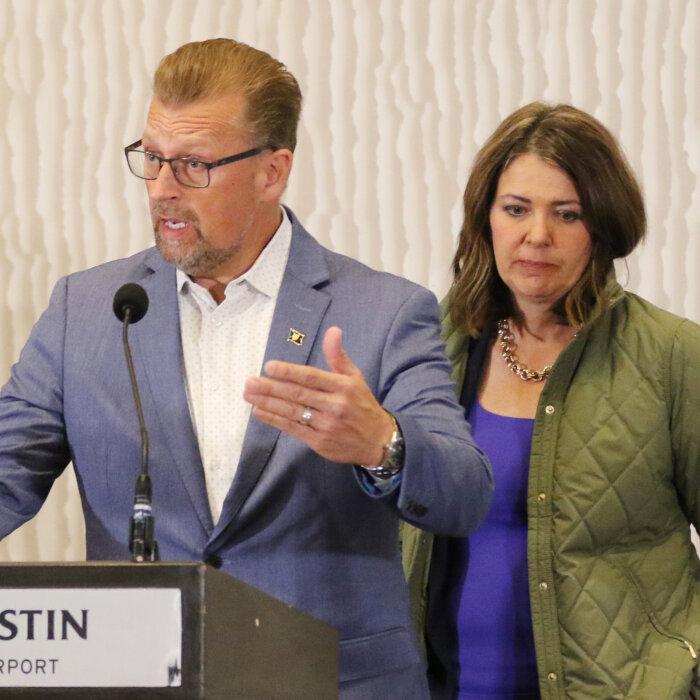

The provincial force will also assist RCMP detachments and fill in the gaps where service is sparse, Public Safety Minister and Deputy Premier Mike Ellis said.
“It’s about making sure that Alberta has the resources and flexibility to meet increasing demand for public safety, especially in rural and remote communities,” he said. “It’s about supporting existing law enforcement, and it’s about ensuring that every Albertan, no matter where they live, if somebody calls 911, we expect somebody to show up to that call, and I do not care what that uniform is.”
Filling the Gap
Ellis said establishing the force also means Alberta will be equipped to handle policing in all areas of the province should Ottawa opt to discontinue its community policing contracts in 2032, when the existing RCMP contracts across Canada are set to expire.Both Ellis and Smith said this is a very real possibility, noting that a federal government white paper released earlier this year is proposing the RCMP withdraw from contract policing to focus on larger issues such as terrorism, foreign interference, organized crime, and violent extremism.
The paper, released in March by Public Safety Canada, urges the government to establish the RCMP as “a world class, intelligence-led, federal policing organization that is anchored on the work of highly skilled investigators and multi-disciplinary teams, and focused on the most serious crimes affecting Canadians.”
The shift in approach by the Mounties means the Alberta Sheriffs Police Service can take over policing in areas currently being served by RCMP detachments, Smith said.
“Alberta’s government is preparing and acting instead of waiting and reacting,” she said. “Our goal is to put solutions in place before serious challenges develop.”
The goal of the provincial force, Smith said, is to make sure all residents “feels that they’ve got the policing that they need close to home,” adding that the province has already received “a couple” of inquiries from interested municipalities.
The new force will be a Crown corporation, but will report to a civilian oversight board rather than the provincial government.
Ellis said the province is still finalizing staffing plans for the new agency, but noted a number of retired police officers have expressed interest in filling these roles.
“I don’t want to make it sound like the retired police officers are in any way not capable of doing their duties,” he added. “Some have retired at 45 and probably have another 15 or 20 years left in them.”
Ellis said during an April press conference that the province had already identified roughly 600 people within the Alberta Sheriffs who could transition into police officers with the necessary training. The sheriffs would subsequently be transferred to the new police agency once hiring begins, he said.
There are currently more than 2,000 sheriffs classified as peace officers who are responsible for prisoner transports and various specialized services, Smith told reporters during the July 2 briefing. Among these 2,000, she noted that 650 are “already trained up to a level” that qualifies them as police officers.
Parhar, speaking alongside Smith and Ellis, said his first priority as chief is to assemble an executive team and establish standards for recruitment, training, and operations.
“We are building a police service that reflects Alberta, its people, its communities and its future,” he said.
Opposition NDP public safety critic David Shepherd questioned why Smith’s government was moving forward with a provincial police force, calling it “a zombie idea” that he said Albertans have repeatedly spoken against. An online survey by Leger commissioned by the University of Lethbridge and the Rural Municipalities of Alberta (RMA) in 2023 showed that 54 percent of respondents disagreed with the province having its own police force, while 23 percent agreed with the measure.
“The UCP are refusing to let it go,” he said in a press conference. “And you can tell they are not doing this out of the best interest of Albertans because they are refusing to talk to or listen to Albertans about this.”
He said Albertans will be left with a large bill for a service they don’t want.
Ellis said earlier this year that Alberta has put aside $6 million this year to hire the new service’s chief, senior staff, and cover initial setup costs.
The Canadian Press contributed to this report.