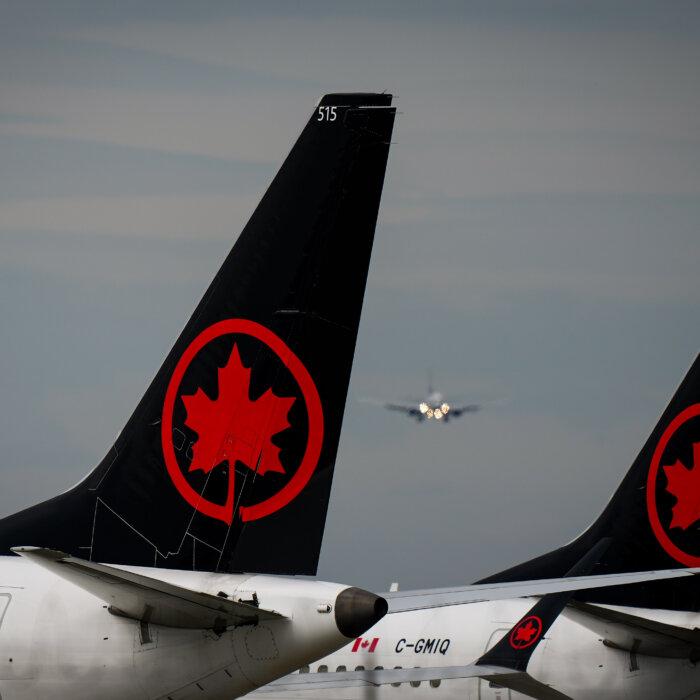
Air Canada flights within North America are set to ramp up on Aug. 20, as the airline continues to restart its operations following a three-day flight attendants strike.
Air Canada and Air Canada Rouge flights resumed on the afternoon of Aug. 19, after the airline reached a tentative agreement with the union representing its 10,000 flight attendants. Air Canada and Air Canada Rouge flights had come to a halt starting on Aug. 16.
The first flights to depart on Aug. 19 were from Toronto to Tokyo-Narita, from Vancouver to Los Angeles, and from Montreal to Toronto. A total of 155 flights were scheduled for the first day of resumed operations.
Air Canada has advised that a return to full, regular service could take seven to 10 days as its aircraft and crews are “out of position.” In the meantime, it says some flights will continue to be cancelled until the schedule is stabilized.
The airline says it expects 90,445 customers to travel within the next 24 hours, while 21,788 customers rebooked as their flights were disrupted. In total, 90 percent of domestic flights, 95 percent of trans-border flights, and 54 percent of international flights are expected to operate over the next 24 hours, Air Canada says.
The airline is continuing to offer full refunds or credit for future travel to customers whose flights have been cancelled, if they are unable to arrange a flight with another airline.
Additionally, Air Canada Executive Vice President Mark Nasr says the airline is set to introduce a policy on Aug. 20 to cover transportation expenses that customers incurred to get to their destination during the labour disruption.
“When customers buy a ticket on Air Canada, we are making a commitment to deliver them safely and on schedule,” Nasr said in an Aug. 19 statement. “Following this disruption, we know confidence has been shaken. We’re working hard to fully restore their trust, starting by getting customers on their way again.”
Air Canada has designated 5,000 agents to assist customers in rebooking their flights and finding alternative travel.
Air Canada struck a new tentative agreement with the Canadian Union of Public Employees (CUPE) on the morning of Aug. 19, with the assistance of federal mediator William Kaplan. As part of the agreement, flight attendants were required to immediately return to work.
Jobs Minister Patty Hajdu had mandated binding arbitration hours after the strike began on Aug. 16. The union had continued to strike in an effort to obtain higher wages for its flight attendants, despite the Canada Industrial Relations Board (CIRB) ruling the continued labour action illegal.
Prime Minister Mark Carney says he is “relieved” that Air Canada and CUPE reached a tentative agreement.
“It is my hope that this will ensure flight attendants are compensated fairly at all times, while ending disruption for hundreds of thousands of Canadian families, workers, and visitors to Canada,” Carney said in an Aug. 19 social media post.
Hajdu also said she was “relieved” to hear the news and called the tentative agreement “good news for workers and Canadians.”
“I am relieved that the parties agreed to meet together last night,” Hajdu said in an Aug. 19 statement. “Throughout our ongoing meetings I strongly urged them to find a deal together at the table.”
Meanwhile, Hajdu launched a probe on Aug. 18 into the airline sector over allegations of unpaid work, which was a central issue for the striking flight attendants. The probe will investigate whether flight attendants are being compensated in a manner that at minimum meets the requirements of the Canada Labour Code.
“Although the Canada Labour Code expressly prohibits unpaid work, these concerning allegations are very serious and we will get to the bottom of it,” she said. “The report will be made public.”
The Canadian Press contributed to this report.