Australian companies have dramatically accelerated their investment in Artificial Intelligence (AI), with spending on its research and development soaring 142 percent since 2021–22.
New figures from the Australian Bureau of Statistics (ABS) show businesses poured $668.3 million into AI R&D in 2023–24, up from $276.3 million two years earlier.
The jump highlights how rapidly firms are integrating AI into their operations, even as wider business spending on research recorded solid growth.
Treasurer Jim Chalmers said experts had “a very heartening discussion” that narrowed differences on issues such as copyright in AI training, an area under the oversight of Communications Minister Michelle Rowland.
“Not a unanimous view yet, but a little bit closer together. And I see that as a very good thing in terms of the overarching legislative question,” Chalmers said.

The government will conduct a gap analysis to decide whether Australia requires a dedicated AI Act or can adapt existing laws.
Optimism About New Tech
A new report from the Tech Council of Australia (TCA) shows most Australian employees feel technology has improved their working lives and view artificial intelligence as a tool for augmentation rather than replacement.The report, Future Ready: Australians and AI Workplace Tech, found 93 percent of workers expect AI will reshape jobs by enhancing roles, not eliminating them.
While cost of living, healthcare, housing, and inflation remain top concerns, the influence of new technology ranked much lower.
Already, 84 percent of office workers report using AI in their daily roles.
Overall R&D
Overall, business expenditure on R&D rose 18 percent to $24.4 billion in 2023–24, holding steady at 0.9 percent of GDP.ABS Head of Business Statistics Robert Ewing said software engineering was the single biggest contributor to information and computing sciences, with spending rising 26 percent to $4.9 billion.
“The professional, scientific and technical services industry made up 38 percent of total R&D, or $9.2 billion,” he said.
“This was followed by manufacturing at $5 billion and financial and insurance services at $3.5 billion.”
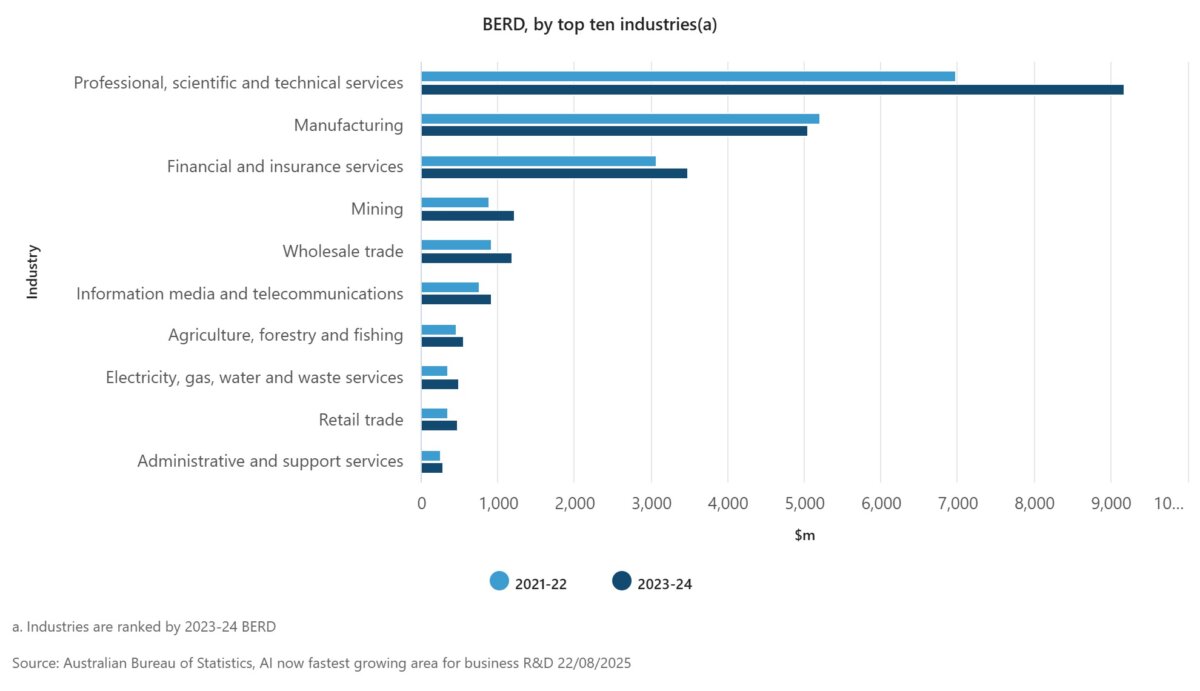
Information and communication services overtook manufacturing as the leading category for the first time.
R&D spending in the sector rose 50 percent to $5.9 billion, while manufacturing fell 3 percent to $4.6 billion, continuing a decline since 2019–20.
“R&D spending on information and communication services is now the leading SEO in Australia, overtaking manufacturing,” Ewing said.
Together with health research, these three sectors accounted for 58 percent of total business R&D.