This copy is for your personal, non-commercial use only. Distribution and use of this material are governed by our Subscriber Agreement and by copyright law. For non-personal use or to order multiple copies, please contact The Epoch Times Reprints.
After Manitoba’s push to promote the northern town of Churchill as a strategic trade hub, Ontario is now turning its attention to economic opportunities in its own north, and Alberta wants a piece of it.
Talk of developing James Bay as an export hub resurfaced this week around a meeting between Ontario Premier Doug Ford and Alberta Premier Danielle Smith. Ontario is seeking to build a deep-water port to help export products to new markets. Alberta, which does not have direct port access, is also pushing for this development.
James Bay, on the southern end of Hudson Bay, is part of Nunavut and borders the provinces of Ontario and Quebec.
The premiers signed two agreements on July 7, committing to the development of infrastructure that would boost energy and critical mineral exports and strengthen interprovincial trade to support key industries. Ford said a pipeline could be used to move energy to international markets through a new deep-sea port in James Bay.
Ford’s recent push for developing the proposed port came amid the new national focus on building major projects, and as the federal government introduced Bill C-5, which recently became law. The new legislation is meant to support the development of major projects of national interest and allow Ottawa to bypass provisions of some laws to ensure projects aren’t stalled.
Prime Minister Mark Carney has not said exactly which projects will be approved, as the government will be studying proposed projects and announcing approvals at a later date. But following a meeting with the premiers last month, Carney said they discussed specific projects like a Western and Arctic energy corridor, an Eastern energy partnership, critical minerals pathways, small modular reactors, and other port and rail projects.
James Bay, the Ring of Fire
James Bay is a large body of water in Northern Ontario that connects to Hudson Bay. The area once held importance for the Hudson’s Bay Company, which began fur trapping in Canada in the 17th century.
As fur trapping declined, the area remained sparsely populated, with several communities of less than 10,000 people in the 20th century. The province of Quebec utilized the region by building several hydroelectric dams on rivers in the James Bay watershed in the 1970s.
In 2008, the Ontario NDP government began exploring the feasibility of developing a seaport north of the town of Moosonee, which would allow mining and forestry products in the north to be shipped elsewhere. However, this idea did not go forward.
Shutterstock
That has recently changed with Premier Ford’s desire to unlock the Ring of Fire, which is a crescent-shaped area in Northern Ontario rich in minerals including copper, cobalt, platinum, nickel, and chromite. The Ontario government has noted that these minerals can play a role in the development of low- and zero-emission vehicles and help “transition to a cleaner, sustainable global economy.”
Since there is no infrastructure connecting the Ring of Fire to the rest of the province, Ontario wants road projects to be built to connect the area with the provincial highway network. However, given the Ring of Fire’s location in the James Bay lowlands, a deep-water port there could be an efficient way to export critical minerals abroad.
Alberta and Port Access
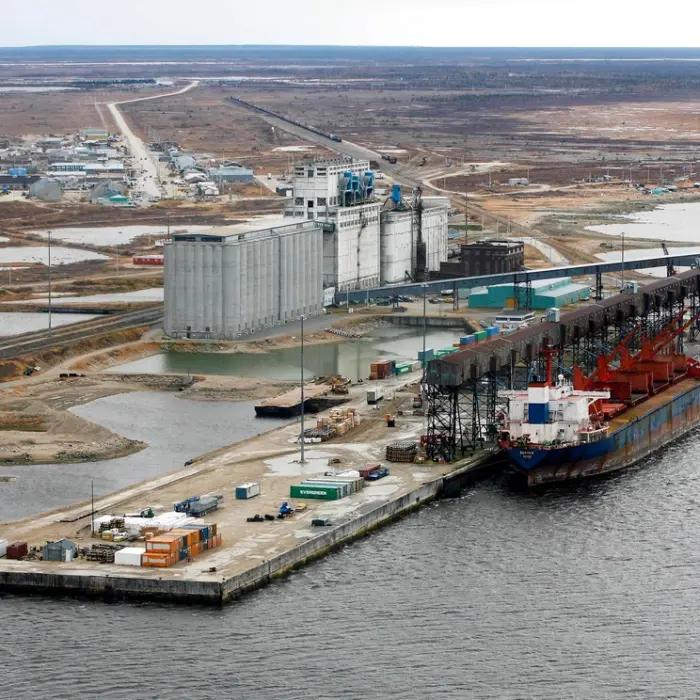
Similar to James Bay, the northern Manitoba port town of Churchill, on the west shore of Hudson Bay, was highlighted by Manitoba Premier Wab Kinew as an opportunity for the Western provinces to get agricultural, mineral, and energy products to other countries through Hudson Bay. The Port of Churchill is Canada’s only deep-water Arctic port that is connected to the North American surface transportation network.
The town saw its importance as a shipping route for grain diminish in the 2010s due to a costly flood, the closure of its port, and the sale of the Hudson Bay Railway. However, millions of dollars of federal and provincial investments in the port, coupled with new exports of critical minerals beginning in 2024 when the port started shipping again, have made it a more attractive project.
Kinew said in May that he wanted to see a “northern trade corridor” to transport resources from Western Canada to external markets through Hudson Bay, and that he had been working with First Nations to see what the “appetite” was for shipping agricultural, energy, and mineral products through the port.
In a similar manner, Premier Smith has also been pushing the federal government to approve an interprovincial energy corridor linking Alberta to Churchill. Smith has revealed her intentions for this, saying that it may be feasible to ship oil to refineries in Canada’s Atlantic provinces via Hudson Bay.
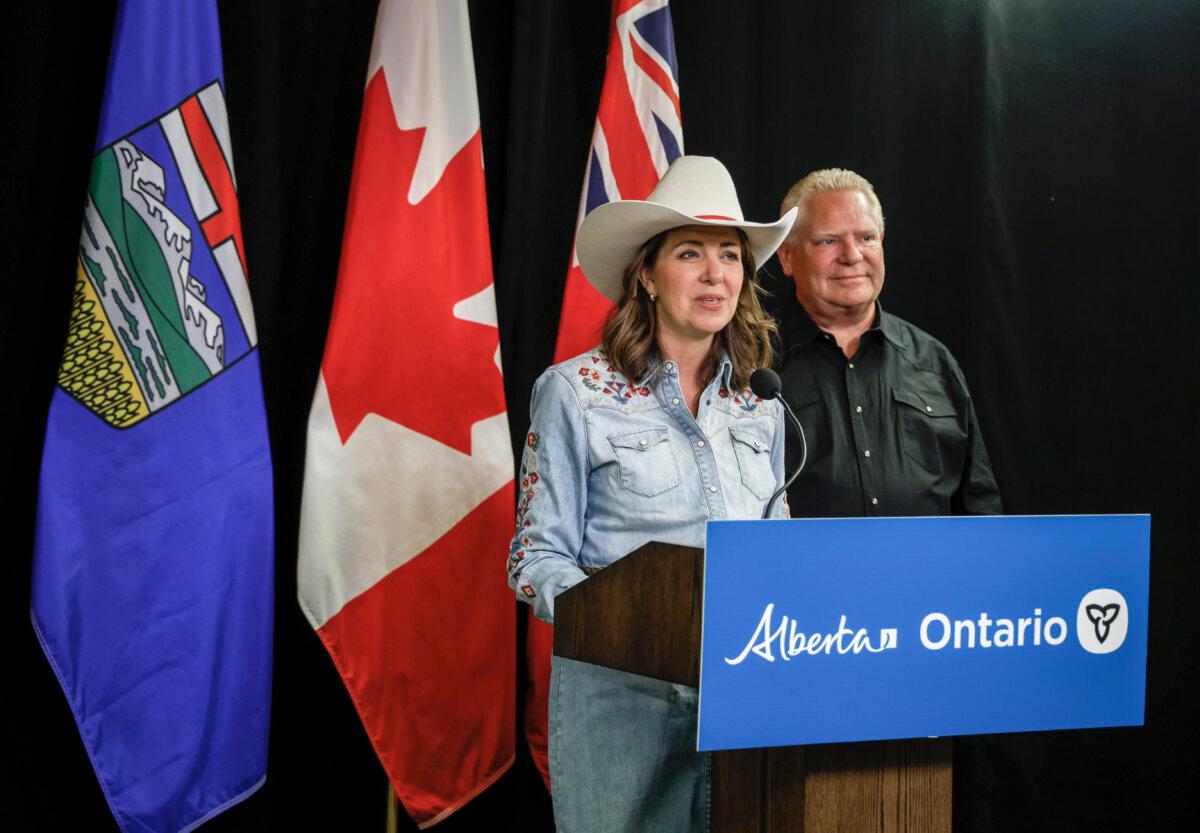
Alberta Premier Danielle Smith and Ontario Premier Doug Ford speak before signing agreements to build new energy and trade infrastructure, in Calgary on July 7, 2025. The Canadian Press/Jeff McIntosh
Alberta’s geography means it lacks direct access to water and has to instead rely on other provinces to get its resources to international markets. Smith recently said in a speech that when it comes to port access, “no province needs it more given the size and value of our resources,” adding that this will “benefit all Canadians to the tune of trillions of dollars of economic activity.”
In 2017, TransCanada cancelled its Energy East pipeline project, which was meant to bring Alberta’s oil and gas to the East coast of the country. The cancellation came amid tougher federal regulations, as well as opposition by Quebec to pipelines crossing its territory. The Liberal government has also banned oil tanker traffic off B.C.’s north coast, a move which Alberta says effectively blocks its export of oil to overseas markets.
While Alberta has long wanted a pipeline to transport its oil to the coast of British Columbia, Premier David Eby recently said there is no proponent or money for the project, signalling his government is still not interested.
However, the memorandum of understanding signed by Smith and Ford signals that Ontario is more open to a partnership on exporting energy and critical minerals to new markets. That deal mentions building new pipelines to connect Alberta oil to “new and existing refineries in southern Ontario,” as well as expanding export opportunities, including by way of “a new James Bay deep-sea port.”
Ontario and Alberta plan to soon launch a joint feasibility study to determine the “optimal route and endpoints” for these new economic and energy corridors. Ontario Energy Minister Stephen Lecce recently confirmed that this study will examine the route, costing, and “regulatory regime that’s going to drive this forward.”
Challenges
Developing a potential James Bay deep-sea port faces some hurdles. Similar to Churchill, a northern Ontario port will have a shortened shipping season due to the bay being frozen, meaning products can only be shipped from around June to October.
While the building or acquisition of icebreakers could also open up shipping year-round, that would take a while. The Canadian Coast Guard is acquiring two new polar icebreakers to be delivered by the early 2030s. In the meantime, Canada has 18 icebreakers.
The road to mineral-rich Ring of Fire and the port in James Bay would both also take time to build. Ontario says the road to the Ring of Fire won’t be ready to begin technical permitting and construction until at least 2028, according to documents obtained using freedom of information laws by Global News, while there is no established timeline for a port in James Bay.
These projects are also likely to face opposition from some indigenous communities. Bill C-5 involves consultations with these groups to determine if the projects are in the national interest. Consultations with First Nations, Métis, and Inuit groups are set to begin in mid-July, Carney said in June.
Additionally, efforts have been ongoing to consider designating and protecting the coastal areas of western James Bay and southwestern Hudson Bay as a national marine conservation area.