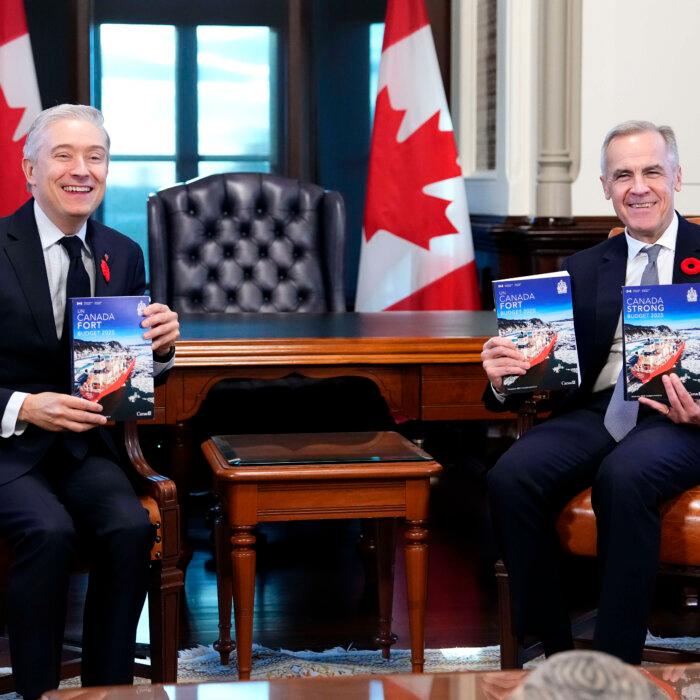
The Carney government tabled its highly anticipated budget on Nov. 4, putting to the test whether it can secure enough opposition support to survive a confidence vote.
So far, the Conservatives and the Bloc Québécois have said they won’t support the budget, while the NDP has said it needs more time before making a decision.
$78 Billion Deficit
Budget 2025 puts the current fiscal year’s federal deficit at $78.3 billion, which is higher than what the parliamentary budget officer had projected, but lower than what some economists had predicted.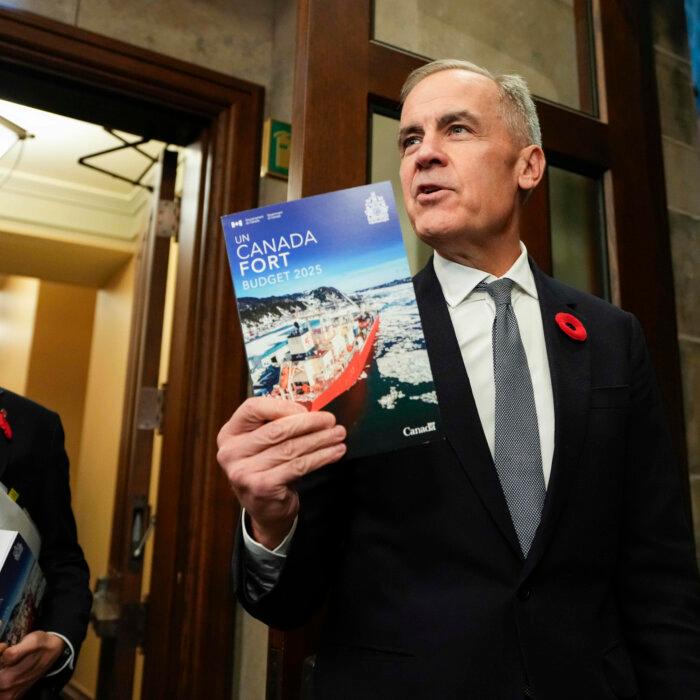
No Plans to Balance Overall Budget
The budget sets out two fiscal anchors—rules to help the government manage its spending and debt levels to ensure they don’t exceed certain limits. One anchor is to balance operating spending with revenues by 2028–29. Operational spending is defined as day-to-day costs such as public servant salaries and benefits given to Canadians and provincial governments, while capital spending is any expenditures or tax incentives that “contribute to public or private sector capital formation,” such as those that relate to infrastructure and other fixed assetsThe budget also has a fiscal anchor of maintaining a declining deficit-to-GDP ratio to “ensure disciplined fiscal management for future generations.”
However, the document does not include plans to balance the overall budget.
Outlook Shows Less Growth Than Predicted in 2024
The projected growth for the 2025–26 fiscal year is significantly less than what the 2024 Fall Economic Statement had predicted.That document had projected that real GDP growth would be 1.7 percent in 2025 and 2.1 percent in 2026. However, Budget 2025 says Canada’s real GDP is now projected to grow at just over 1 percent annually in 2025 and 2026, and attributed this to new tariffs and the uncertainty caused by trade tensions. The Conservatives say Canada needs to be more competitive by dropping taxes such as the industrial carbon levy to attract investments.
The budget says that there is a “risk” that Canada’s economy is adjusting to a “persistently lower growth trajectory” because of lower productivity and weak investment. The government says it is helping the economy by focusing on targeted sectoral measures, such as job re-training, income supports for workers, and liquidity, investment, and procurement supports for businesses.
Public Service Cuts
The budget says that since 2019, the public service has grown at an “unprecedented rate” that is higher than the growth of Canada’s overall population.The government says this will happen through “normal attrition through retirements, voluntary departures, and previous savings exercises,” as well as further measures the government is taking to slow spending and return the public service to a “sustainable size.”
Infrastructure and Competitiveness Initiatives
The budget includes a number of initiatives such as infrastructure spending that the government says are meant to stimulate the economy and draw in more investments. It sets aside $115 billion in planned federal infrastructure funding allocations over five years, which includes $51 billion over 10 years, starting in 2026–27, for a new “build communities strong fund” for local infrastructure such as housing, roads, water, and health facilities.Budget 2025 also puts forth $925.6 million over five years, starting this current fiscal year, to support a large-scale AI infrastructure, and $19 billion over the same time period to sustain Canadian Armed Forces capabilities and spend on defence-related infrastructure.
The budget also modifies Canada’s tax system through a “productivity super-deduction” that will allow businesses to write off the cost of new capital investments faster. The federal government says this would make it more attractive for companies to invest in machinery, equipment, and technology and would give Canada the lowest marginal effective tax rate in the G7.
Immigration Cuts
The budget includes plans to cut the number of new temporary residents entering Canada. Ottawa projects that 385,000 temporary residents will enter Canada in 2026, compared to 673,650 in 2025.The drop will be driven in part by a significant reduction in the number of student visas, down from a previous target of nearly 306,000 to 155,000 in 2026. Meanwhile, the number of temporary foreign workers is projected to fall to 230,000 in 2026 from the previous 390,000.
The plan also reduces the target for permanent resident admission to 380,000 per year for three years, from 2026 to 2028, down from 395,000 in 2025.
The government said this new immigration levels plan will cost $168.2 million over four years due to the “net loss in fee revenue” from fewer temporary resident admissions. The projections for permanent residents are higher than the ones previously predicted by the Trudeau government at a level of 365,000 by 2027.
Military Expenditure
Budget 2025 sets aside a total of $81.8 billion for the Canadian Armed Forces (CAF) over five years, starting this fiscal year, as the government works toward the updated NATO defence spending target of 5 percent of GDP by 2035.This includes $20.4 billion to recruit and retain CAF personnel; $19 billion to repair and modernize military infrastructure; $17.9 billion to expand capabilities with new vehicles, weapons, and ammunition; $10.9 billion to upgrade digital and cyber defence systems; and $6.6 billion to bolster the domestic defence industry.
Net Zero, Energy Projects
Budget 2025 puts heavy emphasis on the industrial carbon tax, saying it is “expected to deliver more emission reductions than any other policy” while having “negligible impacts on affordability for Canadians.”The Conservatives reject this assertion, saying that the industrial carbon tax drives away investment and that the added cost will impact the entire supply chain, driving up costs for consumers.
The budget details some of the projects that the government has said could be fast-tracked for approval through the newly created Major Projects Offices, such as the LNG Canada Phase 2 in Kitimat, B.C., a project that Ottawa says will double the company’s liquefied natural gas capacity.
Tax Changes, CBC Funding
The budget also contains a few miscellaneous measures, such as getting rid of the luxury tax on aircraft valued at over $100,000 and boats valued at over $250,000, which will remove $135 million in government revenue over five years from the current fiscal year to 2029–30. This measure was recently requested by a representative from the Canadian Automobile Dealers Association, who told the House of Commons Industry Committee that the tax is “inefficient” and can end up applying to work trucks purchased by electricians and construction workers.The underused housing tax, which was a 1 percent tax on the ownership of vacant or underused housing in Canada that took effect in January 2022, will also be removed as of the 2025 calendar year.
The government said these two taxes are being removed to “simplify Canada’s tax system and reduce compliance costs for taxpayers and administrative costs for government.”