News Analysis
The Bank of Canada held its key interest rate steady for the sixth time in a row and took on a noticeably more optimistic tone compared to previous meetings.
Bank of Canada Governor Tiff Macklem told reporters on July 15 that Canada’s economic growth has resumed and inflation looks set to decline alongside oil prices. Unlike previous meetings, Macklem also notably did not warn of the potential need for several interest rate increases to tamp down on inflation.
But Macklem said uncertainty remains elevated globally, and noted that oil prices have once again risen in recent days amid the escalating U.S.-Iran war. He kept the door open for more potential interest rate increases, saying the Bank is “prepared to adjust monetary policy as needed.”
The Bank also released its quarterly Monetary Policy Report (MPR), which outlined the Bank’s economic outlook and the key risks facing Canada’s economy.
Here are the main takeaways from the Bank of Canada’s interest rate announcement and July MPR.
Interest Rates Kept Steady
The Bank of Canada was widely expected to keep its key interest rate steady at 2.25 percent, and it did not deliver any surprises on that front. The Bank made four rate cuts in 2025, but has kept them steady since last October.Macklem said in his opening statement that the current policy rate remains “appropriate to sustain the economic recovery” and bring inflation back to the Bank’s 2 percent target.
While Macklem had warned back in April and June in his opening statements that there may be a need for “consecutive increases in the policy rate” if inflation from the Iran war remained high, he did not say so this time. Macklem also did not mention any potential rate cuts to spur economic growth.
Temporary Inflation Spike
Just weeks after Macklem warned of high inflation necessitating higher interest rates in June, Statistics Canada reported that the country’s inflation rate for May hit 3.4 percent—above the Bank’s upper target of 3 percent. The statistics agency said the increase was primarily driven by higher gas prices, as West Texas Intermediate (WTI) crude oil hovered around US$100 per barrel.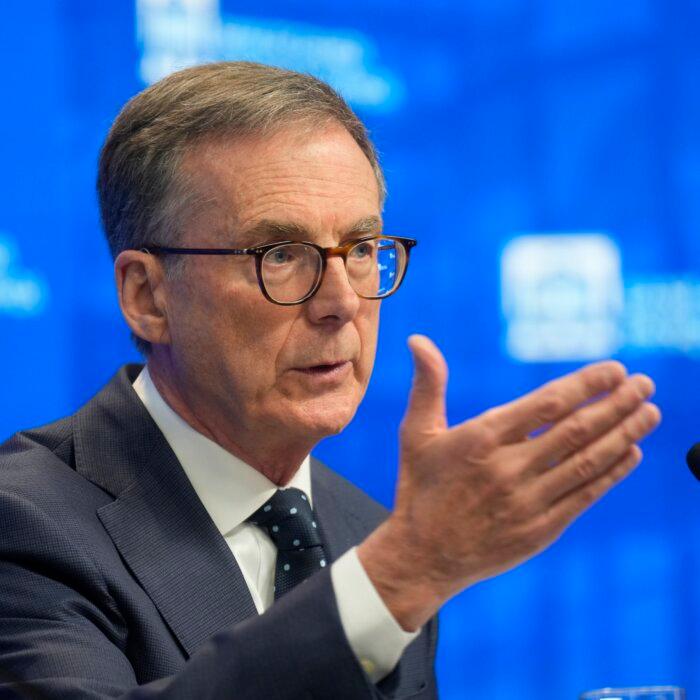
But WTI has since fallen to around US$75, and Macklem told reporters on July 15 that inflation is “expected to stay elevated in June, then ease gradually in the coming months,” before returning to 2 percent by the start of 2027.
The Bank’s July MPR said that, excluding the effects of higher energy prices, inflation in Canada is facing downward pressure from lower housing and rental prices and subdued services inflation.
However, it said food inflation is expected to remain elevated, as a reflection of higher gas, diesel, and fertilizer costs. Goods inflation is expected to rise as “war‑related input costs gradually work their way through supply chains and feed into prices,” the report said, noting that a lower Canadian dollar has also raised import prices.
Iran War Impacts Inflation Projections
Macklem said the Bank’s inflation forecast is “highly dependent on the path for oil and gasoline prices,” and expects oil prices will stay between US$70 and US$75 per barrel throughout 2026. Macklem noted that the longer the Middle East conflict goes on, the higher the risk that higher oil prices will be passed on to consumers in the form of higher prices. While the U.S.-Iran ceasefire agreement initially pushed oil prices lower, tensions have since risen again. Iran has renewed threats to restrict traffic through the Strait of Hormuz, a key global oil shipping route, while the U.S. military has increased its naval presence in the region and maintained that the waterway remains open to international shipping. The MPR said that while tensions have since “escalated,” the Bank’s models still foresee oil prices declining throughout 2026, and hitting around US$75 by January 2027. The report also said the Bank of Canada is monitoring how supply chain bottlenecks, higher transportation costs, longer-term supply shortages due to Middle Eastern infrastructure damage, and the restocking of oil and gas inventories could contribute to Canada’s inflation outlook.Economic Recovery
Macklem told reporters in his opening statement that after Canada’s economic growth appeared to have stalled in the first part of 2026, the data received since April has increased confidence “that the economy is indeed working its way through this period of global upheaval.” Macklem said Canadian consumers and businesses had adapted to the pressure from U.S. tariffs, which had hit Canada’s automotive, lumber, and steel and aluminum sectors throughout 2025. Macklem said while the Canada-United States-Mexico Agreement (CUSMA) will now be subject to annual reviews after the July 1 deadline passed, “more businesses report they are finding ways to navigate through the uncertainty.” The governor said consumer spending appears to be solid, oil and gas investment has improved due to higher oil prices, housing activity has picked up, and export growth has resumed and is expected to strengthen, “albeit along a lower path.” Macklem’s positive view of Canada’s economy came after he said back in June he did not believe Canada’s economy was in a recession, as Canada’s industries had not seen broad-based declines and the unemployment rate had remained stable.Lower Canadian Dollar
The July MPR said that with the U.S. dollar having “appreciated broadly” since the April MPR, the value of the Canadian dollar has fallen to around 71 cents compared to the greenback.“This partly reflects a widening spread between U.S. and Canadian government bond yields,” the report said.
The MPR said the Canadian dollar is now assumed to average around 71 cents to the U.S. dollar for the remainder of 2026 and into 2027, which is down 2 cents from the April report. The report said a lower Canadian dollar will make Canadian exports more competitive, but increase the cost of its imports.
Risks to Economy
The MPR said Canada’s trade relationship with the United States and the Iran war remain the two biggest risks to the country’s inflation outlook. Additional U.S. tariffs could further weaken business investment and household spending, while a continued closure of the Strait of Hormuz would raise commodity and energy prices.The report said that Canada’s labour productivity could be lower than anticipated in its projections if business investment remains weak, which would put upward pressure on inflation. The U.S. economy could also put downward pressure on Canadian inflation if investment in AI weakens, or if yields for long-term U.S. government bonds shoot higher and weaken demand for Canadian goods and services.
While the Bank of Canada projects that Canada’s GDP will grow 0.7 percent in 2026 and 1.8 percent in 2027, it said a weak rebound in exports, continued trade uncertainty resulting in layoffs, and lower housing activity could jeopardize Canada’s economic trajectory.
During the press conference following the rate announcement, Macklem pushed back against a reporter’s suggestion that the Bank of Canada was being too optimistic. “We’re calling it as we see it. Our baseline forecast is that the economy is going to improve. There are risks around that, as I’ve talked about,” he said.