This copy is for your personal, non-commercial use only. Distribution and use of this material are governed by our Subscriber Agreement and by copyright law. For non-personal use or to order multiple copies, please contact The Epoch Times Reprints.
Visitors walk near the glass Pyramid of the Louvre museum as French police have arrested more suspects linked to the theft of treasures from the museum's Apollo gallery in Paris, France, on Oct. 30, 2025. Abdul Saboor/Reuters
The Paris prosecutor announced four more arrests on Tuesday in connection with the broad-daylight $102 million jewel heist at the Louvre Museum in October.
The two men and two women in custody are all from the Paris region and range in age from 31 to 40, said prosecutor Laure Beccuau, whose office is in charge of the investigation.
Her statement did not specify what role the four are believed to have played in the heist, but Le Parisien reported that one of them is thought to be the fourth member of the four-man gang who carried out the Oct. 19 robbery.
French law does not generally allow suspects to be named until they have been convicted. The prosecutor has not identified any of the people arrested, but local media including Le Parisien has partially named them using their first names and initials of surnames.
The loot remains missing, with the jewels described as priceless in terms of cultural value—and unsellable in their original form.
Experts fear the treasures may never be recovered and could have already been dismantled and melted down, to be remade into unrecognizable pieces to be sold to jewelers.
Authorities previously arrested three men suspected of having carried out the daring smash-and-grab heist, along with several others in connection with the crime.
Charges So Far
Investigating magistrates filed preliminary robbery and criminal conspiracy charges against the three men and one woman, who were arrested in October.
The girlfriend of one of the suspected gang members has also been charged with complicity in organized theft and criminal conspiracy.
The robbery, described by media as “the heist of the century,” has focused attention on security at the world’s most-visited museum, which in the past has been the target of numerous other thefts.
Paris prosecutor Laure Beccuau speaks at a courthouse news conference on Oct. 29, 2025, on the judicial investigation into the jewel robbery at the Louvre museum, in Paris, France. Emma Da Silva/AP Photo
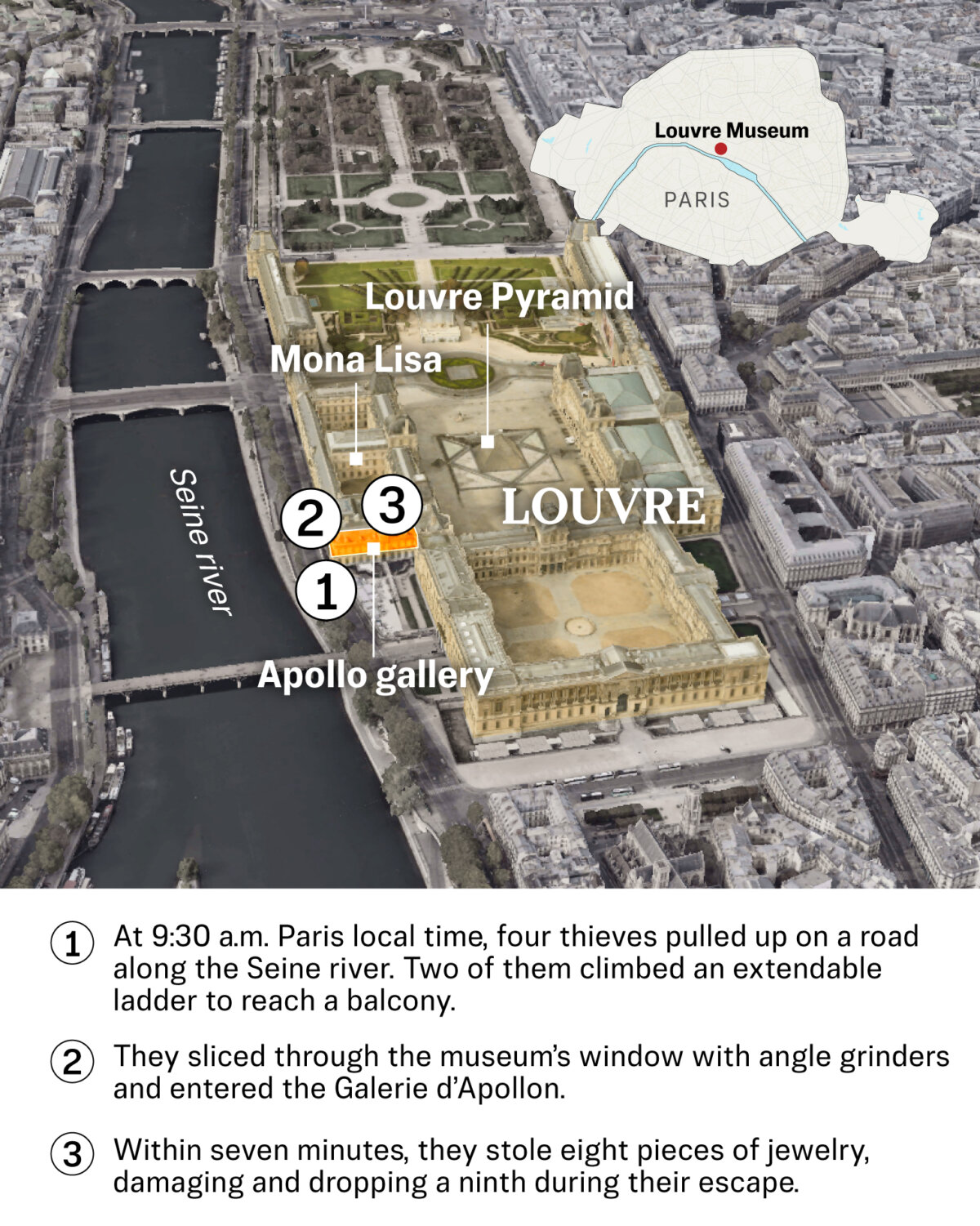
Louvre director Laurence des Cars revealed that although the museum cameras were said to be working properly during the heist, the window of the Apollo gallery was not covered by CCTV.
Two of the thieves took less than eight minutes to force their way through a window into the Apollo Gallery, break into the glass display cases with disc cutters and make off with the trove, descending on a freight lift to meet up with the other men on high-powered scooters, who whisked them away.
Evidence Left Behind
The two men who arrived at the gallery using a stolen delivery truck were caught on camera as they made their way back down in the basket lift usually used for furniture.
The prosecutor, who is the only person officially authorized to speak about the case to the media and public, said investigators took more than 100 samples of DNA during their sweep of the scene.
These samples were used to identify the first two suspects, who are believed to have been inside the gallery, with the thieves leaving behind several items, including clothing.
The sapphire set from Queen Marie-Amelie and Queen Hortense on view in the Louvre’s Apollo Gallery, in 2020. Stephane de Sakutin/Getty Images
A 34-year-old man was apprehended on Oct. 26 as he was about to board a flight to his native Algeria, while a 39-year-old French national was arrested at his home just outside of Paris.
The younger of the two had lived in France since 2010 and was known to police for driving offenses, while the older suspect was known to authorities for theft. He told police he had been working illegally as a taxi driver and that he had previously worked as a delivery driver.
Both were charged after they “partially” admitted to their role in the crime, the prosecutor said.
A third man, suspected of being one of the two getaway drivers, was arrested a few days later.
Beccuau said the profiles of the first three men arrested were not typical of the organized crime professionals often associated with complex operations, but rather they were petty criminals.
‘Local People’
“These are clearly local people. They all live more or less in Seine-Saint-Denis,” she said, referring to a predominantly working-class district in the northern suburbs of Paris.
French Interior Minister Laurent Nunez told Le Parisien after the third man was arrested that he believed the one suspect still on the run was most likely the organizer of the heist.
One of the nine stolen treasures, an emerald-set crown of Napoleon III’s wife, Empress Eugénie, containing more than 1,300 diamonds, was later found outside the museum, having apparently been dropped as the thieves made their escape.
The treasures still missing include a diamond-and-emerald necklace that Napoleon gave to Empress Marie-Louise, jewels worn by 19th-century Queens Marie-Amélie and Hortense, and Empress Eugénie’s pearl-and-diamond tiara.
French police can legally hold the four newly arrested suspects for up to 96 hours before they must either charge or release them.
Rachel Roberts is a London-based journalist with a background in local then national news. She focuses on health and education stories and has a particular interest in vaccines and issues impacting children.