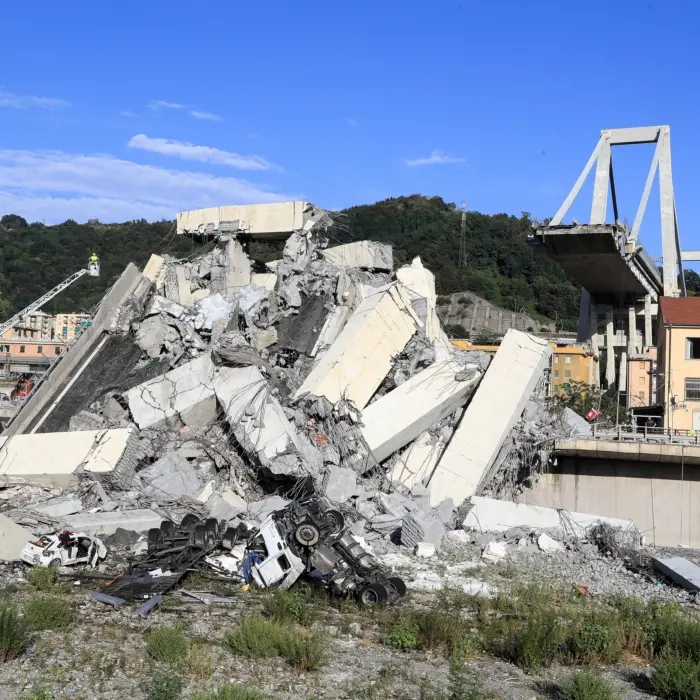
An Italian court sentenced 32 people to a total of more than 170 years in prison on July 16, over their role in a 2018 bridge collapse that claimed the lives of 43 people.
The former head of Italian motorway operator Autostrade per l'Italia (ASPI), Giovanni Castellucci, received the longest sentence of 12 years in prison for his role in the disaster, which saw the Morandi motorway bridge near the city of Genoa fall apart during a rainstorm on the morning of Aug. 14, 2018.
Michele Donferri Mitelli, another former senior manager at the publicly traded motorway management company, was given an 11-year sentence, with a further 30 defendants receiving custodial sentences.
Others sentenced included managers and engineers from ASPI’s engineering subsidiary SPEA, as well as former officials from Italy’s Infrastructure and Transport Ministry.
Of the 57 people who stood trial, a further 25 were either acquitted or cleared due to the statute of limitations, Italian outlet La Repubblica reported.
The Genoa courtroom fell silent as presiding judge Paolo Lepri read the verdicts for around 45 minutes, with 400 relatives of the victims, lawyers, journalists, and members of the public listening, Reuters reported.
Egle Possetti, president of the Committee for the Remembrance of the Morandi Bridge Victims, called the verdicts “important” and “positive.”
“We believe the judges have done a thorough job, examining each position in detail,” she told Italian public broadcaster RAI.
“We are pleased that responsibility has been acknowledged in all three areas of prosecution, that is, by ASPI, by SPEA, and by the ministry,” said Possetti, who lost her sister, brother-in-law, and her sister’s two children in the collapse.
The verdicts, however, are subject to appeal, with Castellucci, who also served as CEO of Atlantia, the controlling shareholder in ASPI at the time, planning to do so.
He was convicted of complicity in multiple counts of manslaughter through negligence, with prosecutors asking for a sentence of more than 18 years, rather than the 12 years he was eventually given, RAI reported.
Castellucci is already in prison, serving a six-year sentence over another fatal incident in 2013 on a viaduct in southern Italy, and was not in court to hear the verdict, but his legal team said they would appeal and that he had been made a scapegoat.
His lawyers, Giovanni Paolo Accinni and Guido Carlo Alleva, said they are “ready to appeal” the sentence, saying they believe their client “could not and should not have been convicted.”
“We will read the reasons. We are convinced of Castellucci’s innocence, but the trial doesn’t end here. Criminalizing company CEOs is unfair; Castellucci is already in prison for this. And so is another CEO who bears no guilt,” they said, according to Genoese outlet Il Secolo XIX.
The other CEO they are referring to is the former CEO of Ferrovie dello Stato and RFI, Mauro Moretti, who is currently serving a five-year sentence relating to a 2009 rail disaster in Viareggio, Tuscany, which killed 32 people.
Under the Italian legal system, the ruling of the first instance can be appealed at least twice.
Following the sentencing, Possetti said that “the new battle begins to succeed in having this ruling confirmed on appeal and above all to delegitimize any attempt to provide additional protection to managers, who should be subject to the law like the rest of us,” Il Secolo XIX reported.
The Collapse
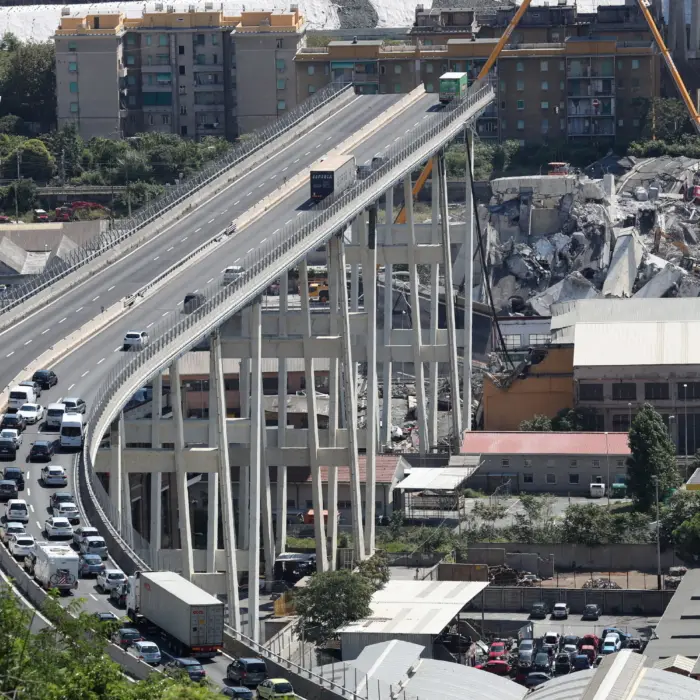
A 650-foot portion of the bridge collapsed, plunging 160 feet onto a riverbed, a railway, and two warehouses, while as many as 35 vehicles were driving across it.
The disaster sparked a dispute between Atlantia, controlled by the Benetton family, and the Italian government, which eventually culminated in the sale of Atlantia’s controlling stake in ASPI.
Prosecutors argued that years of poor maintenance, ignored warning signs, and delayed improvement works contributed to the collapse, saying that vital repairs were postponed while profits continued to be pocketed.
The prosecutors’ argument was backed up by a 2020 expert report into the disaster, which said the collapse was triggered by the rupture of corroded steel cables inside one of the stay cables on the southern side of pile 9, Italian outlet IVG reported that year.
A “pile,” known as a “pier” in the United States, is a vertical concrete structure that supports the weight of the bridge deck above it.
The corrosion of the prestressing strands within pile 9 had progressed over decades due to the ingress of water and oxygen, according to the report, which concluded that the root cause was long-term inadequate maintenance and insufficient inspections by ASPI and its subsidiary Spea.
It found that proper controls and maintenance interventions, if properly implemented, would have had a high probability of preventing the collapse. The report also noted that warnings and recommendations made by the bridge’s original designer, Riccardo Morandi, regarding corrosion risks had been progressively neglected over the years.
The defense teams rejected this theory, saying that the disaster was caused by an original design defect in the bridge’s stay cable in pile 9, which failed, and that no maintenance program could have prevented the collapse.