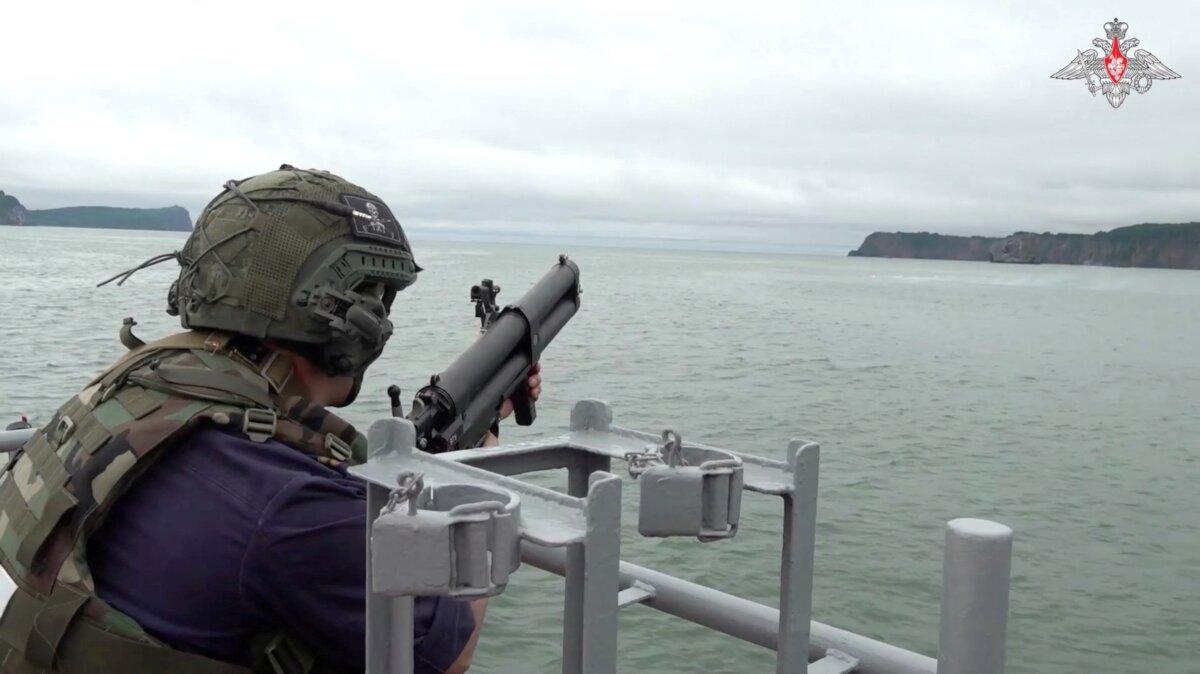
The Russian navy has begun holding military drills in the Pacific and Arctic oceans and the Baltic and Caspian seas, according to Moscow’s defense ministry.
According to the statement, which was posted on the ministry’s Telegram channel, the drills involve more than 150 ships, 120 aircraft, 10 coastal missile defense systems, 950 units of military hardware, and more than 15,000 military personnel.
During the exercises, naval vessels will “deploy in combat employment areas, engage in anti-ship actions, [and] defend bases of operations and economic activity,” the statement reads.
They will also practice repelling attacks by incoming air- and seaborne drones and “practice strikes at objects and surface groups of the enemy,” it states.

The drills are being overseen by Adm. Aleksandr Moiseyev, who has served as commander-in-chief of the Russian navy since 2024.
In 2022, Russia invaded and effectively annexed large swaths of eastern and southeastern Ukraine in what Moscow refers to as a “special military operation.”
Since then, the Russian navy has sustained a number of high-profile losses in its ongoing conflict with Ukrainian forces, especially in the Black Sea.
Russia’s Black Sea Fleet is currently based in the Crimean Peninsula, which Moscow seized from Ukraine in 2014. The region, then under control of Russian forces, declared its independence from Ukraine after holding a referendum.
The Russian invasion of Crimea began in late February 2014, and the referendum was held on March 16 and is not internationally recognized.
Moscow’s largest naval fleet—the Northern Fleet—operates out of the Russian city of Severomorsk near the Barents Sea.
Despite recent losses at sea, Russia is widely believed to still maintain the world’s third most powerful naval force after those of the United States and China.
25-Year Strategy
In late May, Russian President Vladimir Putin approved an ambitious 25-year naval strategy aimed at securing Russia’s position as a leading maritime power.It also provides an assessment of the global “military-political situation,” identifies flashpoints for future conflicts, and compares the relative strength of the world’s leading sea powers, Patrushev said in the interview.
In addition, the strategy document reviews the “current state and capabilities of the [Russian] navy, taking into account the experience of the special military operation” in Ukraine, he said.
According to Patrushev, the document also calls for the development of technological innovations that would allow the Russian navy to outpace those of rival nations.
Along with being a top adviser to Putin, Patrushev currently serves as chairman of Russia’s newly established Maritime College.