This copy is for your personal, non-commercial use only. Distribution and use of this material are governed by our Subscriber Agreement and by copyright law. For non-personal use or to order multiple copies, please contact The Epoch Times Reprints.
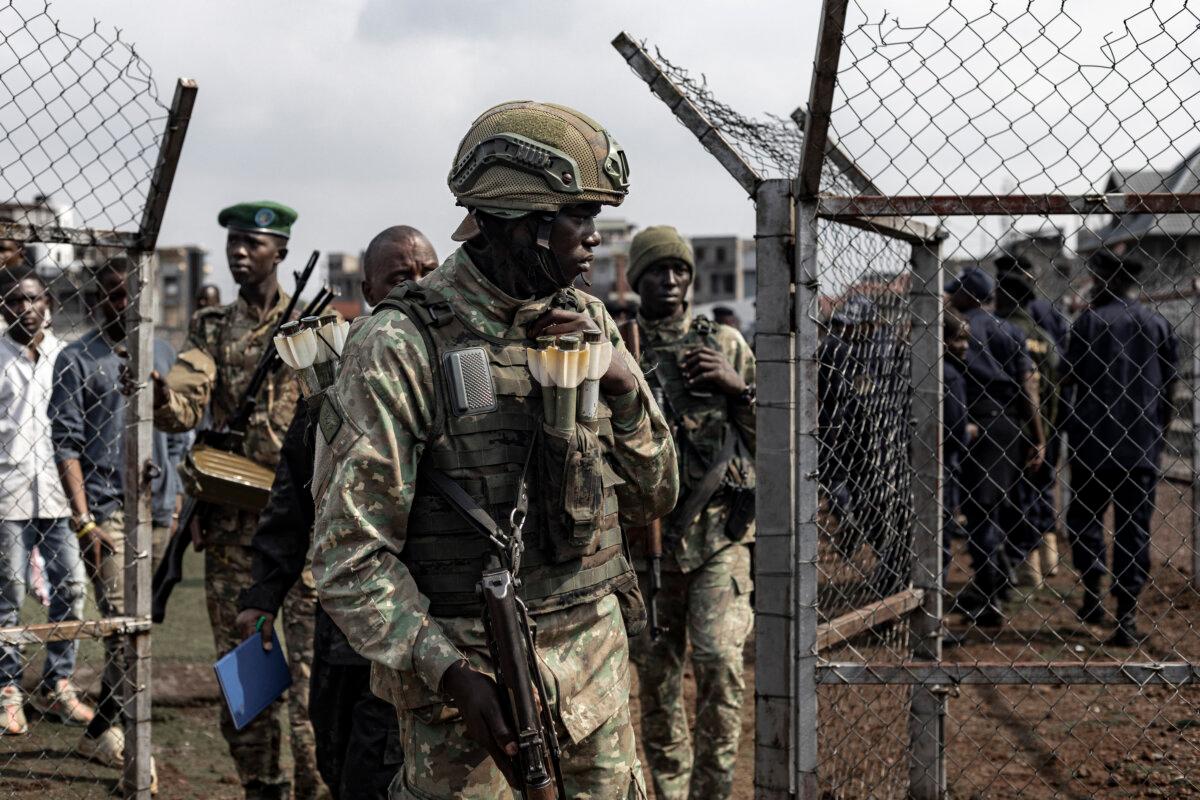
An undated photograph of a member of the M23 rebel group walking on the outskirts of Matanda, in the Democratic Republic of the Congo. Zohra Bensemra/Reuters
Rebels allegedly backed by Rwanda killed at least 140 people in eastern Congo (DRC) in July, nonprofit organization Human Rights Watch (HRW) stated in a report published on Aug. 20.
HRW stated that the civilians, mostly ethnic Hutus, were “summarily executed” by M23 rebels in 14 villages in North Kivu Province in the east of the Central African country.
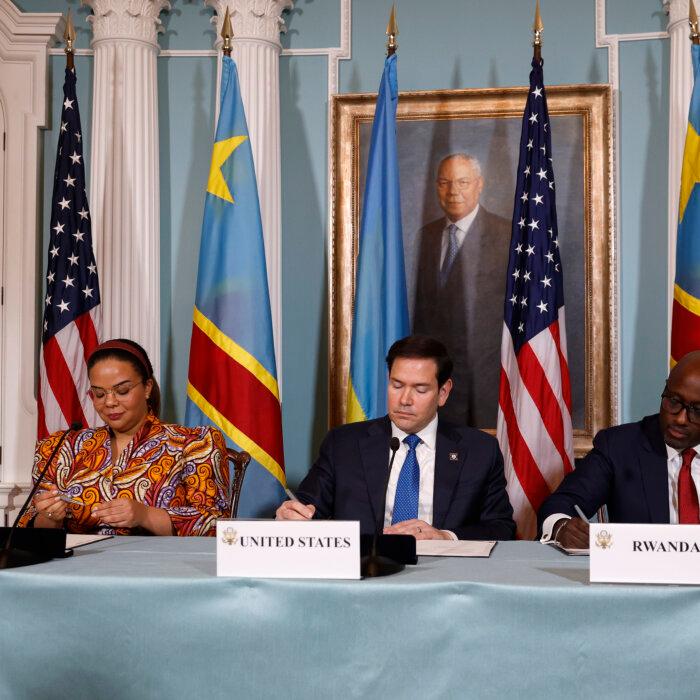
The alleged killings occurred near Virunga National Park just weeks after a U.S.-brokered preliminary agreement was signed on June 27 in Washington between the Rwandan government and the government of Congolese President Felix Tshisekedi, leading to peace talks in Doha, Qatar.
Under the Washington agreement, both sides promised to “refrain from any acts of aggression” and agreed to not “engage in, support, or condone any military incursions or other acts, whether direct or indirect, that threaten the peace and security, or that undermine the sovereignty or territorial integrity of the other party.”
The Congolese government and the rebels missed an Aug. 18 deadline to reach a finalized peace agreement at the talks in Doha.
The Office of the U.N. High Commissioner for Human Rights stated on Aug. 6 that it had “received first-hand accounts indicating that at least 319 civilians were killed by M23 fighters” aided by the Rwandan army between July 9 and July 21.
The United Nations stated that the victims included at least 19 children and 48 women.
‘Dozens of Summary Executions’
Clémentine de Montjoye, senior researcher at HRW, said in a statement: “The M23 armed group, which has Rwandan government backing, attacked over a dozen villages and farming areas in July and committed dozens of summary executions of primarily Hutu civilians.
“Unless those responsible for these war crimes, including at the highest levels, are appropriately investigated and punished, these atrocities will only intensify.”
The Epoch Times was unable to independently verify the report. M23 has denied any role in the killings.
The Rwandan Ministry of Foreign Affairs said in an Aug. 11 statement, “Rwanda rejects the false accusations made in the recent statement of the Office of the United Nations High Commissioner for Human Rights.”
On Aug. 20, HRW stated, “The mass killings appear to be part of a military campaign against opposing armed groups, especially the Forces Démocratiques de Libération du Rwanda (Democratic Forces for the Liberation of Rwanda, or FDLR), a largely Rwandan Hutu armed group created by participants in the 1994 genocide in Rwanda.”
About 800,000 people—mostly from the ethnic Tutsi minority—were killed during the 1994 Rwandan genocide.
Rwandan President Paul Kagame lights a flame at the Gisozi memorial site as Rwanda commemorates the 31st anniversary of the Tutsi genocide, in Kigali, Rwanda, on April 7, 2025. Hugh Kinsella Cunningham/Getty Images
Rwandan President Paul Kagame, an ethnic Tutsi, came to power after his Rwandan Patriotic Front rebels drove out the Hutu-dominated government responsible for the genocide.
He has ruled Rwanda since and has been repeatedly accused by Tshisekedi of meddling in the DRC, which has an ethnic Hutu minority in its North Kivu and South Kivu provinces, both of which have borders with Rwanda.
On Jan. 25, the Council of the European Union urged Rwanda to “cease its support for the M23 and withdraw.”
“The EU strongly condemns Rwanda’s military presence in the DRC as a clear violation of international law, the UN Charter, and the territorial integrity of the DRC,” it stated.
The Rwandan government denied claims made in a 2024 report by U.N. experts that it had deployed up to 4,000 troops over the border to support the M23 rebels, who are largely ethnic Tutsi.
A member of the M23 movement looks on during an enrollment of civilians, police officers, and former members of the Armed Forces of the Democratic Republic of the Congo who allegedly decided to join the M23 movement voluntarily in Goma, Democratic Republic of the Congo, on Feb. 23, 2025. Michel Lunanga/AFP via Getty Images
The Rwandan forces’ “de facto control and direction over M23 operations also renders Rwanda liable for the actions of M23,” the panel of experts said in its 293-page report to the U.N. Security Council.
The DRC, a former Belgian colony that was known as Zaire between 1971 and 1997, has been riven by political violence, civil wars, and rebellions—especially in the mineral-rich east of the country—in the past 25 years.
Catholics Massacred by ISIS Affiliate
In recent years, a new threat has emerged, as the Allied Democratic Forces (ADF), an Islamist extremist group that is affiliated with the ISIS terrorist group, has increased its attacks against Christians in the east of the DRC.
After 43 worshippers were massacred by the ADF during an overnight prayer vigil in a Catholic church in Komanda, DRC, from July 26 to July 27, Pope Leo XIV issued a statement expressing his “consternation and profound sorrow.”
The pope said he hoped “that the blood of [the] martyrs may be a seed of peace, reconciliation, brotherhood and love for the entire Congolese people.”
The U.N. Organization Stabilization Mission in the Democratic Republic of the Congo (MONUSCO), the U.N. peacekeeping mission to the DRC, stated on Aug. 18 that the ADF had killed another 52 people in August.
According to MONUSCO, the attacks took place between Aug. 9 and Aug. 16, near the cities of Beni and Lubero in North Kivu Province.
“These attacks claimed the lives of at least 52 civilians, including eight women and two children, one of whom was a young girl,” MONUSCO stated. “The death toll may rise. The violence was accompanied by abductions, looting, the burning of homes, vehicles, and motorcycles, as well as the destruction of property belonging to populations already facing dire humanitarian conditions.”
The Associated Press and Reuters contributed to this report.