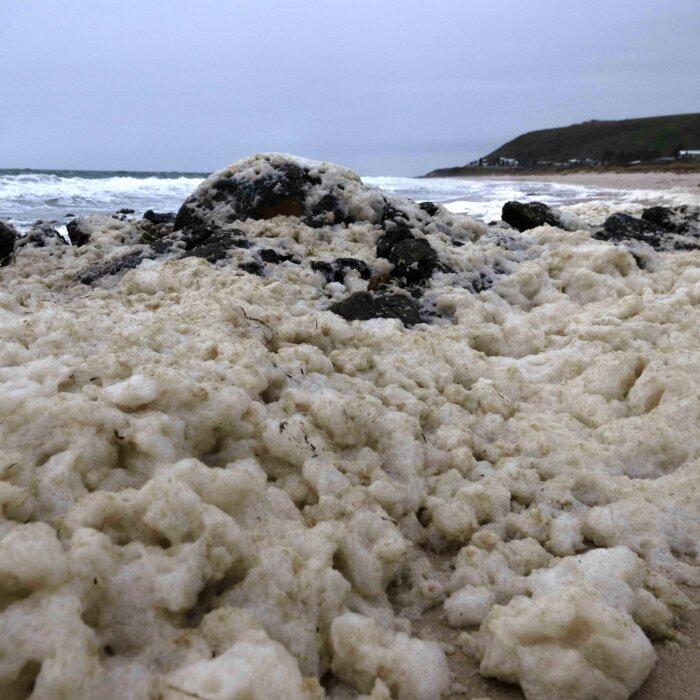
After more than 400 marine species were wiped out by a devastating algae bloom, the federal and South Australian governments have pledged $102.5 million towards protecting South Australia’s coasts and preventing another similar disaster.
The Algal Bloom Summer Plan aims to safeguard beaches, rebuild marine habitats, and help coastal towns recover from the economic and environmental damage.
It focuses on three main goals: protecting South Australians’ summer lifestyle, supporting coastal businesses, and restoring the environment.
More than $37 million has been committed to environmental and scientific projects. This includes new limestone oyster reefs to rebuild shellfish habitats and improve water quality.
Research into seagrass and blue carbon restoration in the Gulf St Vincent will test how these plants filter nutrient-rich runoff that fuels algal blooms.
A breeding and conservation program will target vulnerable fish species hit hardest by last year’s event.
Premier Peter Malinauskas said the joint plan reflected the urgency of the crisis.
“Bringing our Algal Bloom Summer Plan investment up to more than $100 million represents a major investment in environment restoration as well as science and research,” he said.
“Together with the Commonwealth, we’re pulling all levers available to help the state respond to the algal bloom.”
Federal Environment Minister Murray Watt said governments were “tackling this algal bloom outbreak from all angles” and would continue working closely to deliver results.
Science and Monitoring
A further $17.3 million will strengthen water monitoring and research. Real-time oceanographic buoys, linked to CSIRO models and AI forecasting, will track water quality and predict bloom risks.A new Office for Algal Bloom Research, funded with $3.2 million, will coordinate national research on bloom formation, movement, and impact.
The plan also includes a $1 million trial of AI-powered cytobots—submersible sensors that photograph microscopic plankton and send real-time data to scientists.
Coastal Business Relief
The plan also directs $48 million to help coastal communities recover and stay afloat.A dining cashback scheme will offer up to $50 off meals at coastal restaurants, while travel vouchers worth $100 to $500 aim to attract tourists back to affected areas.
New Toxin Testing Hub
In August, the governments also opened a national algae testing lab in Adelaide to speed up detection of brevetoxins—the toxins responsible for last summer’s shellfish contamination.The $28 million facility, operated by Agilex Biolabs, allowed samples to be tested locally rather than sent to New Zealand, cutting wait times that previously stretched to a week.
Warnings Ignored
Research from Flinders University shows algal blooms occur when algae multiply rapidly, driven by warm seas and nutrient build-up.While many blooms are harmless and vital to marine food chains, toxic species can suffocate ecosystems.
The Biodiversity Council called the disaster foreseeable and “a human-mediated event”—fueled by marine heatwaves, nutrient-rich floodwaters, and the loss of ecosystems like seagrass and reefs that once filtered coastal waters.
In a statement on July 24, the council urged governments to act on seven urgent measures, including fast-tracking emergency interventions for species at risk, such as the giant cuttlefish aggregation near Whyalla, and investing in immediate biodiversity recovery programs.