
Keep Focus on Free Expression in WikiLeaks Debate: PEN International

December 20, 2010 Updated: October 1, 2015
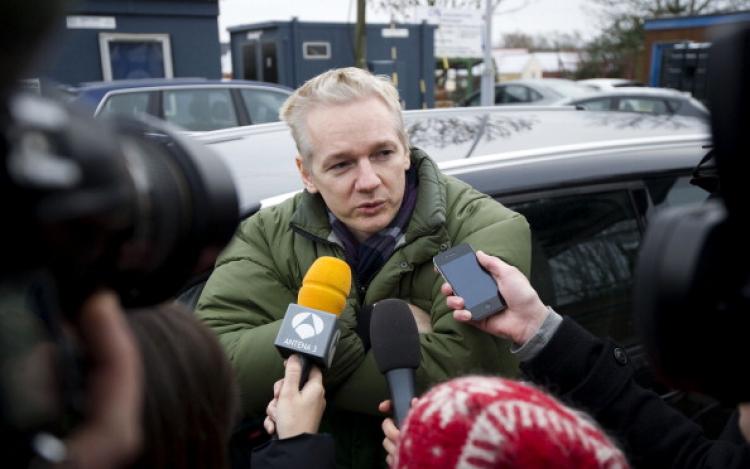
WikiLeaks founder Julian Assange speaks to journalists outside Diss train station in Norfolk on Dec. 18, 2010.  (Carl Court/AFP/Getty Images)
WikiLeaks founder Julian Assange speaks to journalists outside Diss train station in Norfolk on Dec. 18, 2010. (Carl Court/AFP/Getty Images)

VICTORIA, Canada—As the WikiLeaks controversy rages on, PEN International is calling for cooler heads and an emphasis on the need for responsible dialogue around the issue of leaked top-secret U.S. government documents.

The world association of writers has issued a statement urging those voicing opinions on the WikiLeaks debate to “adopt a responsible tone, and not to play to the more extreme sections of society.”

“In a world where journalists are regularly physically attacked, imprisoned, and killed with impunity, calling for the death of a journalist is irresponsible and deplorable,” the statement said, referring to the several death threats WikiLeaks founder Julian Assange has received since his organization recently published hundreds of leaked U.S. diplomatic cables.

“PEN International believes it is important to acknowledge that while the leaking of government documents is a crime under U.S. laws, the publication of documents by WikiLeaks is not a crime. WikiLeaks is doing what the media has historically done, the only difference being that the documents have not been edited,” the statement said.

The organization also said it is concerned about reports that, fearing repercussions, some websites have stopped carrying WikiLeaks, and that some individuals, under threat of legal action, “have been warned against reading information” provided by WikiLeaks.

“PEN International condemns such acts and calls upon corporations and states to avoid breaches of the right to free expression. Governments cannot call for unlimited Internet freedom in other parts of the world if they do not respect this freedom themselves,” the statement said.

PEN Canada is endorsing PEN International’s stance. PEN Canada’s Brendan de Caires says the statement gets to the core of the issue—freedom of information and expression.

“There’s been a tendency to get down to the character of Julian Assange and what exactly is being disclosed and the territorial rights of U.S. jurisdiction—all sorts of, as we would argue, extraneous considerations. The fundamental issue in the WikiLeaks debate is freedom of expression,” de Caires told The Epoch Times.

Former Republican presidential candidate Mike Huckabee said those responsible for leaking the cables should face execution, while Canadian political science professor Tom Flanagan said Assange should be assassinated for the leaks.

Assange has also received death threats from U.S radio personalities and various “right-wing sites,” according to news reports.

“The way the debate has gone, all sorts of lightly considered and fairly inflamed opinions have been tossed into the argument,” says de Caires.

“Last year we worked on the attacks and assaults and murders against more than 900 journalists worldwide, and I think that that was our concern—that we had to say something now.”

U.S. federal authorities are currently investigating whether Assange can be charged under the Espionage Act for releasing the cables and both the “Collateral Murder” video and the “Afghan War Diary” documents, which are said to have been leaked by 23-year-old U.S. soldier Bradley Manning.

Manning, who is being held in solitary confinement in a military prison in Quantico, Va., could receive up to 52 years in prison. His pre-trial hearing and subsequent court martial are expected to take place in the spring of 2011.

Assange, who has called Manning “an unparalleled hero,” is currently confined on bail at a friend’s country mansion in England as he fights efforts to extradite him to Sweden where he faces charges of sexual molestation.

He told reporters last Friday he had heard rumors that the United States is preparing to indict him.

“I don’t have too many fears about being extradited to Sweden. There are much bigger concerns about being extradited to the U.S.,” he said, according to the New York Post.

Although Assange’s actions in releasing the sensitive “Cablegate” documents have been roundly criticized for possibly jeopardizing the lives of people who rely on secrecy to carry out their work, the issue of freedom of expression should remain the focus, de Caires says.

James Catlin, an Australian lawyer who provided legal advice to Assange in London in October, maintains that no concrete evidence has been disclosed in the rape case.

“The evidence is completely flimsy and laughable,” he told The Epoch Times. “My fear for him is that the evidence will be secretly changed to deal with the international pressure the Swedes are currently enduring. Since the evidence is being kept a secret, it could be changed without anyone knowing.”

Catlin said Assange’s Swedish lawyer Bjorn Hurtig, who saw some of the prosecution evidence during a Swedish court hearing, has said publicly that if the English courts knew how little actual evidence there was against Assange, it would have been very unlikely that an arrest warrant would have been granted.

“The principle that information—relevant information in the public interest—should be disclosed is what ultimately should guide the debate, not the specific instance of WikiLeaks.”

PEN International said the WikiLeaks matter is a dynamic issue that “marks a significant turning point in the evolution of the media and the sometimes conflicting principles of freedom of expression and privacy and security concerns.

“The culture of increasing secrecy in governments and the rise of new technology will inevitably lead to an increasing number of transparency issues of this sort.”