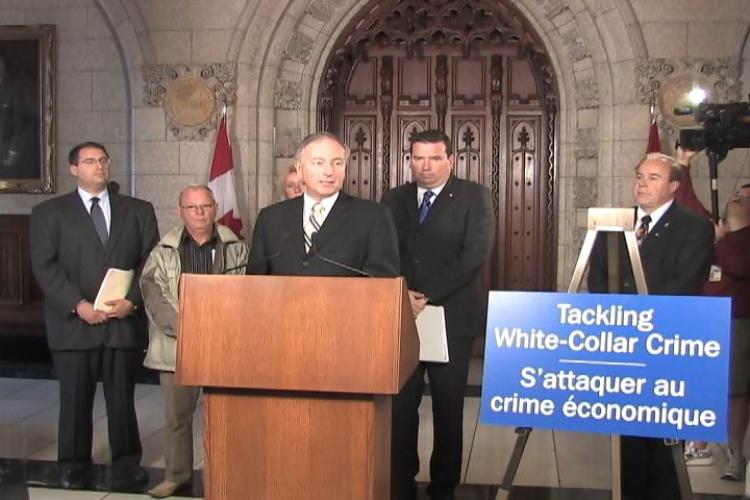
OTTAWA—Justice Minister Rob Nicholson announced on Tuesday that the federal government will introduce tougher legislation against financial fraudsters and other white-collar criminals.
The bill will mean a mandatory jail sentence for serious fraud and longer sentences if additional aggravating circumstances are involved.
The new legislation will also require courts to consider ordering offenders to provide restitution to their victims.
“Canadians lose faith in the criminal justice system when they feel that the punishment does not fit the crime,” Mr. Nicholson said.
The announcement came on the heels of several highly publicized cases of financial scams and corruption in Canada.
The minister addressed the media on Parliament Hill shortly after two press conferences Tuesday morning at which nearly a dozen victims’ groups called on the government to establish sterner measures to fight financial crime.
Among them was a committee representing some 150 victims of an alleged $75 million Ponzi scheme run by disgraced Montreal financial consultant Earl Jones. Jones is facing charges of theft and fraud, and has declared bankruptcy.
Joey Davis, chair of the group, said his mother lost $200,000 in life savings that she entrusted to Mr. Jones. A Ponzi scheme takes money from new investors to pay earlier clients until the whole scheme collapses.
Speaking in French following Mr. Nicholson’s announcement, Christian Paradis, Minister of Public Works and Government Services, noted that victims of white-collar crime often feel shame and tend to blame themselves, yet they are far from being careless with their money.
On Monday, Alberta RCMP laid charges of fraud and theft against two men for operating an alleged Ponzi scheme between 1999 and 2008 that swindled investors out of more than $100 million.
Victims’ groups are urging the government to create a new Securities Crime Unit that will allow the RCMP and municipal and provincial police to more effectively investigate white-collar securities crimes and prosecute the perpetrators.
Currently the police must seek approval for criminal investigation from a joint group comprising the provincial securities commissions and a number of self-regulatory organizations from the investment industry.
Prosecutions typically take 10 or more years to complete—if investigations take place at all—and rogue financial advisors face low sentences even as their thefts and forgeries amount to huge amounts of losses for their victims.
The bill will mean a mandatory jail sentence for serious fraud and longer sentences if additional aggravating circumstances are involved.
The new legislation will also require courts to consider ordering offenders to provide restitution to their victims.
“Canadians lose faith in the criminal justice system when they feel that the punishment does not fit the crime,” Mr. Nicholson said.
The announcement came on the heels of several highly publicized cases of financial scams and corruption in Canada.
The minister addressed the media on Parliament Hill shortly after two press conferences Tuesday morning at which nearly a dozen victims’ groups called on the government to establish sterner measures to fight financial crime.
Among them was a committee representing some 150 victims of an alleged $75 million Ponzi scheme run by disgraced Montreal financial consultant Earl Jones. Jones is facing charges of theft and fraud, and has declared bankruptcy.
Joey Davis, chair of the group, said his mother lost $200,000 in life savings that she entrusted to Mr. Jones. A Ponzi scheme takes money from new investors to pay earlier clients until the whole scheme collapses.
Speaking in French following Mr. Nicholson’s announcement, Christian Paradis, Minister of Public Works and Government Services, noted that victims of white-collar crime often feel shame and tend to blame themselves, yet they are far from being careless with their money.
On Monday, Alberta RCMP laid charges of fraud and theft against two men for operating an alleged Ponzi scheme between 1999 and 2008 that swindled investors out of more than $100 million.
Victims’ groups are urging the government to create a new Securities Crime Unit that will allow the RCMP and municipal and provincial police to more effectively investigate white-collar securities crimes and prosecute the perpetrators.
Currently the police must seek approval for criminal investigation from a joint group comprising the provincial securities commissions and a number of self-regulatory organizations from the investment industry.
Prosecutions typically take 10 or more years to complete—if investigations take place at all—and rogue financial advisors face low sentences even as their thefts and forgeries amount to huge amounts of losses for their victims.