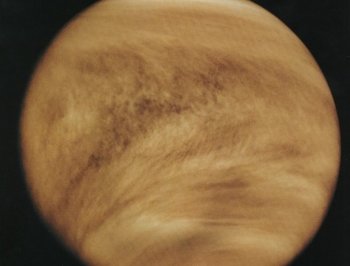
New research has revealed that unusual weather phenomena are occurring around 68 miles (110 kilometers) above Venus’ surface in cooler atmospheric layers known as the mesosphere and thermosphere.
Earth’s seasons arise due to its tilt of approximately 23 degrees, which affects sunlight intensity and day length in the two hemispheres each year. However, various features on Venus contrive to create climatic stability.
The planet is tilted so much that it is almost completely upside down, making its net tilt less than three degrees from the sun, and hence the seasonal effect is negligible.
It has a more circular orbit than Earth, limiting temperature changes due to its distance from the sun not varying much. Also, temperatures are stabilized by the thick acidic atmosphere and slow rotation rate with a single night lasting almost two months on Earth.
Lastly, most of Venus’ surface water has vaporized into space, meaning there are no storms or rain.
But international researchers working with NASA spotted an atmospheric circulation pattern opposite to a “Hadley cell,” which occurs on Earth when warm air at the equator rises and flows to the poles, where it cools and falls.
"Although the air over the polar regions in these upper atmospheric layers on Venus was colder than the air over the equator in most measurements, occasionally it appeared to be warmer," said Theodor Kostiuk of NASA Goddard in a press release.
"In addition, although the surface temperature is fairly even, we’ve seen substantial changes – up to 54 degrees Fahrenheit (about 30 Kelvin change)—within a few Earth days in the mesosphere—thermosphere layers over low latitudes on Venus," he added.
"The poles appeared to be more stable, but we still saw changes up to 27 degrees Fahrenheit (about 15 Kelvin change)."

Additionally, sunlight could be heating the layers, which are above the sulfuric acid blanket. It is even possible that the sun’s magnetic activities, for example solar flares, affect them.
The data analyzed cover many years, and show variations across days, weeks, and even a decade. For example, temperatures in 2009 were cooler than that in the early 1990’s.
"In addition to all these changes, we saw warmer temperatures than those predicted for this altitude by the leading accepted model, the Venus International Reference Atmosphere model," said Kostiuk.
"This tells us that we have lots of work to do updating our upper atmospheric circulation model for Venus."
The team’s findings were published online in the journal Icarus on July 23.